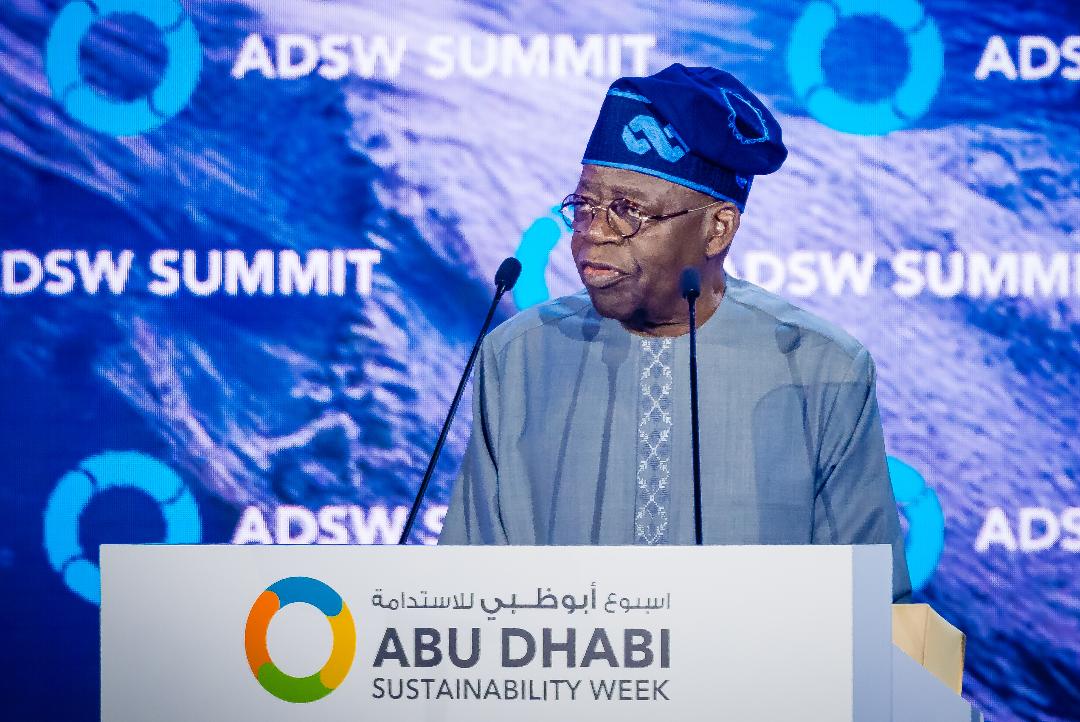
President Bola Tinubu has announced that Nigeria will co-host Investopia with the United Arab Emirates (UAE) in Lagos in February 2026, an initiative aimed at attracting global investors and accelerating sustainable investment inflows.
Tinubu announced this at the 2026 Abu Dhabi Sustainability Week (ADSW) on Tuesday, January 13, on the sidelines of which Nigeria also concluded a Comprehensive Economic Partnership Agreement (CEPA) with the UAE to deepen trade and cooperation in renewable energy, infrastructure, logistics, and digital trade.
Present at the signing of the agreement were Tinubu, President of the United Arab Emirates, Mohamed bin Zayed Al Nahyan, Nigeria’s Minister of Industry, Trade, and Investment, Dr Jumoke Oduwole, UAE Minister of Foreign Trade and Minister in charge of Talent Attraction and Retention, Dr Thani bin Ahmed Al Zeyoudi.
President Tinubu described CEPA as a historic and strategic agreement that will also enhance cooperation in aviation, logistics, agriculture, and climate-smart infrastructure, creating enduring opportunities for the people of the two countries.
He stated that Investopia will bring together investors, innovators, policymakers, and business leaders to transform opportunities into commitment and ideas into investment.
“We warmly invite our partners to join us and help build the next chapter of sustainable and shared prosperity for Nigeria, Africa, and the world,” the president was quoted as saying in a statement issued by his spokesman, Bayo Onanuga.
Tinubu told the Summit that Nigeria aims to mobilise up to $30 billion annually in climate and green industrial finance as it accelerates energy transition reforms and expands nationwide electricity access.
He said: “The foundation of every modern economy is electricity. As an emerging economy in the Global South, we understand the delicate balance between industrialisation and decarbonisation, ensuring neither is pursued at the expense of the other.
“We are calling for a fundamental shift in the global financial architecture: a move away from the restrictive requirement of sovereign guarantees, which unfairly penalise developing economies.
“Instead, the focus should be on blended finance and first-loss capital mechanisms that allow private sustainable capital flows directly into our green projects without further straining national balance sheets.”
Tinubu reaffirmed Nigeria’s target of net-zero emissions by 2060, under its Energy Transition Plan, while pursuing industrial growth and universal energy access.
He invited foreign investors to partner in Nigeria’s lithium and critical minerals sector, stressing that the government prioritises local processing and value addition.
Tinubu noted that Nigeria’s ongoing economic reforms are producing tangible results, including a 21 per cent growth in non-oil exports.
He said: “These reforms, alongside wider fiscal and monetary measures, are delivering results. Non-oil exports have grown by 21 per cent, supported by a more diversified product base. Capital importation has risen, and Nigeria now has over 50 billion dollars in investment commitments across key sectors.
“We are ready to work with partners across the world to ensure that the next era of development is not only green and inclusive, but just and enduring.”

- EPL: Hull hold Chelsea at Stamford Bridge as Liverpool fail to beat Fulham - September 12, 2026
- 2027: Tinubu, Atiku, Obi lead as INEC unveils final list of presidential candidates - September 12, 2026
- NGX investors trade N130.1bn shares, gain N157.5trn in one week - September 12, 2026