
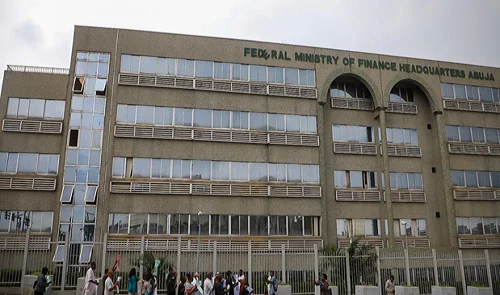

Tension erupted on Monday at the Federal Ministry of Finance headquarters in Abuja as protesting indigenous contractors blocked the main entrance, preventing the Minister of State for Finance, Doris Uzoka-Anite, from accessing the complex.
The protesters, under the umbrella of the All Indigenous Contractors Association of Nigeria (AICAN), barricaded the gate to protest what they described as the Federal Government’s failure to pay for completed projects.
They accused the government of withholding funds meant to settle verified contracts, alleging that budgetary provisions made in the 2024 and 2025 fiscal years had not been released. According to the contractors, the prolonged delay has plunged many of their members into severe financial hardship.
Addressing the protesters, AICAN President Jackson Nwosu said the renewed demonstration was triggered by mounting unpaid obligations, worsening cash-flow challenges, loan defaults and the seizure of assets belonging to contractors who borrowed to execute government projects.
“The government failed to honour its agreement to pay contractors whose project details were submitted and verified. Payments concluded before the closure of the payment portal at the end of December never reflected in our accounts,” Nwosu said.
He dismissed official claims that about 80 per cent of outstanding debts had been cleared, insisting that only between 30 and 40 per cent of verified claims had been paid.
Nwosu further alleged that the issuance of payment warrants stopped in May 2025, even as contractors continued executing projects without compensation, pushing total liabilities beyond N4 trillion.
As Uzoka-Anite arrived at the ministry, security operatives attempted to clear a passage for her convoy but were resisted by the protesters, who chanted slogans in protest. During the confrontation, a gunshot was reportedly fired as security personnel tried to disperse the crowd.
Reacting to the incident, AICAN Vice President Fredrick Agada accused authorities of intimidation instead of addressing the contractors’ grievances.
“This is a peaceful protest. We are harmless. We are only demanding payment for jobs already done,” he said.
Also speaking, the association’s Secretary-General, Babatunde Oyeniyi, said AICAN had engaged the Ministry of Finance, the National Assembly and other relevant agencies since June 2025 without any concrete outcome.
He warned that continued neglect of indigenous contractors was damaging the local economy and deepening financial distress within the sector.
The association insisted the protest would continue until all verified payments are settled, stressing that indigenous contractors should not be treated differently from foreign firms, whose payments, it alleged, are processed promptly.
Similar protests were staged last year at the National Assembly Complex and the Ministry of Finance as pressure mounted on the government to address outstanding liabilities.
In December 2025, President Bola Tinubu set up a multi-ministerial committee to address debts owed to federal contractors, estimated at about N1.5 trillion. The committee includes the Minister of Finance and Coordinating Minister of the Economy, Wale Edun; the Minister of Budget and Economic Planning, Atiku Bagudu; the Director-General of the Budget Office, Tanimu Yakubu; the Minister of Works, Dave Umahi; the Minister of Housing and Urban Development, Ahmed Dangiwa; and the Chairman of the Federal Inland Revenue Service, Zacch Adedeji.
Meanwhile, a Senate committee has invited Edun to explain the prolonged delay in settling the contractors’ claims.
The Federal Government has also acknowledged the liabilities in the 2026 Appropriation Bill, where N1.7 trillion was earmarked to clear outstanding contractor debts for capital projects executed in 2024. The provision appears under the line item, “Provision for 2024 Outstanding Contractor’s Liabilities.”
In addition, N100 billion was allocated for “Payment of Local Contractors’ Debts/Other Liabilities,” bringing the total provision to N1.8 trillion within the N23.2 trillion capital expenditure framework of the 2026 budget, aimed at accelerating infrastructure delivery while addressing legacy debts.

- Why PFIPC DG missed Reps hearing — IG - July 29, 2026
- Zamfara expects 2,000 jobs from new lithium processing plant - July 29, 2026
- Tension mars INEC stakeholders’ meeting ahead of Osun governorship poll - July 29, 2026