

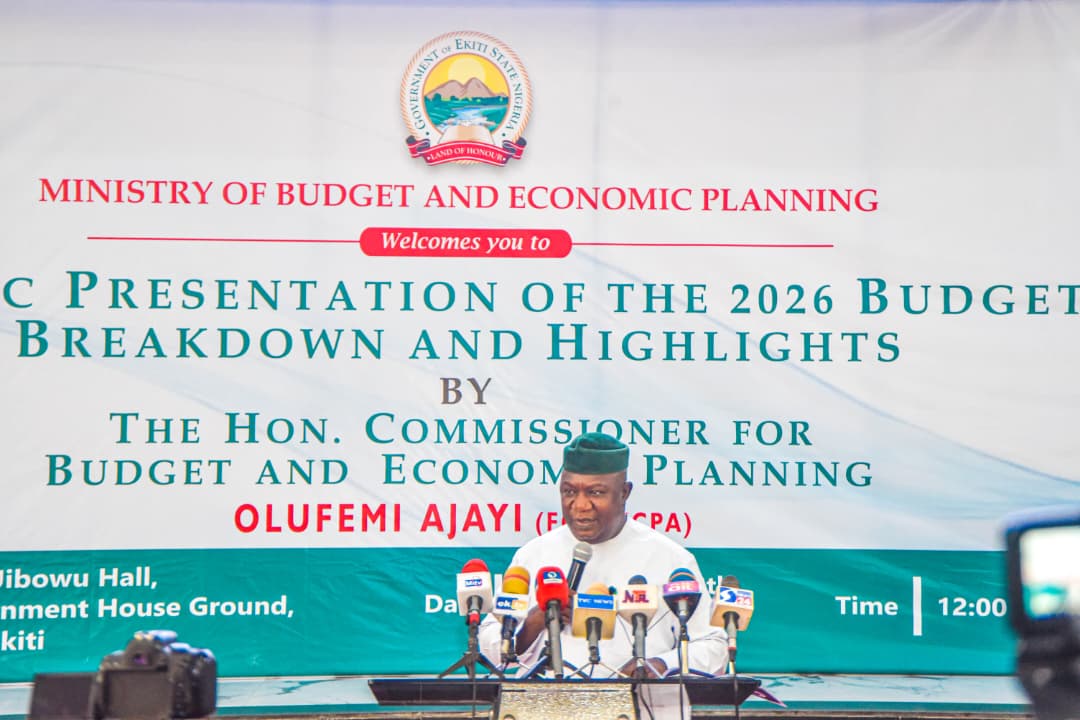
The Ekiti State Government has presented the analysis of the N415.572 billion 2026 Budget of Impactful Governance, affirming a projection of N8.8trillion Gross Domestic Product (GDP) for the year.
Presenting the budget to a cross section of government officials, financial experts, and media representatives at the Government House in Ado-Ekiti, the capital of Ekiti State, on Wednesday, January 28, 2026, the Commissioner for Budget and Economic Planning, Femi Ajayi, stressed that the budget is expected to strengthen the State’s economy through key strategic interventions in the agriculture, arts, education, infrastructure and tourism and the informal sectors.
Ajayi added that it signalled the administration’s commitment to prudent fiscal management and implementation of economic reforms essential for unlocking the potential and opportunities of the economy.
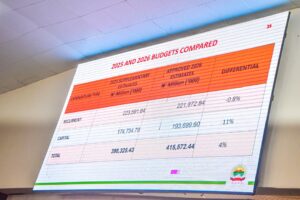
While noting that the budget was prepared in consonance with the 2026-2028 MTEF and 30 years development plan, Ajayi explained that MTEF enables the government to efficiently allocate available resources rationally towards the completion of projects within a medium-term period as it contains the key parameters and other macroeconomic projections driving the medium-term revenue and expenditure framework which were estimated based on emergent realities with a ceiling of N570,048,520,552.00 for the projected year.
He added that the fiscal document contains the blueprints to achieve the administration’s vision of Shared Prosperity by adopting a zero-based budgeting approach and focuses essentially on the completion of all ongoing projects to improve the economy.
How Oyo recorded ₦103bn IGR in 2025 — Commissioner
The commissioner disclosed that the revenue to finance the 2026 budget would be sourced from the state revenue estimate for the year, including the federal allocation, 30%, Value Added Tax (VAT) 19%, Grants from Domestic and Foreign Development partners 29%, State Independent revenue, 11%, and loan from domestic or foreign borrowing 2%.
While adding that the recurrent expenditure of the budget would be distributed into personnel cost (28%) ― overhead cost, 28%; grants and subsidy, 18%; debt servicing, 0.2% among others, the commissioner also highlighted the capital expenditure allocation by sector to include economic, 72%; administrative, 13%; social. 14% and law and justice, 1% ― Ajayi also revealed that the capital expenditure based on the six pillars of the administration include governance, 9%; agriculture and rural development, 22%; arts, culture and tourism, 1%; youth development and job creation, 2%; human capital development, 9% and infrastructure and industrial development, 57%.
Ajayi reaffirmed the commitment of the Biodun Abayomi Oyebanji administration’s commitment to fiscal accountability and transparency to achieve fiscal sustainability and macro-fiscal objectives of government.
He said the government remains committed to sustainable growth and development, aimed at improving the well-being of the people by providing safety nets to cushion the impact of any reform measures on the vulnerable segments of the population.
Earlier in his remarks, the governor’s Chief of Staff, Niyi Adebayo, commended Oyebanji for providing the necessary impetus that has assisted the state at ensuring unbridled development to the state through various people-friendly reforms and programmes.
Adebayo said the success of the past budgets under the administration was hinged on the government’s policy of inclusivity through responsible and responsive governance, promotion of fiscal transparency and accountability essential to the shared prosperity agenda of the government.

- Presidential campaign council: We don’t need your validation, OK Movement tells NDC - September 20, 2026
- Man City top EPL after Sunderland thriller as Liverpool beat Bournemouth - September 20, 2026
- APC to Atiku: Explain legal, financial basis of proposed petrol subsidy - September 20, 2026