
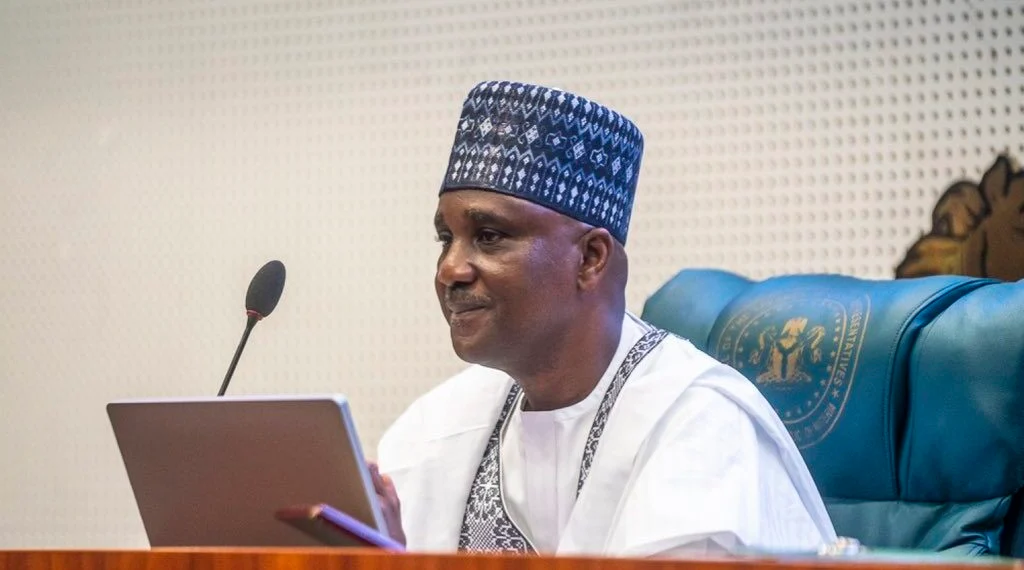

The Speaker of the House of Representatives, Tajudeen Abbas, has defended the National Assembly’s decision to adopt a hybrid system of electronic and manual transmission of election results in the amended Electoral Act, saying the move is aimed at preventing voter disenfranchisement and curbing apathy ahead of the 2027 general elections.
Abbas said Nigeria’s limited internet coverage and unstable power supply make it unrealistic to rely solely on real-time electronic transmission nationwide.
He spoke on Sunday while receiving Spain’s Ambassador to Nigeria, Felix Costales, during a courtesy visit to his office at the National Assembly complex in Abuja.
According to a statement issued by his Special Adviser on Media and Publicity, Musa Krishi, the Speaker received the envoy alongside Chairman of the House Committee on Appropriations, Abubakar Bichi; Chairman of the House Committee on Foreign Affairs, Wole Oke; and Chairman of the Nigeria-China Parliamentary Friendship Group, Jafaru Yakubu.
Abbas explained that the hybrid provision in the amended Electoral Act was a pragmatic response to Nigeria’s infrastructural realities. He noted that even in major cities like Abuja, stable internet service cannot be guaranteed at all times.
Citing data from the Nigerian Communications Commission, he said nearly 40 per cent of the country remains underserved in terms of internet penetration, making exclusive electronic transmission impractical.
“With about 40 per cent of the country lacking adequate internet coverage, insisting on real-time electronic transmission alone could effectively disenfranchise millions of voters,” Abbas said.
He added that voter turnout remains a major concern, revealing that only about 12 to 15 per cent of registered voters typically participate in elections. According to him, introducing a purely electronic system could further reduce participation, especially in rural and underserved communities.
“That is why we adopted a hybrid system. Where electronic transmission is feasible, it should be used. Where it is not, manual transmission should apply. There is no way electronic transmission can be effectively deployed in every part of the country at this stage,” he stated.
The Speaker also pointed to Nigeria’s energy challenges, arguing that reliable electricity is essential to power devices and internet infrastructure needed for real-time electronic transmission on election day.
He maintained that democracy is a gradual process that improves over time and expressed optimism that Nigeria’s electoral process would continue to strengthen with international collaboration.
Abbas assured that, based on his engagement with the leadership of the Independent National Electoral Commission, the 2027 general elections would be more credible and inclusive.
He also called for deeper legislative cooperation between Nigeria and Spain, particularly in areas such as legislative drafting and institutional strengthening.
Earlier, Costales said his visit was aimed at enhancing legislative diplomacy and deepening bilateral relations between Spain and Nigeria. He pledged Spain’s support for efforts to consolidate democratic institutions in Nigeria.
“You can count on us—whatever we can do to deepen Nigerian democracy,” the envoy said, noting that political polarisation is a global phenomenon and that compromise remains essential for democratic progress.
President Bola Tinubu recently assented to the amended Electoral Act passed by the National Assembly as part of reforms targeted at improving the credibility and inclusiveness of future elections, particularly the 2027 general polls.
The amendment formally authorises the use of both electronic and manual transmission of election results, depending on infrastructure availability and operational feasibility—a provision that has sparked debate among political actors and civil society groups.
While supporters describe the hybrid model as a practical solution to Nigeria’s infrastructural gaps, critics argue that it could undermine transparency if not properly implemented and monitored.