

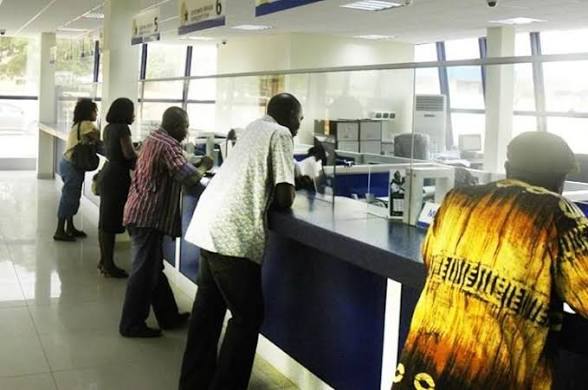
Nigerian banks generated a combined N209.18 billion from account maintenance charges in the first quarter of 2026, representing a 14.07 per cent increase from the N183.37 billion recorded during the same period in 2025.
An analysis of the unaudited financial statements of 11 listed banks showed that the growth in account maintenance income mirrored a broader rise in banking transactions and fee-based earnings across the industry.
The review revealed that total fee and commission income among the banks rose to N984.47 billion in the first three months of 2026, up from N866.30 billion recorded in the corresponding period of last year.
The figures cover 11 of the 13 banks listed on the Nigerian Exchange, excluding FCMB Group and Unity Bank, which had not released their first-quarter results at the time of analysis.
Under the Central Bank of Nigeria’s Guide to Charges by Banks and Other Financial Institutions, account maintenance fees apply only to current accounts and are designed to cover the cost of maintaining active transactional accounts.
Among the lenders, Zenith Bank recorded the highest standalone account maintenance income at N25.07 billion, followed by Access Holdings with N16.68 billion, Guaranty Trust Holding Company with N15.12 billion and United Bank for Africa with N13.26 billion.
Ecobank Transnational Incorporated reported N118.06 billion under cash management and related charges, the closest equivalent to account maintenance fees disclosed in its financial statements.
In overall fee and commission earnings, Ecobank led the industry with N237.80 billion, followed by Access Holdings with N205.03 billion, UBA with N124.07 billion, First Holdco with N96.12 billion and Zenith Bank with N84.79 billion.
GTCO posted the strongest growth in account maintenance income among banks that separately disclosed the figures, recording a 42.15 per cent increase from N10.63 billion to N15.12 billion.
Sterling Financial Holdings followed with a 38.31 per cent rise to N2.38 billion, while Wema Bank’s account maintenance income increased by 31.30 per cent to N3 billion. Zenith Bank recorded a 30.81 per cent increase to N25.07 billion, while UBA’s earnings from the segment grew by 27.65 per cent.
For total fee and commission income, Zenith Bank posted the fastest growth at 41.43 per cent, followed by Fidelity Bank at 39.70 per cent, Sterling Financial Holdings at 33.25 per cent, Stanbic IBTC Holdings at 30.37 per cent and First Holdco at 23.67 per cent.
Despite the overall industry growth, some lenders recorded declines in account maintenance earnings. Fidelity Bank’s income from the segment fell by 2.52 per cent to N3.24 billion, while Stanbic IBTC’s account transaction fees, the closest equivalent disclosed, declined by 4.98 per cent to N1.91 billion.
The report also showed varying performances across other fee-generating business lines, including electronic banking, credit-related services, foreign exchange transactions, asset management, brokerage and custody services.
Commenting on the development, the Chief Executive Officer of the Centre for the Promotion of Private Enterprise, Dr Muda Yusuf, attributed the growth in banking fees and commissions to increased economic activity, rising business confidence and stronger participation in the formal economy.
According to him, banking transactions typically reflect broader economic performance because demand for financial services is driven by business and commercial activities.
Yusuf said the improvement in banks’ earnings was a sign of ongoing economic recovery, improved investor confidence and growing macroeconomic stability.
The rise in banking fee income coincided with positive economic indicators. Nigeria’s private sector recorded its strongest expansion in nine months in May 2026, with the Stanbic IBTC Purchasing Managers’ Index climbing to 54.1 points, supported by stronger consumer demand, higher output levels and improved business operations.
The banking industry has also benefited from ongoing reforms by the Central Bank of Nigeria. The apex bank recently disclosed that 33 financial institutions had raised additional capital as of March 2026, while 30 banks had already met the new minimum capital requirements for their respective licence categories.

- Bauchi woman stabs husband over belongings - October 25, 2026
- FG releases N38.93bn for 166 tertiary institutions - October 25, 2026
- Ebola: NCDC isolates nine fresh contacts as tracing expands - October 25, 2026