


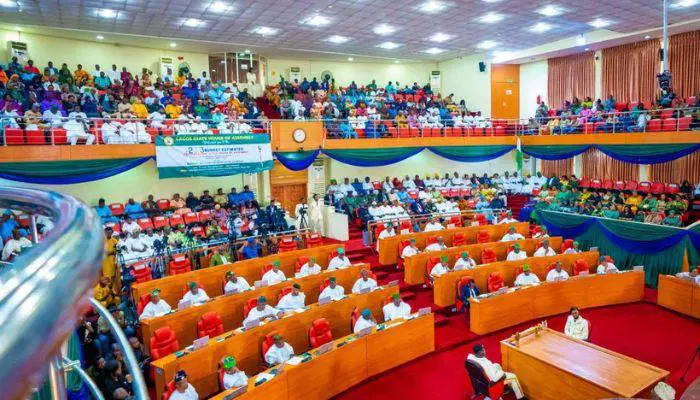
The proposed establishment of state police received a major boost on Thursday as governors, speakers of the 36 State Houses of Assembly, the Labour Party and the Forum of APC Speakers threw their weight behind the constitutional amendment recently passed by the Senate.
The endorsements came a day after the Senate approved the Constitution Alteration Bill seeking to establish state police, a move widely seen as a significant step towards decentralising policing and tackling Nigeria’s worsening security challenges.
The bill must now secure the approval of at least 24 state Houses of Assembly before it can be transmitted to President Bola Tinubu for assent.

Benue State Governor Hyacinth Alia described the passage of the bill as a landmark achievement, saying state police would improve intelligence gathering and enable faster responses to insecurity because officers would have a better understanding of local communities and terrain.
He also commended President Tinubu and the National Assembly for advancing what he described as a long-awaited security reform.
Across the country, state assemblies signalled their readiness to consider the legislation.
In Kano, lawmakers held a stakeholders’ meeting with Governor Abba Kabir Yusuf to deliberate on the proposal before taking an official position.
The Speaker of the Gombe State House of Assembly, Abubakar Luggerewo, said the bill would undergo committee review, public hearings and stakeholder consultations before lawmakers vote on it. He, however, noted that the Assembly’s initial assessment was favourable.
Bayelsa lawmakers also expressed support, pledging to fast-track consideration of the bill once received, while the Plateau and Ondo State Houses of Assembly described state policing as a necessary response to rising insecurity.
The Conference of Speakers of State Legislatures in Nigeria equally endorsed the proposal.
Its Chairman and Speaker of the Delta State House of Assembly, Emomotimi Guwor, said community-based policing would improve public safety and assured Nigerians that state legislatures would give the bill diligent consideration in line with constitutional requirements.
Similarly, the Forum of Progressive Speakers of State Legislatures under the APC described the Senate’s action as a historic breakthrough.
The forum’s chairman and Speaker of the Jigawa State House of Assembly, Haruna Dangyatin, said the legislation would empower states to respond more effectively to security threats while promising strong legislative oversight to prevent abuse.
The Labour Party also backed the amendment, urging governors and lawmakers across the federation to support the reform.
The party’s National Publicity Secretary, Ken Asogwa, said decentralised policing had become necessary in view of the country’s growing security challenges, adding that safeguards contained in the bill would help prevent political abuse of state police.
Former Senator Ayodele Arise also supported the proposal, arguing that local policing would improve intelligence gathering and enhance rapid response to crime, while stressing the need for constitutional checks to prevent misuse by state governments.
However, the Peoples Redemption Party opposed the bill, accusing the Federal Government of lacking the credibility to oversee such a major security reform.
In a statement signed by its National Chairman, Dr Hakeem Baba-Ahmed, the party urged Nigerians to reject the proposal, arguing that the issue should be left for a future administration.
The Senate approved the constitutional amendment on Wednesday after considering the report of its Committee on the Review of the Constitution.
The bill proposes a dual policing system under which state governments can establish police services while the Federal Police Service retains responsibility for terrorism, organised crime, border security, cybercrime, arms trafficking and other federal offences.
The proposed amendment also introduces safeguards to prevent abuse, including provisions barring governors from directing state police to target political opponents or critics.
It further empowers the Federal Government to intervene where a state police service becomes incapable of maintaining public order, engages in systematic human rights violations or where national security is threatened.
The bill also seeks to expand the National Police Council by including representatives of the Nigerian Bar Association, Nigeria Labour Congress, National Human Rights Commission, retired senior police officers and state attorneys-general to strengthen oversight and accountability.
If approved by at least 24 state legislatures and signed into law by the President, the amendment will mark the most significant restructuring of Nigeria’s policing system since independence.

- Xenophobia: 105 Nigerians return home from South Africa - September 26, 2026
- AI, cyber threats reshape banking as CIBN inducts 2,178 bankers - September 26, 2026
- Old Trafford hosts thousands as Jerry Eze leads NSPPD prayer conference - September 26, 2026