

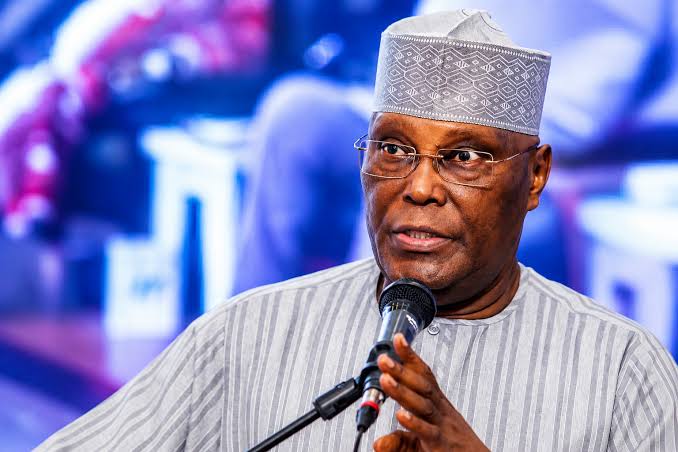
Former Vice-President and African Democratic Congress presidential candidate, Atiku Abubakar, has pledged to reopen Nigeria’s land borders and expand port facilities in the South if elected president in 2027.
Atiku made the promise in a video shared on Friday by an ADC chieftain, Dele Momodu, while explaining how his proposed economic policies would address unemployment and the rising cost of moving goods across the country.
The former vice-president criticised restrictions on land crossings, arguing that the policy had severely affected legitimate businesses that depended on trade with Nigeria’s neighbours.
He said states in the North had historically benefited from commercial activities with Cameroon, Chad, Niger Republic and Benin Republic, but that border restrictions had disrupted the livelihoods of traders in the region.
According to Atiku, many young entrepreneurs who invested millions of naira in cross-border businesses were forced to shut down their operations, resulting in job losses.
“The Northern states are bordering Cameroon, Chad, Niger and Benin Republic. And you close all those borders,” he said.
“All our young men who are doing trading between these countries, they carry goods across. All what we call transborder trade is a legitimate business.”
Atiku said the economic consequences of the border restrictions could also worsen insecurity by depriving young people of legitimate sources of income.
“So I said I am going to reopen the borders and I will,” he stated.
The ADC candidate also proposed the development of ports across the southern and South-East regions as part of efforts to improve the distribution of imported goods.
He said he had previously engaged European shippers and companies involved in port development on ways to establish and expand port facilities in the region.
Atiku argued that having functional ports closer to different parts of the country would reduce transportation costs and ease the movement of cargo to the hinterland.
He particularly cited the difficulty businesses face in transporting containers from Lagos to Yola, Adamawa State.
“If I drop my container in Calabar or in Uyo or in Port Harcourt, it will just take me 24 hours to take the container to Yola,” he said.
“But right now, it takes me not less than two months to take my container from Lagos because you have to cross over from South-West, you go to North-East, and then there is even no road.”
He said improving the country’s port and road networks would create a more efficient supply chain, lower logistics costs and support businesses operating across the country.
Nigeria’s land border closure began in 2019 under former President Muhammadu Buhari, with the Federal Government citing smuggling, illegal importation and the need to boost domestic production among the reasons for the policy.
Some major border crossings were reopened in December 2020, while additional corridors have been reopened under the current administration.
The Federal Government reopened the Tsamiya border with Benin Republic in Kebbi State and the Kamba corridor linking Nigeria to Niger Republic in February 2026.
However, tighter controls remain at some other border points as the government continues efforts to balance legitimate trade with concerns over smuggling and other cross-border crimes.

- Wike rallies Rivers monarchs for Tinubu’s re-election - October 17, 2026
- Shettima inaugurates Tinubu campaign office, says North’s support is not a blank cheque - October 17, 2026
- Okonjo-Iweala: My mother was kidnapped over $2.4bn fuel subsidy fraud probe - October 17, 2026