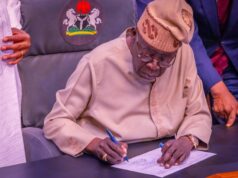
President Bola Tinubu has asked a United States court to reject a request seeking the release of records relating to past investigations allegedly involving him, arguing that the documents are protected by privacy laws.
Tinubu, who joined the case as an intervenor, made the request in a response filed on Friday before the US District Court for the District of Columbia.
He urged the court to dismiss a motion for summary judgment filed by Aaron Greenspan, founder of PlainSite, and allow the Federal Bureau of Investigation (FBI) and Drug Enforcement Administration (DEA) to maintain redactions and withholdings in documents already released.
Greenspan had filed Freedom of Information Act (FOIA) requests seeking records concerning Tinubu, including what he described as the “entire FBI file” on the Nigerian president and FBI interview records from 1992 to 1993.
The requests were among 12 FOIA applications submitted to six US federal agencies for investigative records relating to a Chicago heroin trafficking case from the early 1990s. Tinubu was one of four individuals named in the requests.
In April 2025, US District Judge Beryl Howell ruled that the FBI and DEA had improperly refused to confirm or deny whether they possessed records relating to Tinubu.
She ordered the agencies to search for and process non-exempt documents responsive to Greenspan’s requests.
The agencies subsequently released thousands of pages, some of which contained redactions, alongside a Vaughn index explaining the reasons for withholding certain information.
Greenspan later asked the court to compel further disclosure, arguing that the records released by the agencies did not fully satisfy his requests.
Tinubu: FOIA Cannot Be Used to Obtain Private Information
In his latest filing, Tinubu argued that FOIA was designed to promote transparency about government activities, rather than provide information about private individuals contained in government files.
“Plaintiff’s motion should be denied because FOIA is not a tool for obtaining information the government collected about private individuals,” his lawyers argued.
The president’s legal team maintained that Greenspan’s requests were primarily focused on obtaining information about Tinubu rather than determining how the FBI, DEA or other agencies performed their official duties.
They cited a 1989 US Supreme Court decision which held that disclosure of records concerning private citizens generally reveals little about government operations.
Tinubu’s lawyers also relied on FOIA Exemption 7(C), which protects law-enforcement records where disclosure could constitute an unwarranted invasion of personal privacy, as well as provisions of the US Privacy Act.
They argued that the FBI and DEA had therefore “properly redacted or withheld exempt information” from the documents released.
Lawyers Reject Argument on 2025 Glomar Ruling
Tinubu’s lawyers also rejected Greenspan’s argument that Howell’s 2025 ruling, which prevented the FBI and DEA from using “Glomar” responses to refuse confirmation of records, eliminated the president’s privacy rights over the contents of the files.
A Glomar response allows a government agency to refuse to confirm or deny whether responsive records exist.
According to Tinubu’s legal team, Howell’s ruling distinguished between Tinubu’s privacy interest in keeping secret the fact that he had been investigated and his separate privacy interest in the contents of any investigative records.
They argued that the 2025 decision addressed the former issue but did not order the disclosure of the contents of investigative files.
The lawyers further maintained that the disclosure of some information about Tinubu’s past in the public domain did not automatically remove his privacy interests in undisclosed information contained in government records.
Tinubu Disputes Public Interest Argument
Tinubu’s lawyers also challenged Greenspan’s argument that there was a legitimate public interest in releasing the documents because Tinubu is Nigeria’s president.
They argued that public curiosity about Tinubu’s background, political career or suitability for office did not amount to the type of public interest recognised under FOIA.
“Plaintiff’s interest in an individual or that individual’s activities is not a ‘public interest’ that FOIA recognizes,” the lawyers argued.
They said Greenspan’s filings demonstrated that his primary objective was to obtain information about Tinubu rather than investigate possible misconduct by the FBI, DEA or other US government agencies.
The lawyers also dismissed suggestions of a secret prosecution or government cover-up as “unsubstantiated allegations”, arguing that Greenspan had not provided sufficient evidence of government wrongdoing to justify further disclosure.
Tinubu’s legal team also opposed Greenspan’s challenges to the agencies’ searches, the DEA’s Vaughn index, the claimed exemptions and the handling of segregable information.
The president is asking the court to dismiss Greenspan’s motion for summary judgment and allow the existing redactions and withholdings by the FBI and DEA to remain.
How the Case Began
Greenspan filed the FOIA requests in 2022 and 2023, seeking records from the CIA, FBI, DEA, Internal Revenue Service, Executive Office for United States Attorneys and Department of State.
The requests concerned investigative records connected to the Chicago drug-trafficking case and named Tinubu, Lee Andrew Edwards, Mueez Abegboyega Akande and Abiodun Agbele.
Several agencies initially issued Glomar responses, saying they could neither confirm nor deny the existence of responsive records.
However, in her April 2025 ruling, Howell held that the FBI and DEA had failed to establish a sufficient privacy interest to keep secret the fact that Tinubu had been the subject of a criminal investigation.
She ordered the agencies to search for and process non-exempt records, while upholding the CIA’s Glomar response.
Tinubu has consistently denied wrongdoing in connection with the allegations.

- Tinubu approves lifetime salaries for retired immigration chiefs — Minister - October 17, 2026
- NAFDAC busts N500m fake drink factory, destroys 5.3bn products in one week - October 17, 2026
- Nigerian man jailed in UK for hacking woman’s accounts, selling intimate photos - October 17, 2026