


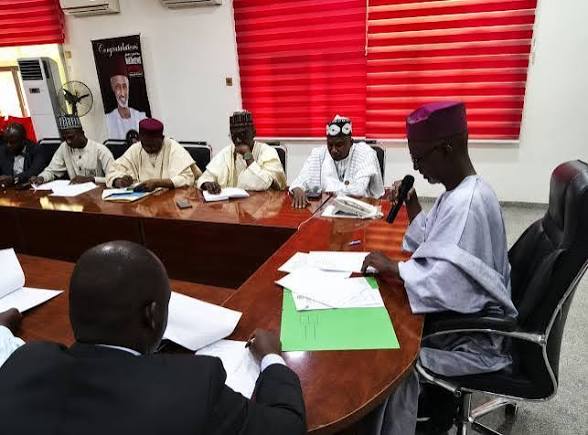
The Kano State Government has begun moves to overhaul the traditional Almajiri education system, with the formation of a 20-member committee to develop a framework for regulating and integrating Tsangaya schools.
The new Advisory Committee on Almajiri Education and Welfare Reform is expected to examine how the system currently operates and recommend measures to improve the education, welfare and protection of children enrolled in it.
The committee is headed by the state Attorney-General and Commissioner for Justice, Abdulkarim Kabir Maude, while Amina Yusuf-Yargaya, Permanent Secretary in the Ministry of Finance, will serve as secretary.
Musa Tanko-Muhammad, Press Secretary to the Secretary to the State Government, announced the development in a statement issued in Kano on Thursday.
The committee brings together officials of government, traditional rulers, Islamic organisations, education and legal experts, as well as representatives of child-rights organisations.
Among its key tasks is the development of regulatory and enforcement mechanisms that will guide the operation of Tsangaya schools.
It is also expected to draw up a roadmap for testing the proposed reforms, monitoring their implementation and ensuring that the programme can be sustained.
The government plans to broaden the curriculum available to Almajiri children by combining Qur’anic learning with literacy, numeracy, vocational education and life skills.
At the same time, the committee is expected to develop safeguards against abuse and exploitation and propose a legal framework for registering, licensing and supervising Tsangaya schools.
Funding will also form part of the committee’s assignment, with members expected to explore sustainable financing options for the reformed system.
The panel will engage Qur’anic teachers, parents, Islamic scholars, traditional institutions and communities as part of the reform process.
SSG Umar Faruk-Ibrahim said the government was confident that the committee’s composition would provide the expertise needed to address challenges affecting Almajiri children.
He stressed that the initiative was not an attempt to dismantle traditional Qur’anic education.
Instead, he said, the government wanted to preserve its religious and cultural foundations while strengthening child protection and giving children access to skills and knowledge that would improve their prospects in the future.

- 2027: Atiku, Obi, Sowore lack what it takes to defeat Tinubu — Wike’s aide - October 22, 2026
- How suspect used fake NNPC documents to defraud Singaporean $285,000 - October 22, 2026
- NEC approves 90-day plan to ease hardship, lower transport costs - October 22, 2026