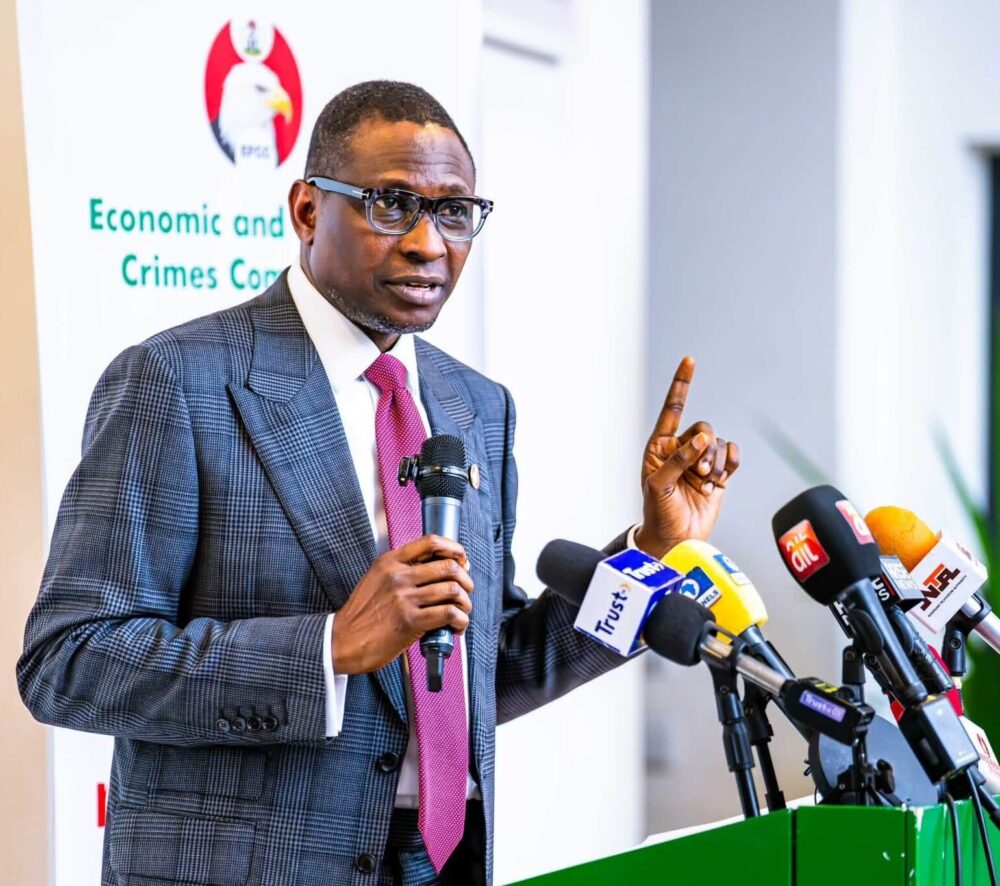
The Chairman of the Economic and Financial Crimes Commission, Ola Olukoyede, has dismissed proposals for a central agency to take charge of all assets recovered by government institutions, saying the volume and spread of such assets would make the arrangement unworkable.
Olukoyede gave his position on Tuesday in a post on X while responding to the growing debate over the management and disposal of forfeited assets.
The EFCC chairman said his view was informed by direct experience, noting that he previously served as the commission’s secretary and was involved in managing recovered assets.
“I have followed the debate on managing forfeited assets closely. I am not a commentator on this — I am a practitioner. As Secretary of the EFCC, I managed assets for years,” he said.
According to him, attempts by other countries to establish central institutions for managing recovered assets had not produced sustainable results.
“Some are calling for a single agency to handle all recovered assets. It was tried in the UK at a cost of over £34 million and folded within a year. South Africa tried it too. Sixteen months. Look it up,” Olukoyede said.
He also questioned the practicality of transferring assets recovered by more than 20 statutory agencies to a single institution.
“Over 20 statutory agencies recover assets for government. The Police alone have divisions in nearly every local government and stations in most wards, all forfeiting assets. No single agency could manage the Police holdings alone, let alone everyone else’s,” he stated.
Olukoyede also cited the Asset Management Corporation of Nigeria, AMCON, which was established to manage certain recovered assets, as an example of the potential risks associated with centralised management.
“We should also remember AMCON, set up to manage recovered assets — the government lost over ₦5 trillion there,” he said.
Rather than establishing another central body, the EFCC chairman advocated strict enforcement of the accountability framework contained in the Proceeds of Crime Act and the EFCC Act.
“POCA got it right by placing the duty on each agency: what did you recover, and what have you done with it?” he said.
Olukoyede maintained that agencies should be required to publicly account for assets recovered under their mandates, pointing to the EFCC’s own disclosure practices.
“That, alongside Section 31 of the EFCC Act, is the most effective model anywhere in the world. So hold every agency to it. Ours goes up on our website within 24 hours, and our annual report has gone to the National Assembly on time every year of my tenure,” he added.
He gave an assurance that assets recovered by the EFCC would be protected from abuse under his leadership.
“My pledge to Nigerians: not a pin nor a penny of recovered assets will be mismanaged under my watch,” he said.
The EFCC has reported a substantial increase in recovered and forfeited assets under Olukoyede. At a briefing in Abuja last week, he disclosed that the commission had secured interim and final forfeiture orders covering 10,053 tangible assets.
The assets, according to him, include properties, vehicles, plots of land, electronic equipment, schools, factories, hotels, oil rigs, barges, machinery and aircraft, as well as 102 tonnes of solid minerals.
He said the disposal of finally forfeited assets had generated approximately N12.07 billion, which was remitted to the Federal Government.
Olukoyede also disclosed that between October 2023 and June 2026, the EFCC recovered more than N1.23 trillion, $684.48 million, £373,905.78 and €9.34 million.
Of the recovered funds, he said N661.32 billion and $492.37 million had been released to beneficiaries.
The handling of forfeited assets has remained a subject of public scrutiny, with concerns raised over transparency, accountability and the processes used by government agencies to manage and dispose of properties and other assets recovered from suspected proceeds of crime.
Olukoyede has previously argued that the Proceeds of Crime Act has strengthened the EFCC’s ability to manage the recovery process by providing a clearer legal framework and reducing delays between forfeiture and disposal.
He maintained that instead of creating another central institution, government should strengthen existing accountability requirements and compel every agency involved in asset recovery to account for what it recovers and how such assets are managed.

- Obi confirms Benue convoy attack, says visit was not for campaign - September 8, 2026
- Kaduna warns boards against meddling in agency affairs - September 8, 2026
- Thugs obstruct Obi’s convoy in Benue - September 8, 2026