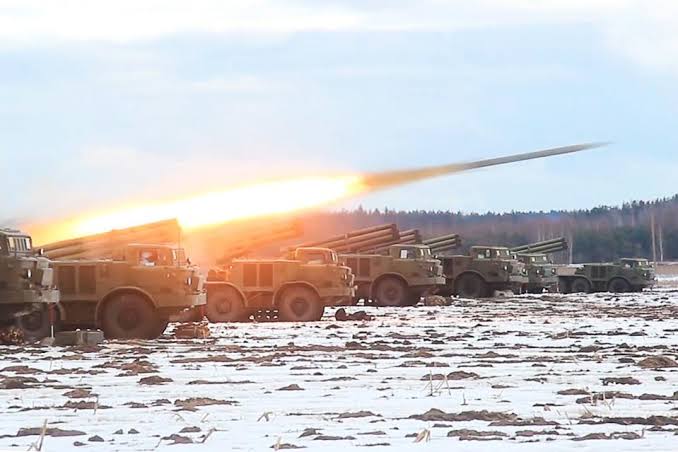
North Korea launched a ballistic missile towards the East Sea on Sunday, prompting an emergency security meeting in South Korea and renewed calls for Pyongyang to halt its missile tests.
South Korea’s Joint Chiefs of Staff said the missile was launched from the Wonsan area on North Korea’s east coast at about 3:00pm local time.
“Our military detected a ballistic missile launched from the Wonsan area of North Korea towards the East Sea at around 3:00 pm (0600 GMT),” the Joint Chiefs of Staff said.

South Korean authorities said they had increased surveillance for possible further launches, while Seoul, Washington and Tokyo were sharing information on the projectile.
Japan also confirmed the launch, with the office of Prime Minister Sanae Takaichi describing it on X as a suspected ballistic missile.
Japan’s Defence Ministry later said the projectile had already fallen, without providing details on where it landed or how far it travelled.
Following the launch, South Korea’s presidential National Security Office convened an emergency meeting to assess the incident and its implications for national security.
The South Korean government condemned the launch as a “grave act” and said it violated United Nations Security Council resolutions.
It called on Pyongyang to immediately stop its ballistic missile activities.
Sunday’s launch came eight days after North Korea fired several short-range ballistic missiles towards the East Sea during what it described as a joint firepower exercise.
The latest test also followed Pyongyang’s rejection of a resolution adopted by the International Atomic Energy Agency calling for an end to its nuclear activities.
During the IAEA’s General Conference this week, North Korea accused what it called “hostile forces” of attempting to dismantle its nuclear programme.
A North Korean Foreign Ministry spokesperson said the IAEA resolution would not alter Pyongyang’s position as a nuclear weapons state.
North Korea has formally enshrined its nuclear status in law and repeatedly rejected calls for denuclearisation.
Kim Yo Jong, the sister of North Korean leader Kim Jong Un, recently described the country’s nuclear-armed status as “absolute” and dismissed efforts to persuade Pyongyang to abandon its nuclear weapons programme.
The size of North Korea’s nuclear arsenal remains uncertain. US President Donald Trump said in August that Pyongyang had 57 nuclear weapons, while South Korean estimates have placed the figure between 80 and 120.
AFP

- Osimhen ruled out of Super Eagles AFCON qualifiers - September 20, 2026
- Sickle cell patient undergoes first hip replacement in Yobe - September 20, 2026
- APC’s Datti wins Kano by-election - September 20, 2026