

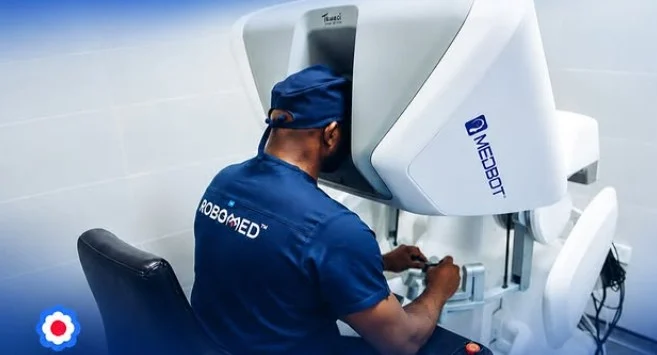
Nigeria has recorded what the Redeemer’s Health Village, Mowe, Ogun State, described as West Africa’s first telerobotic surgery, with doctors performing an operation on a patient located about 500 kilometres away in Abuja.
The procedure, a right radical nephrectomy involving the removal of a kidney, was carried out over the weekend through a collaboration between Redeemer’s Health Village (RHV), RoboMed Global and Nisa Premier Hospital, Abuja.
Unlike conventional robotic surgery, where the surgeon operates from the same facility as the patient, the procedure allowed surgeons at RHV to remotely control a surgical robot at the Abuja hospital through an internet connection.

Speaking after the operation, the Chief Executive Officer of RHV, Dr Adedamola Dada, described the procedure as a major development in Nigeria’s adoption of advanced surgical technology.
“It’s a huge breakthrough, and then of course, it is the first time telesurgery is done in West Africa,” Dada said.
He said the technology could eventually allow specialists outside Nigeria to perform complex procedures on patients in the country without travelling to the location of the patient.
“What this simply means is that for very complicated cases where we don’t even have the manpower in the country, surgeons can stay in the United States and operate on that patient here,” he said.
The telerobotic procedure was preceded by another robot-assisted operation performed at RHV on the same day.
Dada said surgeons carried out a pyeloplasty on a 28-year-old patient to reconstruct the renal pelvis and remove an obstruction affecting the flow of urine.
“What we have done is called a pyeloplasty. It’s an attempt to reconstruct the pelvis, remove the obstructions, and ensure that the urine flows freely,” he said.
Dada, however, identified the shortage of trained personnel as one of the major challenges to the expansion of robotic surgery in Nigeria.
He called on the Federal Government to support the training of surgeons, nurses, biomedical engineers and other specialists required to operate and maintain robotic surgical systems.
“Most of the time, the equipment is really not a challenge; the challenge now is the manpower,” he said.
According to him, government-sponsored training and scholarships could help build a pool of Nigerian professionals capable of sustaining the technology.
“The government needs to support and sponsor Nigerians — the surgeons, nurses, biomedical engineers — who would want to come for the training by awarding them scholarships so that in another one or two or three years, we would have a lot of professionals who can do this,” he said.
Prof. Obi Davies-Ekwenna, the robotic surgeon who led the remote operation, said the procedure demonstrated how technology could reduce geographical barriers to specialist healthcare.
“We were able to operate on a patient in Abuja, 500 kilometres away. We were able to operate on a patient with a kidney tumour, a cancer tumour. And so that was successful,” he said.
Davies-Ekwenna said telerobotic surgery could also provide patients with access to specialists within and outside Nigeria without requiring them to travel to where the surgeon is based.
“It means access to experts from within and outside the country. Telesurgery can be done from any part of the world with precision, with excellent results,” he said.
The Chairman of the RHV Board, Dr Kunle Onokoya, said the adoption of robotic technology was also expanding the range of complex procedures that could be performed.
“The kind of surgery that otherwise would have been inoperable, meaning that the risk from surgery was too great, is now being done with robot-assisted surgery,” Onokoya said.
The development adds to growing efforts by private healthcare providers in Nigeria to introduce robotic-assisted procedures and expand access to specialised surgical care.

- NSCDC raids illegal juice factory in Lagos - September 22, 2026
- Nigeria moves to acquire 12 US-made attack helicopters - September 22, 2026
- Dangote plans $10bn power investment to tackle Africa’s electricity crisis - September 22, 2026