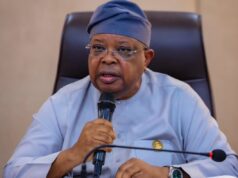


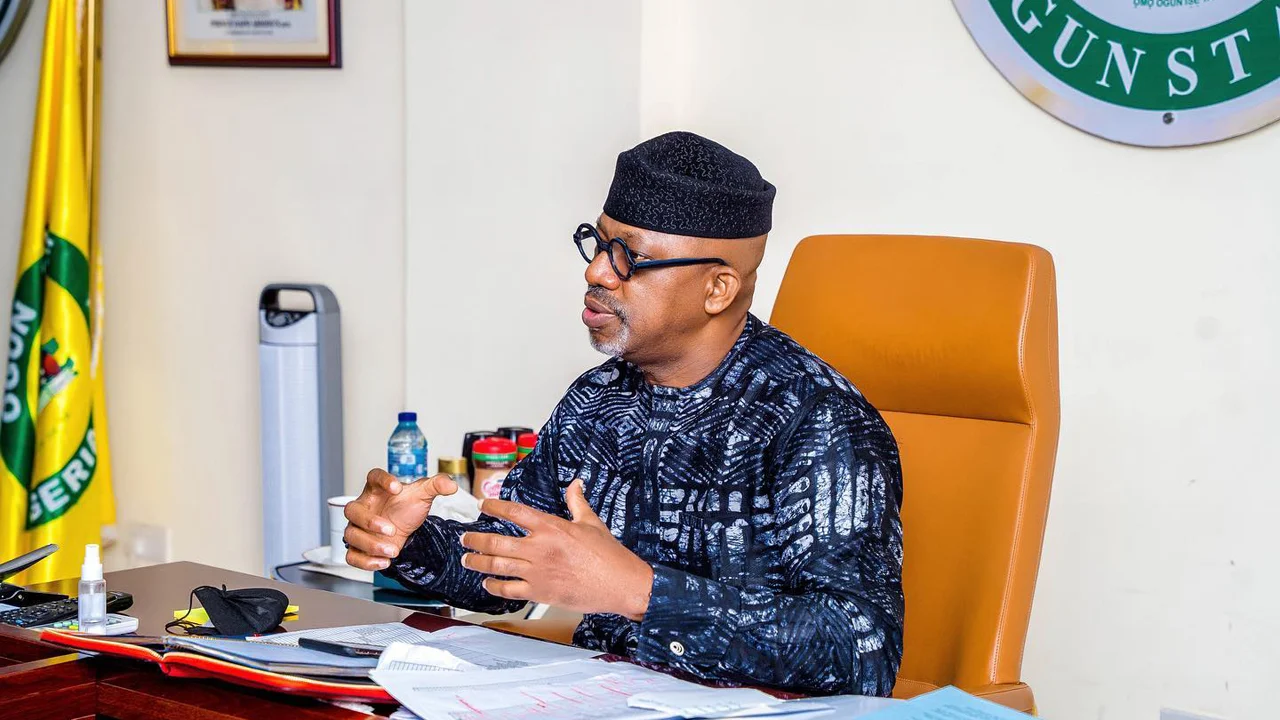
Nigeria will need an additional 554,353 police personnel to adequately staff the proposed state police system, Ogun State Governor Dapo Abiodun has said.
Abiodun, who chairs the Southern Governors’ Forum, said the recruitment could be spread over three years, requiring about 184,784 personnel annually.
He disclosed this on Thursday while delivering the keynote address at a colloquium marking the posthumous 70th birthday of former Ondo State Governor Rotimi Akeredolu at the International Conference Centre, University of Ibadan, Oyo State.

The event, themed “Fundamentals and Governance of State Policing: Towards a New Architecture for National Security in Nigeria,” focused on the proposed decentralisation of policing and the framework needed to make it effective.
Citing data from the Nigeria Governors’ Forum, Abiodun said the country’s policing needs, based on the United Nations benchmark of one police officer to 414 citizens, underscored the urgency of establishing state police.
“The debate is no longer whether Nigeria needs state police, but how swiftly and sustainably we establish it,” he said.
He argued that Nigeria could no longer rely on a security structure in which policing responsibilities were concentrated at the federal level, insisting that local knowledge was essential to effective law enforcement.
“Security is intrinsically local. You cannot police a community whose language you do not speak, whose terrain you do not know. State policing is not a threat to unity; it is the bedrock of stability and prosperity,” he said.
However, Abiodun warned that disparities in states’ revenue-generating capacity could undermine the proposed system if the Federal Government failed to establish a sustainable funding arrangement.
He said Lagos, Rivers, the Federal Capital Territory, Ogun and Enugu accounted for 61.6 per cent of states’ internally generated revenue, while 76 per cent of states generated below the national average of N13,600 per capita.
According to him, half of the states generated less than N6,334 per capita, raising concerns about their ability to finance policing operations without federal support.
“Insecurity in low-revenue states spills over nationally. Underfunding one state’s police becomes everyone’s crisis,” he said.
The governor called for a constitutional state police take-off fund that would provide equal-access grants, additional support based on needs and funding tied to compliance with established standards.
He said the Presidential Working Group was developing operational plans, financial models, accountability mechanisms and legislative oversight frameworks for the proposed system.
These, he added, would cover recruitment, training, governance and procedures for addressing abuses.
Abiodun stressed that recruitment must be transparent and properly vetted, while officers should receive training in investigations, evidence handling, lawful arrests, conflict management, proportionate use of force and the protection of vulnerable people.
He also warned against political interference, insisting that police protection must be available to all citizens regardless of their political affiliations.
“Political opponents, journalists, peaceful protesters and minority communities deserve equal protection,” he said.
The governor called for improved welfare for personnel, including regular salaries, adequate equipment, medical care, insurance and support for their families.
He said funding must be transparent and sufficient to cover salaries, training, maintenance, communications, investigations and equipment replacement.
Abiodun further cautioned that private contributions to security trust funds must not give donors influence over investigations or access to preferential treatment.
Linking security to economic development, he said Nigeria could not achieve its ambition of becoming a $1tn economy without addressing insecurity.
“We cannot build a $1 trillion economy on fragile security. FDI will not flow where investors fear. Agriculture cannot thrive when farmers cannot access farms,” he said.
He described state policing as both a security and economic strategy, arguing that safer communities would encourage investment, protect agricultural activities and improve infrastructure development.
Abiodun also credited Akeredolu with helping to advance the state policing debate through the establishment of the Western Nigeria Security Network, popularly known as Amotekun, on January 9, 2020.
Ondo State Governor Lucky Aiyedatiwa, who succeeded Akeredolu, said the late governor’s advocacy had moved from a regional campaign to the centre of Nigeria’s national policy and constitutional discussions.
Aiyedatiwa said the challenge was to establish a system that would respond effectively to local security needs while remaining professional, accountable and respectful of citizens’ rights.
“The Nigerian federation must find the balance between national cohesion and local responsiveness; between federal authority and subnational capacity; between operational effectiveness and fundamental rights,” he said.
Former Ekiti State Governor Kayode Fayemi also praised Akeredolu’s commitment to justice, regional cooperation and decentralised security, saying his contributions extended beyond the establishment of Amotekun.
Fayemi said Akeredolu’s legacy should be measured by the institutions and ideas he helped advance, rather than the public offices he occupied.
Similarly, the Director-General of the DAWN Commission, Seye Oyeleye, urged stakeholders to move beyond debate and focus on implementing a workable state police system.
He said the priority should be determining how the proposed police formations would be funded, trained, equipped and protected against political abuse.
“The debate on state policing is no longer about whether. It is about how. How do we fund it? How do we train and equip it? How do we guard against abuse? How do we keep it accountable to the people, not to politicians?” he said.
Oyeleye maintained that state policing was a national necessity rather than a regional or ethnic agenda, given Nigeria’s federal structure and security challenges.

- US: 6-year-old boy curses at police after shooting teacher in classroom - October 9, 2026
- Why Moove is exiting Nigeria after Uber’s withdrawal - October 9, 2026
- Ben Affleck defends AI in filmmaking, says technology will not take over Hollywood - October 9, 2026