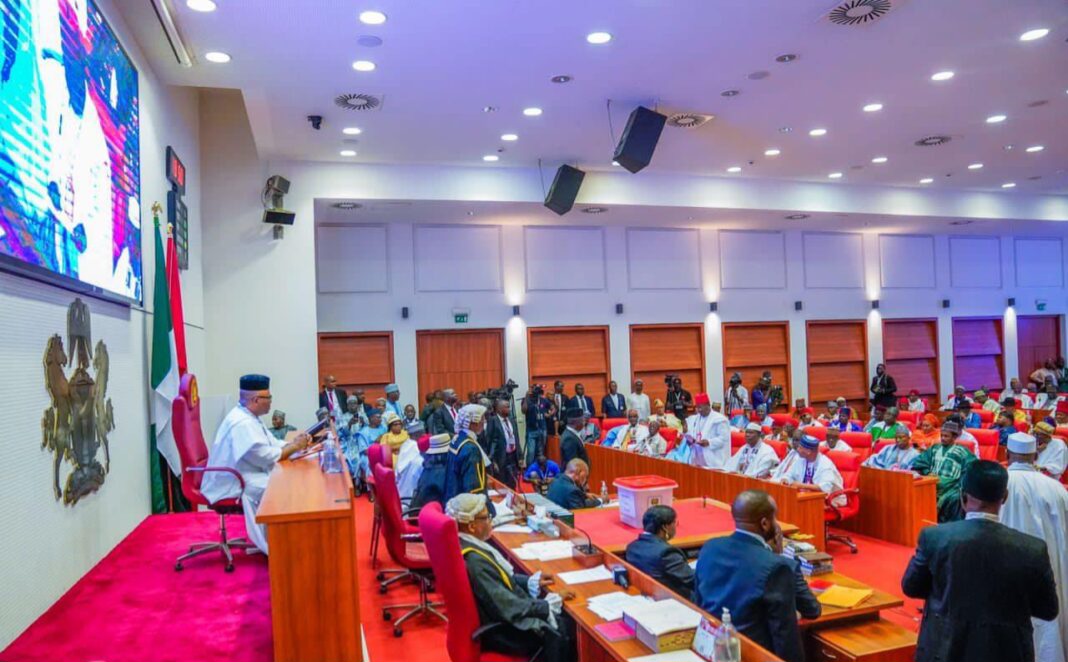
The Senate has ruled out amending the Electoral Act 2026 before the 2027 general elections, insisting that political parties must conduct their primaries and other electoral activities under the existing law.
Senator Yemi Adaramodu, Chairman of the Senate Committee on Media and Public Affairs, said the National Assembly would only consider reviewing the legislation after the elections if the need arose.
Adaramodu’s position comes amid renewed debate over party membership registers and candidate nomination procedures following a Supreme Court judgment that restored disputed provisions of the Electoral Act.

“We have already done the electoral reform and passed that one; it is meant for the 2027 elections,” he said in an interview with Saturday PUNCH.
“It is only after the elections that we can consider a review if there is any necessity or calls for amendments and rejigging.”
The senator urged anyone dissatisfied with the law to submit a petition to the Senate but maintained that the National Assembly would not reopen the legislation while preparations for the polls were underway.
He warned that changing the electoral framework at this stage could disrupt political parties’ preparations and candidate selection processes.
“Parties have used the law to produce candidates who are going to contest in January and February.
“So, are you now going to shift the goalpost in the middle of the game?” he asked.
The Senate’s position follows a unanimous judgment by a seven-member panel of the Supreme Court, which overturned a Court of Appeal decision declaring Sections 77(5), 77(6), 77(7) and 84(2) of the Electoral Act 2026 unconstitutional.
The apex court restored the provisions governing party membership registers and candidate nomination procedures, while setting aside the lower court’s decision nullifying aspects of the Independent National Electoral Commission’s timetable for the 2027 elections.
The Court of Appeal had ruled on a suit filed by the Zenith Labour Party, which challenged the provisions on the grounds that they interfered with the internal administration of political parties.
However, the Supreme Court upheld the statutory provisions regulating party membership records and nomination methods.
Sections 77(5), 77(6) and 77(7) restrict participation in party primaries, congresses and conventions to members whose names appear on the membership register submitted to INEC.
Section 84(2) provides for direct primaries and consensus as methods through which political parties can nominate candidates.
The Supreme Court ruling has renewed scrutiny of how the provisions will be enforced, particularly in disputes involving membership records, waivers and nomination processes ahead of the 2027 general elections.

- Google opens AI content detector to users worldwide - October 10, 2026
- Owerri airport faces 25-day closure for runway repairs - October 10, 2026
- 2027: Senate rules out Electoral Act review before elections - October 10, 2026