


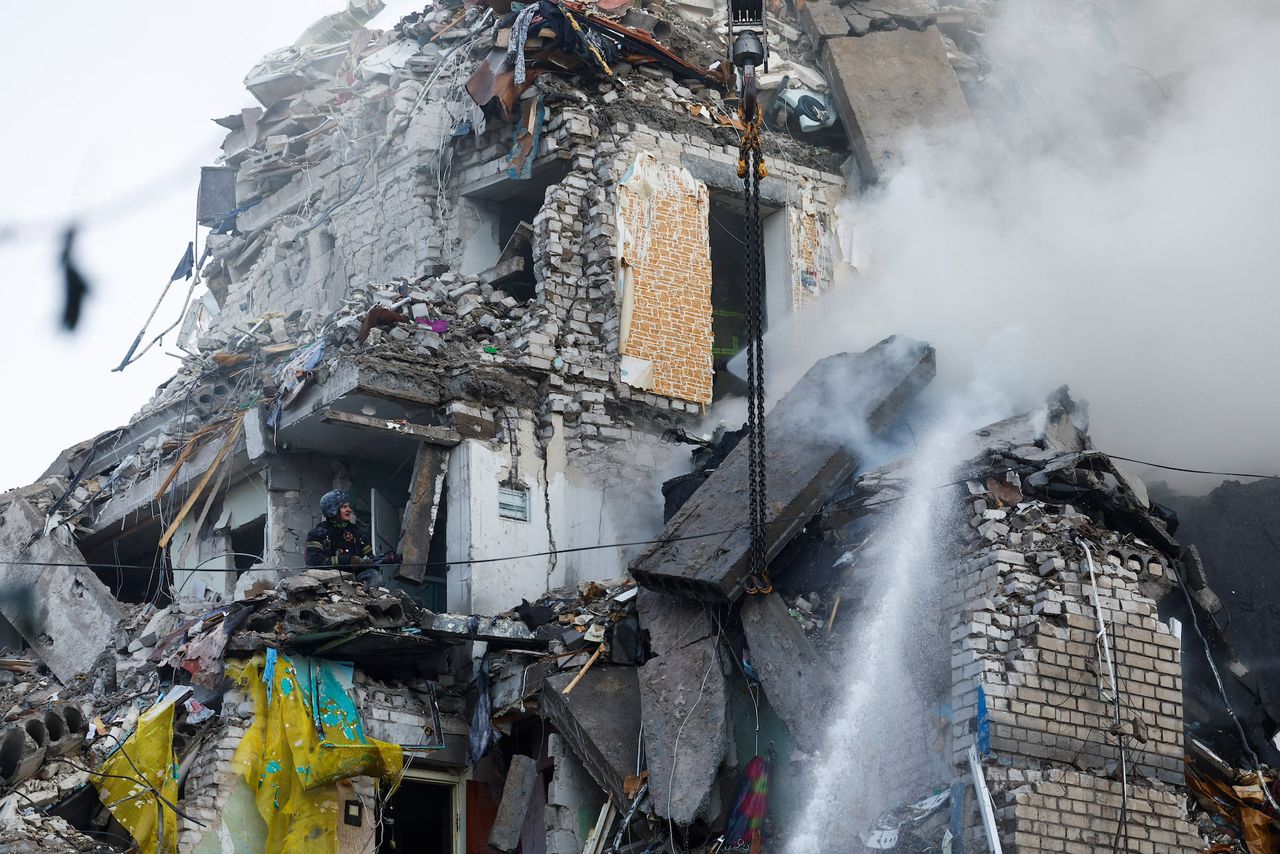
Russian strikes on a school distributing humanitarian aid have killed no fewer than 26 people, dashing fragile hopes of “progress towards peace” after a local ceasefire in the south expired without violations.
Russia resumed its strikes on the southern region of Kherson after the end of a ceasefire in the area, the longest truce in the war raging between the neighbours since Russia’s 2022 invasion.
A rare pause in the fighting, brokered by United States First Lady Melania Trump to enable a mission to the Russian-occupied city of Oleshky, ended on Sunday after starting on Tuesday, with neither side reporting breaches.
But hours after the truce, Russia targeted a village in Zaporizhzhia, adjacent to Kherson, with repeated strikes that killed at least 26 people on Monday, November 2, 2026.
Some of the dead had come to collect aid at a local school, AFP reported.
Footage posted by the Ukrainian emergency services showed the building reduced to piles of smouldering rubble and rescuers working at the site.
Ukrainian President Volodymyr Zelensky said in his daily address: “Every Monday, humanitarian aid was distributed to people there.
“The Russians carried out the first strike just as people arrived – several aerial bombs. Then, there was a repeat strike – more aerial bombs, this time targeting the shelter.”
Zelensky added that after the Oleshky truce, “there was a moment when the next steps could have shown that progress towards peace was possible”.
“With these killings, Russia is sending an entirely opposite signal: Russia is counting on more killings. There must be a response to this,” the president said.
Russia-Ukraine war: Zelensky seeks Europe’s support as ties with Trump deteriorate
Acting regional governor Mykhailo Semikin said among those killed were two rescue workers and four police officers.
The service named the rescuers as two 44-year-olds – Denys Konovalenko and Oleksy Sushchevsky.
“Every day, they went out to help people, working in dangerous conditions and risking their own lives to save others,” it said in a statement.
Russia has intensified its attacks this year, firing ballistic missiles and fast jet-powered drones, both of which are hard to intercept.
Moscow said an app belonging to its emergency situations ministry that also warns of attacks had been hacked.
The app is not widely used in Russia, where warnings of Ukrainian drone attacks are not as common and typically sent by text message in border regions.

- Google unveils free offline AI learning hub for Nigerians - November 3, 2026
- Shettima: Tinubu’s second term’ll be era of prosperity for Nigerians - November 3, 2026
- Russian strikes on school distributing humanitarian aid kill 26 in Ukraine - November 3, 2026