


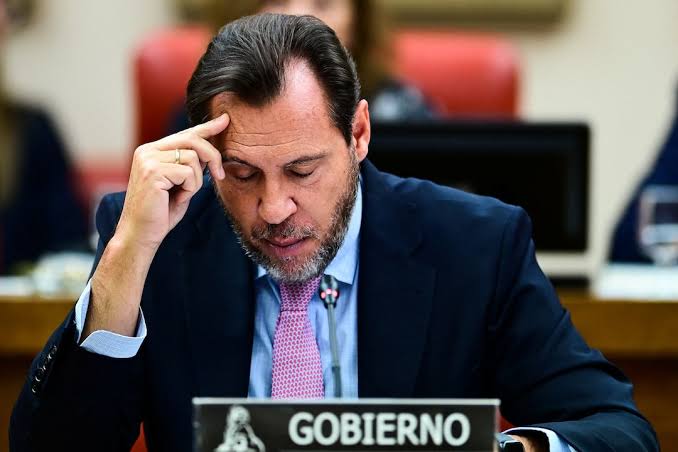
Spain’s transport minister Oscar Puente resigned on Tuesday, November 3, 2026, following a train crash that killed 69 people in the country.
The crash was one of the worst railway disasters in Europe this century and a blow for Prime Minister Pedro Sanchez ahead of a snap poll in November 2026.
Puente, who had earlier pledged to work “tirelessly” to restore confidence in the world’s second-largest high-speed rail network, also said he was withdrawing from the November 29 general election.
Last week’s crash, along with another disaster earlier this year, have overshadowed campaigning for the ballot, in which Sanchez is trailing in opinion polls.
A crash in Andalusia in January 2026 claimed 46 lives on the same key line connecting Madrid with the city of Seville, Spain’s first high-speed route when it opened in 1992.
Puente said: “A transport minister in a country like Spain cannot remain in office after two accidents of such seriousness in less than a year, however different they may be, whether or not I bear direct responsibility.
“I made my decision about my future in the first few minutes after the tragedy, as soon as I learned about it.
“Today I am making that decision public, in the place where it is most appropriate to do so.”
Hours earlier, at a press conference during which he presented measures to improve safety, the minister had said the government would “work tirelessly to achieve and regain the public’s trust in high-speed rail”.
Spain risks 30% tax on World Cup prize
The right-wing opposition, which had demanded Puente’s resignation, and unions have criticised him for appearing to pin all the blame for the disaster on one control centre operator.
The accident happened when a train operated by the state-owned Renfe ploughed into the back of a stationary train belonging to the private Spanish company Iryo on Wednesday outside the village of Urda, around 130 kilometres (80 miles) south of Madrid.
The failure of an automatic safety system halted all trains on a 63-kilometre stretch of track, but a control centre nonetheless authorised the Renfe service to resume its journey.
Among the measures announced at the earlier press conference by Puente was the creation of software for control centres that would issue automatic alerts and make it easier to spot anomalies in traffic.
The minister said an AI agent would be created to oversee the system and “minimise the possibility of human error”, describing the proposal as unprecedented.

- US midterm elections: Trump congratulates Democrats, blames Iran war - November 4, 2026
- ‘I drove taxi to pay school fees in US’: Tinubu recalls struggles, lauds N372bn student loan scheme - November 4, 2026
- ‘I’m not fit to be in office after 2 accidents’: Spanish transport minister resigns after deadly train crash - November 4, 2026