

The Federal Capital Territory Administration (FCTA) has defended the reduction of the University of Abuja’s land from 11,824.04 hectares to 4,685 hectares, revealing that Minister Nyesom Wike approved 4,519.80 hectares for the institution despite a previous recommendation limiting it to 100 hectares.
The FCTA said the 100-hectare recommendation was made by a joint committee established in 2016, which reviewed the university’s original land allocation and found it excessive compared with the National Universities Commission’s (NUC) recommended size.
In a statement on Monday, Wike’s Senior Special Assistant on Public Communications and Social Media, Lere Olayinka, described the protest by the university’s Joint Action Committee as misplaced.
Olayinka said the 12-member committee, inaugurated on November 10, 2016, included five representatives of the university and recommended reducing its land size to 100 hectares.
He said the report was subsequently approved by the immediate past FCT Minister, Mohammed Musa Bello.
However, Olayinka said Wike, upon assuming office, approved 4,519.80 hectares for the university, significantly exceeding the committee’s recommendation.
He argued that the allocated land was sufficient for the university’s expansion, estimating that it could accommodate more than 80,000 buildings if developed into plots of 500 square metres each.
The FCTA spokesperson also alleged that the university had allocated portions of its land to individuals and corporate organisations, including the Economic and Financial Crimes Commission, which he claimed received 100 hectares without recourse to the FCTA.
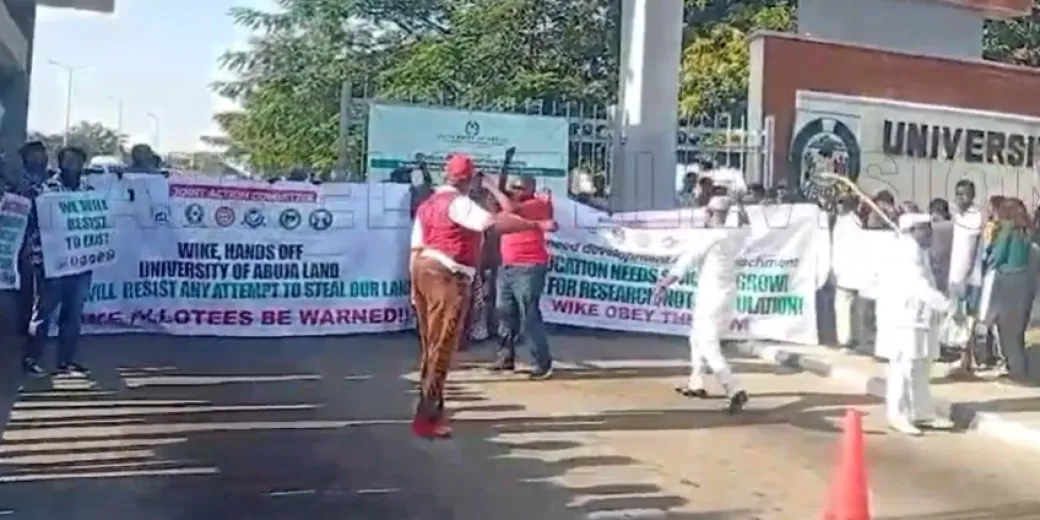
UniAbuja community protests land allocation, warns allottees to stay away
He challenged the protesting groups, comprising the Academic Staff Union of Universities, Senior Staff Association of Nigerian Universities, Non-Academic Staff Union of Educational and Associated Institutions, Students’ Union Government and alumni association, to justify the institution’s demand to retain more than 11,000 hectares.
Olayinka also questioned the university’s expansion achievements in its 38 years of existence, asking what developments justified retaining its original land size.
The FCTA maintained that the reduction would not affect the university’s academic activities or staff welfare, urging the protesting groups to disclose their interests in the land dispute.
The statement followed Monday’s protest by the university’s Joint Action Committee against the reduction of its land from 11,824.04 hectares to 4,685 hectares.

- Cat beats airport security, flies from Egypt to UK - November 16, 2026
- Drug-resistant infections could kill 39 million people by 2050 — WHO - November 16, 2026
- I once tried ingesting broken glass — Kunle Afolayan’s son - November 16, 2026