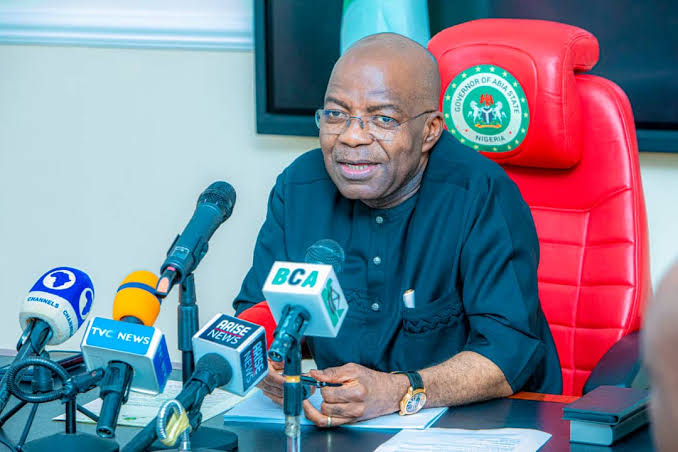
Abia State Governor Alex Otti has said his administration has replaced political considerations with merit and competence in the appointment of senior civil servants, insisting that public offices should be earned through demonstrated ability.
Otti disclosed this on Tuesday in Umuahia while speaking at an Executive Education Series organised by the Abia State Leadership Academy.
The programme, which focused on strengthening governance, ethical leadership and public service delivery, brought together public officials and other stakeholders to examine ways of improving the state’s administrative capacity.
The governor said the process for selecting Permanent Secretaries had been redesigned to make competence the primary consideration.
He recalled that the state advertised vacant Permanent Secretary positions in 2023, attracting 425 directors who underwent computer-based examinations and oral interviews.
According to him, the candidates were ranked according to their performance, with the best-performing candidate appointed Head of Service and other successful candidates selected as Permanent Secretaries.
Otti said the exercise was repeated after the retirement of the previous Head of Service, with the candidate who emerged top in the subsequent process appointed to lead the civil service.
He also cited the appointment of Benson, an indigene of Edo State, as Head of Service as evidence that his administration would not sacrifice competence for considerations of origin.
The governor said Benson had spent several years working in Abia after completing the National Youth Service Corps programme and subsequently built a career within the state civil service.
Otti argued that those who live and contribute to the development of Abia should be regarded as members of the state’s community, regardless of their state of origin.
He said sustainable development could only be achieved when public institutions were staffed by people with the competence, experience and integrity required to implement government policies.
Former Aviation Minister and ex-Corps Marshal of the Federal Road Safety Corps, Osita Chidoka, who delivered the keynote address, said a government’s policies would remain largely ineffective without a capable bureaucracy to execute them.
Drawing examples from China, Britain, Singapore, Rwanda and Nigeria, Chidoka said successful governments depended on institutions capable of translating political decisions into measurable outcomes.
He argued that public authority should be entrusted to people who had demonstrated competence, describing government as too important to be run casually.
Chidoka said China’s development offered lessons on the importance of merit-based public administration, while Singapore demonstrated how investment in human capital, planning, integrity and performance management could strengthen state capacity.
“Policy without execution just becomes a paper,” he said.
The former minister said Nigeria had previously demonstrated the ability to develop and implement ambitious national development plans, but weak institutions and poor implementation had often prevented such plans from achieving their full potential.
He urged Abia to ensure that its development programmes were supported by a professional civil service capable of maintaining reforms regardless of changes in political leadership.
Chidoka also criticised the growing reliance on contractors and consultants for responsibilities that should ordinarily be handled by properly trained public servants.
He said the weakening of technical expertise within government institutions had made it increasingly difficult for administrations to sustain projects and policies beyond the tenure of individual office holders.
“Behind every visible achievement of government lies an invisible chain of competence,” he said.
He further challenged political appointees to focus on building systems that would survive their departure rather than creating initiatives dependent on individual personalities.
According to him, reforms that disappear whenever a commissioner, governor or other political office holder leaves cannot be described as genuine institutional reform.
He described recurrent expenditure as an important component of effective governance, noting that overhead costs provide civil servants with the tools and infrastructure needed to perform their duties.
Chidoka said functional offices, electricity, transportation, internet connectivity and computers were necessary for public servants to deliver quality services.
He also stressed the importance of technology in reducing bureaucratic delays and improving government operations, citing his experience introducing digital systems during his time in public service.
The former minister warned that constructing physical infrastructure without building the human and institutional capacity required to operate it would limit the benefits to citizens.
“There is infrastructure we can photograph, and there is infrastructure that makes the photographed infrastructure actually work,” he said.
He also identified a potential disconnect between political appointees, whose tenures are relatively short, and career civil servants, who may spend decades within the public service.
Chidoka said political leaders should work deliberately to bridge the gap and create systems that preserve successful reforms after their departure.
He urged officials to incorporate effective reforms into government rules, procedures, performance standards and conditions of service rather than leaving them dependent on individual leaders.
Reflecting on his experience at the Federal Road Safety Corps, he said measures such as performance assessments, computer-based examinations, merit-based promotions and quality management systems had helped institutionalise reforms within the organisation.
He also commended the Abia Leadership Academy for developing young people across the state’s 17 local government areas, but said its ultimate success should be measured by the quality of leaders and institutions it produces over time.
Chidoka urged participants to view leadership as a responsibility to build institutions that would continue functioning after their tenure.
“Judge administration by what survives and performs after its founders have moved on, not by the eloquence of its founding purpose,” he said.
He added that the long-term objective should be to establish a public service capable of delivering results without constant intervention from political office holders.
“Build one in which the commissioner does not have to make the telephone call before something happens, and the governor does not have to intervene personally before the system works,” he said.
Chidoka said the experiences of China, Singapore, Rwanda, Britain and Nigeria demonstrated that strong institutions ultimately depend on capable people.
“There is no high capacity state without high-capacity people,” he said.
The Executive Education Series is part of the Abia Leadership Academy’s efforts to strengthen public-sector leadership, promote ethical governance and develop a pipeline of future leaders and public servants across the state.

- INEC omits PDP’s Adebutu, Pantami from final 2027 governorship lists - October 10, 2026
- US inmate who survived failed execution returns to prison - October 10, 2026
- South African great-grandmother jailed for 20 years over deaths of three children - October 10, 2026