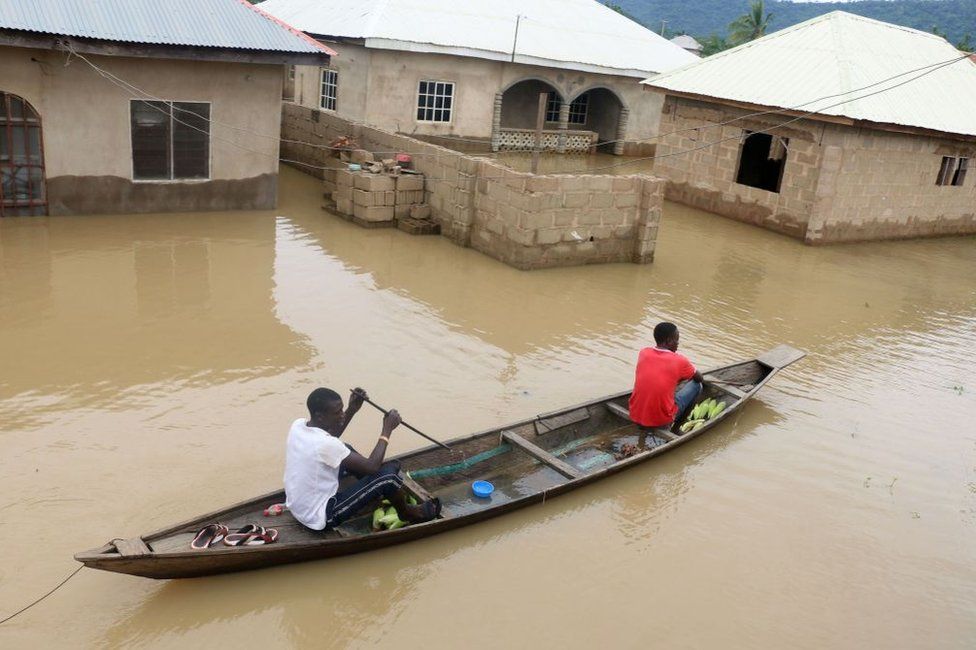
The Federal Government has declared that 33 states and the Federal Capital Territory (FCT), Abuja, will experience flooding in 2026, with 14,118 communities identified as high-risk nationwide.
The Minister of Water Resources and Sanitation, Prof. Joseph Utsev, announced this at the public presentation of the 2026 Annual Flood Outlook (AFO) by the Nigeria Hydrological Services Agency (NIHSA) in Abuja on Wednesday, April 15, 2026.
Utsev said the high-risk communities are located in 266 Local Government Areas based on scientific forecasts and hydrological assessments.
Utsev listed the affected states to include Abia, Adamawa, Anambra, Bauchi, Bayelsa, Benue, Borno, Cross River, Delta, Ebonyi, Edo, Enugu, Gombe, Imo, Jigawa, Kaduna, and Kano.
Others are Kebbi, Kogi, Kwara, Lagos, Nasarawa, Niger, Ogun, Ondo, Osun, Oyo, Plateau, Rivers, Sokoto, Taraba, Yobe, and Zamfara, including the FCT.
The minister said that 15,597 communities in 405 local government areas across 35 states would face moderate flood risk, while Ekiti remained the only state not affected.
He added that 923 communities in 77 local government areas across 24 states fell within the low flood risk category.
States in this category include Adamawa, Anambra, Bauchi, Bayelsa, Benue, Borno, Cross River, Delta, Ebonyi, Edo, Jigawa, Kaduna, Kano, Kebbi, Kogi, Nasarawa, Niger, Ogun, Ondo, Osun, Oyo, Sokoto, Taraba, and Zamfara,” he said.
Utsev warned of possible flash and urban flooding in major cities, including Abuja, Lagos, Port Harcourt, Ibadan, and Kano.
FG signs $1bn investment deal with India steel company
Utsev said coastal and riverine flooding is expected in Bayelsa, Cross River, Delta, Lagos, Ogun, Rivers, and Ondo due to rising sea levels and tidal surges.
“The AFO is not just a scientific report; it is a call to action. Early warning saves lives and reduces economic losses,” the minister stressed.
Utsev attributed increasing flood incidents to climate variability, rapid urbanisation, inadequate drainage infrastructure, and poor land-use practices.
He revealed that the federal government has been strengthening hydrological monitoring through improved data systems, automated river gauges, and advanced modelling techniques.
Utsev added that collaboration with the Nigerian Meteorological Agency (NiMet) and the National Emergency Management Agency (NEMA) were being enhanced to improve forecast accuracy and early warning dissemination.
The minister urged state governments to integrate flood risk considerations into land-use planning, urban development and infrastructure design.
He also called for improved drainage systems, effective floodplain management and stronger community preparedness to minimise impacts.

- Drama as man drags fiancée to court, seeks return of wedding gifts - September 8, 2026
- Yamal: I won’t beg for Ballon d’Or - September 8, 2026
- FULL LIST: Messi, Mbappe, Yamal make 30-man Ballon d’Or 2026 shortlist - September 8, 2026