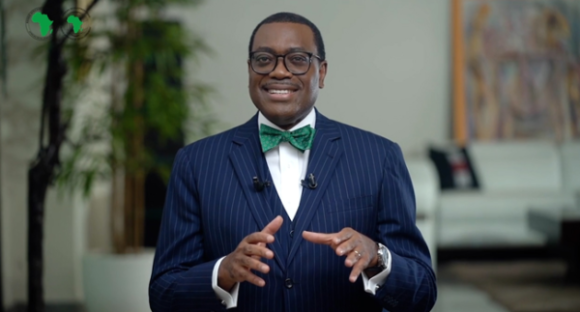

The outgoing President of the African Development Bank (AfDB), Dr Akinwumi Adesina, says 600 million people lack access to electricity in Africa.
Adesina said though Africa has some of the largest renewable energy sources, 600 million people lack access to electricity in the continent.
To bridge the massive energy deficit, the AfDB boss said the continent needs huge investment opportunities in the sector.
He made the assertions at the 2025 Standard Chartered Bank Africa Summit held recently in Lagos.
Adesina identified the renewable energy sources available in Africa as solar (11 Terawatts), hydro (350 gigawatts), wind (150 gigawatts), and geothermal (15 gigawatts).
He noted that unlocking these potentials will power massive industrial development for the continent, allowing it to be more competitive and expand value addition to its vast agricultural commodities, minerals and metals.
Adesina disclosed that the AfDB and the World Bank’s jointly launched Mission 300 has as a goal to connect 300 million people to electricity by 2030.
Adesina stated: “This requires public and private sector investments.
Sidi Ould Tah elected AfDB president
“The Energy Compacts for the first 12 countries total $127 billion, with over $61 billion expected from the private sector.”
To attract capital and investments into the sector and other infrastructure assets, the outgoing AfDB President noted that public-private partnerships should be expanded.
Also needed, according to him, are vehicles for preparing bankable project pipelines.
Speaking on United Nations Sustainable Development Goals (SDGs), Adesina said to achieve the goals by 2030, Africa also needs massive investments in infrastructure, energy and digital connectivity,
He added that there must be huge investments in roads and transport, social sectors including health, education, water and sanitation, as well as human capital.
He stated that the continent will need at least $1.3 trillion per year in financing.
Adesina said: “This will require the mobilisation of capital at several levels, including from domestic resources mobilisation, capital markets, private sector investments, concessional finance, and foreign direct investment.
“To achieve faster and more stable economic growth, Africa must move away from aid to investment to unlock its vast assets.”

- FG unveils learner identification number to boost education system - April 10, 2026
- FULL LIST: JAMB delists 23 CBT centres over technical deficiencies - April 10, 2026
- Tomato farmers predict steady price hike from May - April 10, 2026