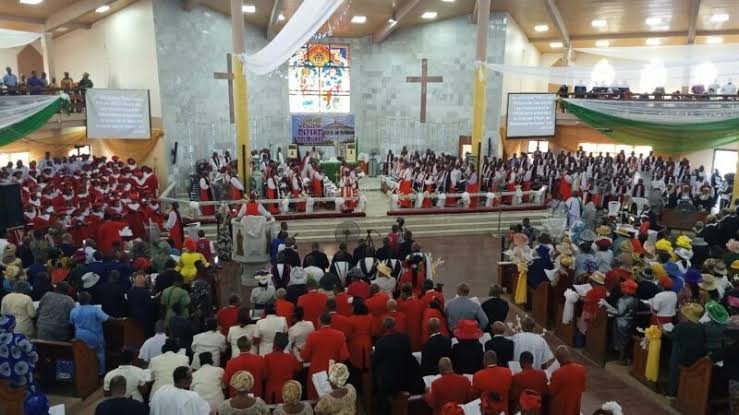
The Church of Nigeria, Anglican Communion, has issued guidelines for receiving politicians and government officials from speaking during church services and programmes.
The Anglican Church also warned against publicly praising such government figures.
The church made this known via a statement issued by the Primate, Most Rev’d Henry Ndukuba, on Saturday, July 12, 2025.
The decision was taken during the recent Episcopal Consultation held in the Diocese of Nike, Enugu State.
It aims to curb the increasing use of religious platforms for political messaging and to protect the integrity of Christian worship.
The new guideline is to ensure that the Church of Nigeria remains a place of worship, unity, and spiritual guidance, free from the distractions and divisions of partisan politics.
A notable protocol is the restriction on the use of Anglican Church’s lectern consecration for the reading of God’s Word by visiting dignitaries, reinforcing the sacredness of church spaces.
The Anglican Church acknowledged growing concerns about the increasing use of church gatherings as platforms for political messaging, which, according to the Primate, threatens to compromise the church’s neutrality and core values.
Akume confirms Odunuga’s appointment as special adviser
The memo, distributed to all parishes, emphasises the importance of welcoming all individuals, including public officials, while firmly maintaining the Church’s non-partisan stance.
According to the guidelines, any guest expected to address the congregation must first have a discussion with church leadership to ensure appropriate conduct.
Politicians and government officials are to be clearly informed that church platforms are not to be used for partisan speeches or political propaganda.
Church leaders are also instructed to avoid any statements or actions that could be interpreted as politically biased.
Officials are also cautioned against eulogising guests in a manner that might compromise the Anglican Church’s reputation or integrity.
Ndukuba reiterated the church’s commitment to inclusivity, stating that all individuals were welcome at services and events.
The cleric said: “However, it draws a clear line against any form of partisanship or conduct that could sow division among congregants.
“While affirming its role as a moral compass in society and its responsibility to engage with government authorities on issues affecting the faithful, the Church insists that its primary mandate remains spiritual.”

- Ireti Kingibe: ADC suspends FCT ward chairman, two others - March 16, 2026
- Adeola Akinremi unveils new poem Scattered Ground - March 16, 2026
- EPL: Tottenham strike late to stun Liverpool as Man United boost top-four bid - March 15, 2026