

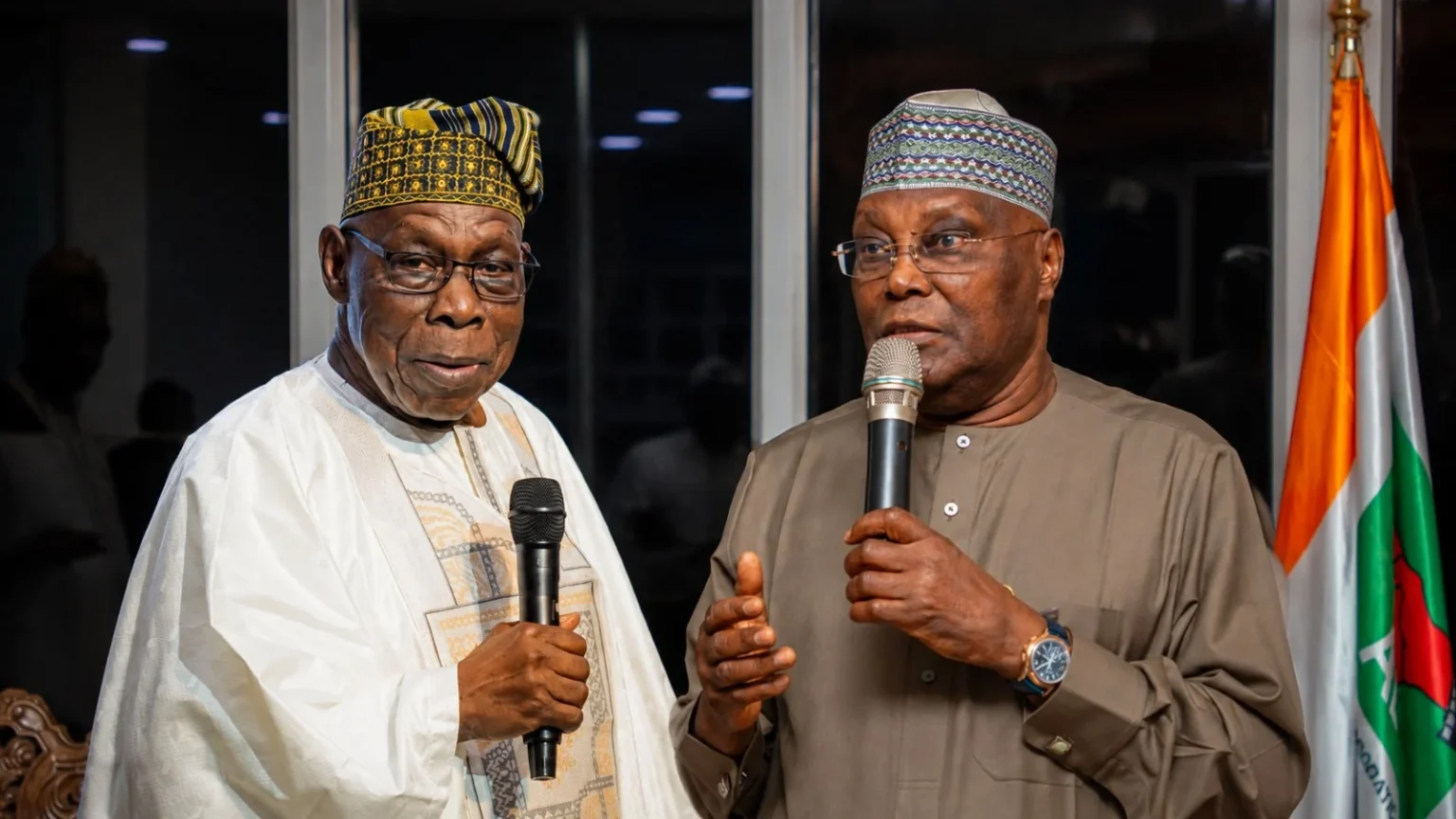
Former Vice President Atiku Abubakar has accused former President Olusegun Obasanjo of sustaining what he described as a 20-year campaign of “lies, political manipulation and orchestrated deceit” against him.
Atiku, through his Media Adviser, Paul Ibe, made the accusation on Sunday while reacting to Obasanjo’s recent claim that the former vice president mobilised the late Speaker of the House of Representatives, Ghali Na’Abba, to remove him from office during their 1999–2007 tenure.
Obasanjo reportedly made the allegation on July 23, reviving one of the long-running disputes surrounding his political relationship with Atiku.

Ibe, in a statement issued in Abuja, said Obasanjo had repeatedly revived allegations of betrayal and corruption against Atiku, particularly around election periods.
“This time, he chose to make a man who passed away nearly three years ago the subject of his baseless allegation,” Ibe said, referring to Na’Abba, who died in 2023.
He argued that the late speaker could no longer respond to the allegation and described the claim as malicious.
Ibe, however, cited former House of Representatives member Abubakar Bwari, who served as Chief Whip between 1999 and 2007, as contradicting Obasanjo’s account.
According to Bwari, Na’Abba never sought Obasanjo’s removal. He reportedly said Atiku, rather, acted as an emissary to lawmakers on behalf of the former president.
The Atiku camp also challenged claims surrounding the 2003 presidential election, citing former Abia State governor, Orji Uzor Kalu, who reportedly said Atiku appealed to PDP governors to support Obasanjo’s re-election.
“Atiku knelt down; we were like 17 governors. He knelt down for us and said that he does not want to be disloyal to Obasanjo,” Kalu was quoted as saying.
Ibe said Kalu’s account contradicted narratives allegedly promoted by Obasanjo’s camp that the former president had been forced to seek Atiku’s support for a second term.
According to the statement, Kalu also said Atiku had the backing of several PDP governors to pursue the presidency but declined to betray Obasanjo.
“Atiku was almost a President. We had gotten everyone to postpone the (PDP) convention and had gotten what we needed to move forward, but he said this man trusted him, and allowed him to work with him. That he cannot betray Obasanjo,” Kalu was quoted as saying.
Ibe further revisited the controversial investigation into the Petroleum Technology Development Fund (PTDF) shortly before the 2007 presidential election.
Obasanjo had asked the Senate to investigate alleged financial impropriety involving the fund, while Atiku denied wrongdoing and submitted himself for investigation.
The former vice president had maintained that the allegations were politically motivated and connected to his opposition to Obasanjo’s bid for a third term in office.
In seeking to challenge the narrative, Ibe cited accounts contained in the autobiography of the late Awujale of Ijebuland, Oba Sikiru Adetona, titled Awujale.
According to Ibe, the book detailed the Economic and Financial Crimes Commission’s treatment of businessman Mike Adenuga during the period and alleged that the investigation was connected to attempts to establish a link between Adenuga, Atiku and PTDF funds.
Ibe also rejected allegations that Adenuga used PTDF funds to finance the acquisition of Globacom’s operating licence, saying the businessman obtained financing from BNP Paribas Bank.
The statement further cited Oba Adetona’s account of Adenuga’s subsequent dealings with Obasanjo, including an alleged request by the former president for the businessman’s assistance with the construction of an administrative block at Bells University, founded by Obasanjo.
“Mike agreed, and Cachez Turnkey Projects Ltd handled the project for him,” the statement quoted the late monarch as writing.
Ibe said the account raised questions about what he described as the contrast between the former president’s public treatment of Adenuga and his alleged private dealings with the businessman.
The latest exchange is part of the longstanding political rift between Obasanjo and Atiku, whose relationship deteriorated during their second term in office.
The duo were political allies during the 1999 presidential election, when Obasanjo emerged as the Peoples Democratic Party candidate and selected Atiku as his running mate.
Although they secured re-election in 2003, disagreements later emerged over political succession, alleged corruption and Obasanjo’s controversial third-term bid.
Atiku subsequently left the PDP and contested the 2007 presidential election on the platform of the Action Congress after his relationship with Obasanjo collapsed.
The former vice president has remained active in opposition politics and is now the presidential candidate of the African Democratic Congress for the 2027 election.
Ibe said Obasanjo’s latest allegation should therefore be viewed against the background of their two-decade political conflict.
He accused the former president of repeatedly attempting to damage Atiku’s reputation, insisting that the latest claims would not withstand scrutiny.
Obasanjo has yet to publicly respond to the latest allegations contained in Atiku’s statement.
His Special Assistant on Media, Kehinde Akinyemi, when contacted for a reaction, simply said, “No comment.”

- I’ll lead Tinubu’s 2027 campaign in FCT, Rivers — Wike - September 25, 2026
- Ilenikhena, Usor strike as Nigeria overturn Madagascar in AFCON qualifier - September 25, 2026
- Man City found guilty of 114 Premier League charges, set to appeal - September 25, 2026