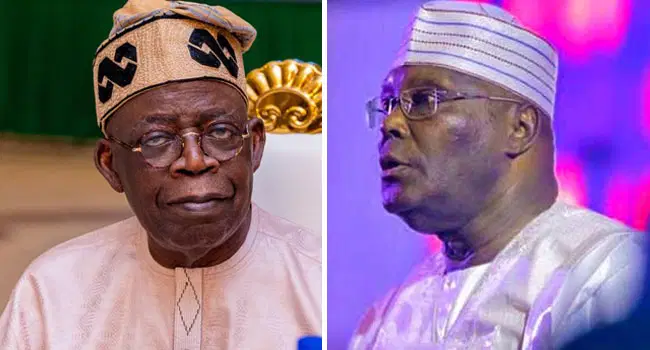

Former Vice President Atiku Abubakar has criticised President Bola Tinubu’s borrowing strategy, questioning why the Federal Government continues to accumulate domestic debt despite what he described as an estimated ₦7.98 trillion windfall from higher-than-budgeted international crude oil prices.
In a statement issued by his Senior Special Assistant on Public Communication, Phrank Shaibu, Atiku, the presidential candidate of the African Democratic Congress (ADC), described the administration’s economic management as contradictory, opaque and lacking fiscal discipline.
He noted that the Federal Government raised about ₦5 trillion from the domestic bond market in the first half of 2026, representing nearly 80 per cent of the amount borrowed during the same period in 2025.
According to Atiku, such borrowing would only be justifiable if government revenues had declined, arguing that rising global oil prices suggest otherwise.
He pointed out that while the 2026 Appropriation Act benchmarked crude oil at $64.84 per barrel, Brent crude averaged about $92 per barrel between March 1 and July 14, with Nigerian crude typically selling at a premium.
Atiku said the difference between the budget benchmark and prevailing oil prices translated into about $27.15 in additional revenue per barrel. Based on an average daily production of 1.5 million barrels over 135 days, he estimated the government earned an extra $5.76 billion, equivalent to about ₦7.98 trillion.
“This naturally raises two unavoidable questions. First, why is a government enjoying such an extraordinary oil windfall borrowing at almost twice last year’s pace as though the nation were in financial distress? Second, where is the money?” he asked.
The former vice president recalled that previous administrations maintained fiscal buffers, including the Sovereign Wealth Fund, to warehouse and account for excess crude earnings.
He also lamented that despite increased oil revenues and the removal of fuel subsidies, many Nigerians continued to face economic hardship, citing a recent United Nations report indicating that about 80 per cent of Nigerians could not afford a decent meal daily.
Atiku said an ADC-led government would adopt a rules-based fiscal framework to ensure that revenues earned above the budget oil benchmark are transparently managed and channelled toward debt reduction, infrastructure, healthcare, education and agriculture.
“Nigerians deserve answers. They deserve accountability. Above all, they deserve a government that manages national wealth in the public interest,” he said.
Atiku says Tinubu adopting his power reform proposal
In a separate statement, Atiku also claimed that the Tinubu administration had embraced a power sector reform proposal he first advocated more than 20 years ago.
He was reacting to recent remarks by the Minister of Power that Nigeria could no longer rely solely on large, centralised power plants to solve its electricity challenges.
According to Atiku, the position aligns with his long-standing advocacy for decentralised electricity generation using a mix of gas, hydroelectric, solar and other energy sources.
“It should not take a government three years in office to discover what was obvious more than two decades ago,” he said.
He criticised the administration for increasing electricity tariffs before implementing reforms capable of improving power supply.
Atiku recalled that while serving as vice president under former President Olusegun Obasanjo, he opposed the government’s heavy reliance on gas-fired electricity generation despite being appointed to chair the Power Sector Reform Committee.
He said he declined to lead the committee because he believed Nigeria required a diversified energy mix rather than dependence on a single source of power generation.
According to him, billions of dollars were committed to the reform programme, but the expected outcomes were not achieved despite substantial contract awards and payments.
Atiku added that although the National Assembly later investigated the power sector reforms, he was never invited because he had declined to chair the committee.
He maintained that Nigeria’s challenge was not a lack of ideas but a failure to implement the right policies at the appropriate time.