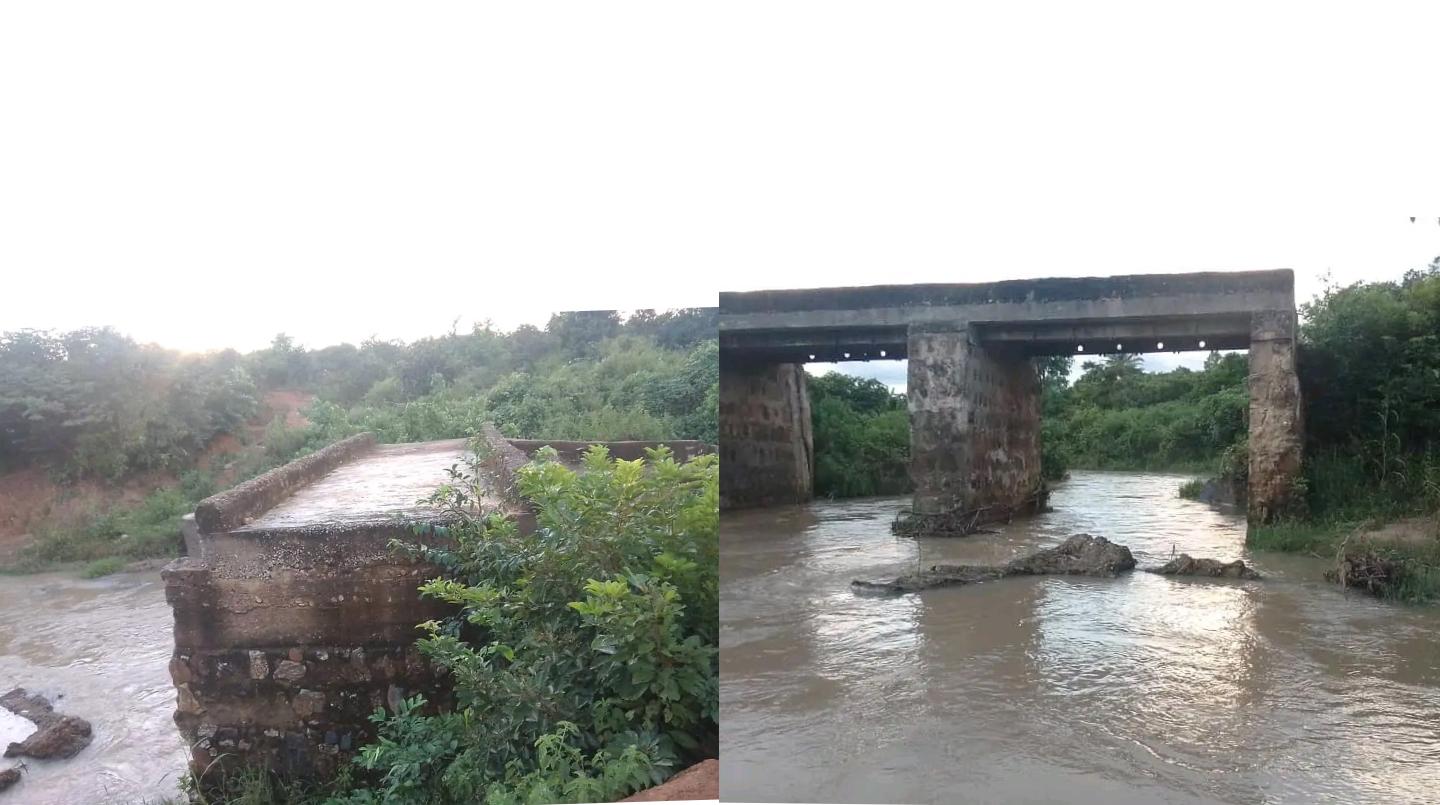
For more than three years, the only bridge linking several communities in Akwanga Local Government Area of Nasarawa State has stood broken above a fast-flowing brown river. Residents have been left to fend for themselves.
The bridge connects Gwanje By Hill College of Education to Angwan Ruwa, Ngazu, Ndoh, Kola, Nganche, Angre, Vereh and Numan Gona communities. Its collapse has cut them off from one another and from the services they rely on.
Photographs of the site show the concrete deck resting on stone-and-mortar piers, with one section fallen away on the riverbank side. Boulders and debris jut out of the muddy water.
On the other bank, thick weeds and shrubs have grown around the abutment, a sign of how long the structure has been left unrepaired.
For residents, the damage goes well beyond a broken crossing which has made it harder to reach healthcare facilities, schools, markets and other essential services, they told THE STAR.
A journey that should be routine now depends on the mood of the river, and the worry is greatest in the rainy season, when the water swells and crossing becomes riskier.
The roads leading to the bridge are also in poor condition, leaving the communities almost completely isolated from each other.
Residents who once moved freely between neighbouring settlements to trade, study or seek treatment now face longer, harder routes, or none at all.
The situation was highlighted by Tracka, a civic accountability initiative, in a post addressed to Governor Abdullahi Sule of Nasarawa State.
Tracka called on the Nasarawa State Government, the Federal Ministry of Water Resources, and the Federal Ministry of Works to facilitate the immediate reconstruction of the bridge and the rehabilitation of the connecting roads.
For the people of Gwanje, Angwan Ruwa, Ngazu and the other affected communities, the wait has now passed three years. Their concern is simple: that the next rainy season will find the bridge still broken, and that a sick relative, a schoolchild or a farmer heading to market will once again be left standing on the wrong side of the water.

- South African court orders Cadac pension curators to fix 20-year rules breach - September 30, 2026
- Broken bridge leaves Akwanga communities cut off for over three years - September 30, 2026
- Indian hospital features ex-Nigerian President Abdulsalami after knee replacement - September 30, 2026