


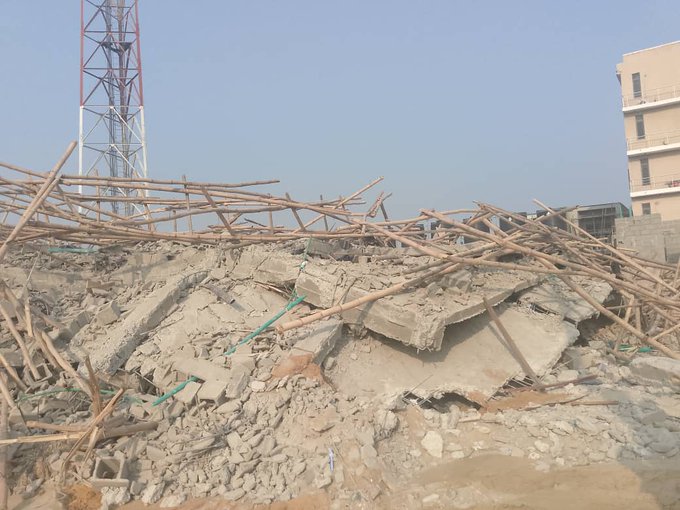
Nigeria lost an estimated N4.6trn to building collapses and fire incidents between 2022 and 2025, as poor construction practices, substandard building materials and weak regulatory enforcement continue to threaten lives and destroy businesses.
The figure represents an average annual loss of about N1.15trn in destroyed goods, properties and business assets, according to the Chartered Institute of Forensics and Certified Fraud Investigators of Nigeria (CIFCFIN).
The institute’s President and Chairman of its Governing Council, Dr Iliyasu Gashinbaki, disclosed this during the induction of the inaugural cohort of Certified Engineering Failure Forensic Investigation (CEFFI) professionals.
Gashinbaki said the financial losses, alongside the growing number of building collapses, highlighted the need for stronger investigations, accountability and enforcement of construction standards.
He cited a 2026 engineering study which identified 111 validated building-collapse incidents across Nigeria between 2015 and 2025.
According to him, the incidents resulted in 321 deaths and 344 injuries, representing an average of approximately 32 deaths and 34 injuries annually within the dataset.
The figures add to concerns over the safety of buildings across the country, particularly in urban centres where residential, commercial and public structures have collapsed, sometimes killing occupants and destroying livelihoods.
Federal Government figures cited last month indicated that Nigeria had recorded more than 650 building collapses, resulting in over 1,600 deaths since 1974.
Lagos, the country’s commercial centre, accounts for more than half of the recorded incidents, with major collapses in 2021, 2022 and 2024 claiming several lives.
Experts have repeatedly attributed building failures to substandard blocks and other construction materials, unprofessional building practices, inadequate supervision and attempts by developers to reduce costs.
Fire destroys 110 structures at Kano timber market
The Standards Organisation of Nigeria, state ministries of works and local councils are among the institutions responsible for regulating building materials and ensuring compliance with construction standards.
However, recurring incidents have raised questions about the effectiveness of their monitoring and enforcement mechanisms.
To address the problem, CIFCFIN, in partnership with the Council for the Regulation of Engineering in Nigeria (COREN) and the Nigeria Building and Road Research Institute (NBRRI), established the CEFFI initiative to strengthen investigations into engineering failures.
Gashinbaki said the programme would bring together engineering, forensic science, law, regulation and investigation to improve accountability whenever structural failures occur.
“Where there is suspected negligence, fraud, malpractice or deliberate compromise of safety, properly conducted forensic engineering can preserve the technical evidence required,” he said.
He urged regulators, project owners, contractors, professional bodies and law enforcement agencies to ensure that engineering failures did not end with repairs, abandonment or silence.
According to him, the country must move away from reactive responses towards evidence-based investigations capable of identifying negligence and holding those responsible accountable.
His concerns come amid fresh incidents of structural failures across the country.
Recently, one person was injured after a five-storey building under construction partially collapsed on Durban Street, Wuse II, Abuja.
The National Emergency Management Agency confirmed that the incident occurred at about 6:30pm on Saturday, October 17, 2026.
In a statement issued by its Press Unit, NEMA said its Abuja Operations Office received an alert and immediately activated relevant emergency response agencies.
The FCT Fire Service and the AYA Emergency Response Ambulance Bay team were among the agencies deployed to coordinate search and rescue operations.
The agency said no life was lost, while the injured worker was evacuated to a nearby hospital for treatment.
To prevent further incidents, experts have called for stronger criminal and civil liability for manufacturers, suppliers, contractors and professionals whose negligence or deliberate compromise of safety contributes to building failures.
They also advocated mandatory certification for block manufacturers, regular market sampling and laboratory testing of construction materials, as well as stricter checks on imported building products.
Local councils were urged to license and inspect block-moulding businesses, publish lists of certified producers and withdraw licences from repeat offenders.
The experts further called for mandatory physical inspections at critical construction stages, including foundations, lintels and roofing, rather than relying solely on documents submitted during building approval processes.
They said digital permit platforms showing inspection records and compliance status could also improve transparency and reduce opportunities for corruption.
They maintained that effective enforcement, independent investigations and prosecution of offenders were necessary to prevent avoidable deaths and protect investments in the country’s built environment.

- CBN reshuffles oil export terminals, appoints eight inspection firms - November 3, 2026
- North Korea denies involvement in $6.3bn Binance cryptocurrency theft - November 3, 2026
- Army destroys kidnappers’ camp in Kogi - November 3, 2026