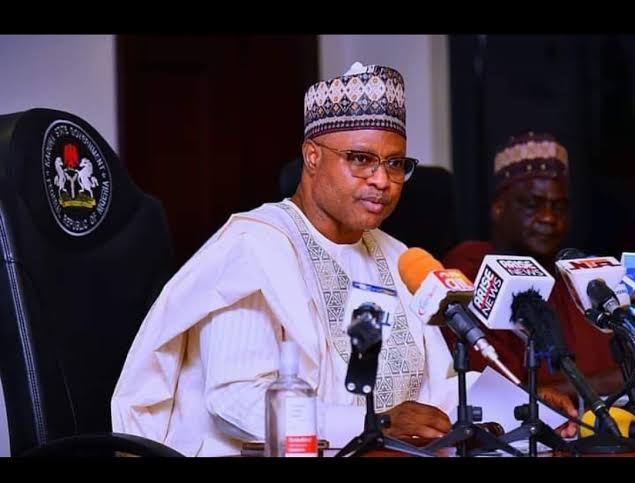

Kaduna State Governor, Uba Sani, has called for the adoption of reserved legislative seats for women, lamenting that their participation in Nigerian politics does not reflect their population size or voting strength.
The governor made the call on Thursday at the flag-off of the North-West zonal campaign for the Reserved Seats for Women Bill, which is part of the ongoing constitutional amendment process.
He noted that although women make up nearly half of Nigeria’s population and a larger proportion of active voters, they remain grossly under-represented in both elective and appointive offices.
According to him, women occupy less than five per cent of legislative seats at the national level, a situation he described as a result of long-standing structural, cultural, economic and institutional barriers rather than a lack of competence.
Governor Sani observed that the North-West has historically recorded low female participation in elective politics due to entrenched social norms, economic challenges and limited access to political networks.
However, he stressed that these challenges are not permanent and can change with deliberate institutional reforms and inclusive leadership.
He cited Kaduna State as an example of progress, noting that the state has recorded notable milestones in women’s political participation.
He listed the presence of a female Deputy Governor, a female member of the State House of Assembly who also serves as Majority Leader—the first woman to hold such a position in the North-West—as well as a female Head of Service and a female elected local government chairman in Jaba Local Government Area.
The governor added that women currently head key ministries and agencies in Kaduna State, including Health, Business Innovation, Youth Development and Women Affairs. He said these achievements show that women can win elections, lead effectively and command public trust when given equal opportunities.
According to him, the Reserved Seats for Women Bill aligns with global democratic best practices and seeks to address the persistent under-representation of women by creating constitutionally guaranteed spaces for them in legislative institutions.
He explained that the bill proposes the creation of 182 additional seats reserved exclusively for women across the National and State Assemblies.
These include one additional seat per state and the Federal Capital Territory (FCT) in the Senate, one additional seat per state and the FCT in the House of Representatives, and three additional seats per state in the State Houses of Assembly—one for each senatorial district.
Governor Sani emphasised that the bill does not remove existing seats but expands representation to promote inclusion.
He added that it is designed as a temporary measure to last four election cycles, or 16 years, after which it will be reviewed.
He also referenced countries such as Rwanda, Uganda, Kenya, Tanzania, Bangladesh and Zimbabwe, where similar mechanisms have produced positive outcomes.
Speaking at the event, the APC National Women Leader, Dr Mary Alile Idele, expressed concern over the steady decline in women’s representation in Nigeria’s National Assembly from 2003 to 2023.
She said women held about seven per cent of seats in 2003, which dropped to around six per cent in 2007, stagnated at about seven per cent in 2011, and fell further in subsequent years.
According to her, women have held fewer than five per cent of National Assembly seats since 2019, placing Nigeria among countries with the lowest rates of female political representation globally.
Dr Idele described the trend as alarming, noting that a democracy where half of the population accounts for less than five per cent of political representation is operating below its full potential.
She argued that the Reserved Seats for Women Bill would guarantee constitutionally protected political space for women, strengthen democratic inclusion, improve policymaking through diverse perspectives and inspire young women to participate in leadership.
She commended President Bola Tinubu’s Renewed Hope Agenda for prioritising inclusive growth, gender empowerment and national unity, stressing that the proposed bill should be seen as an investment in Nigeria’s future rather than a favour to women.