

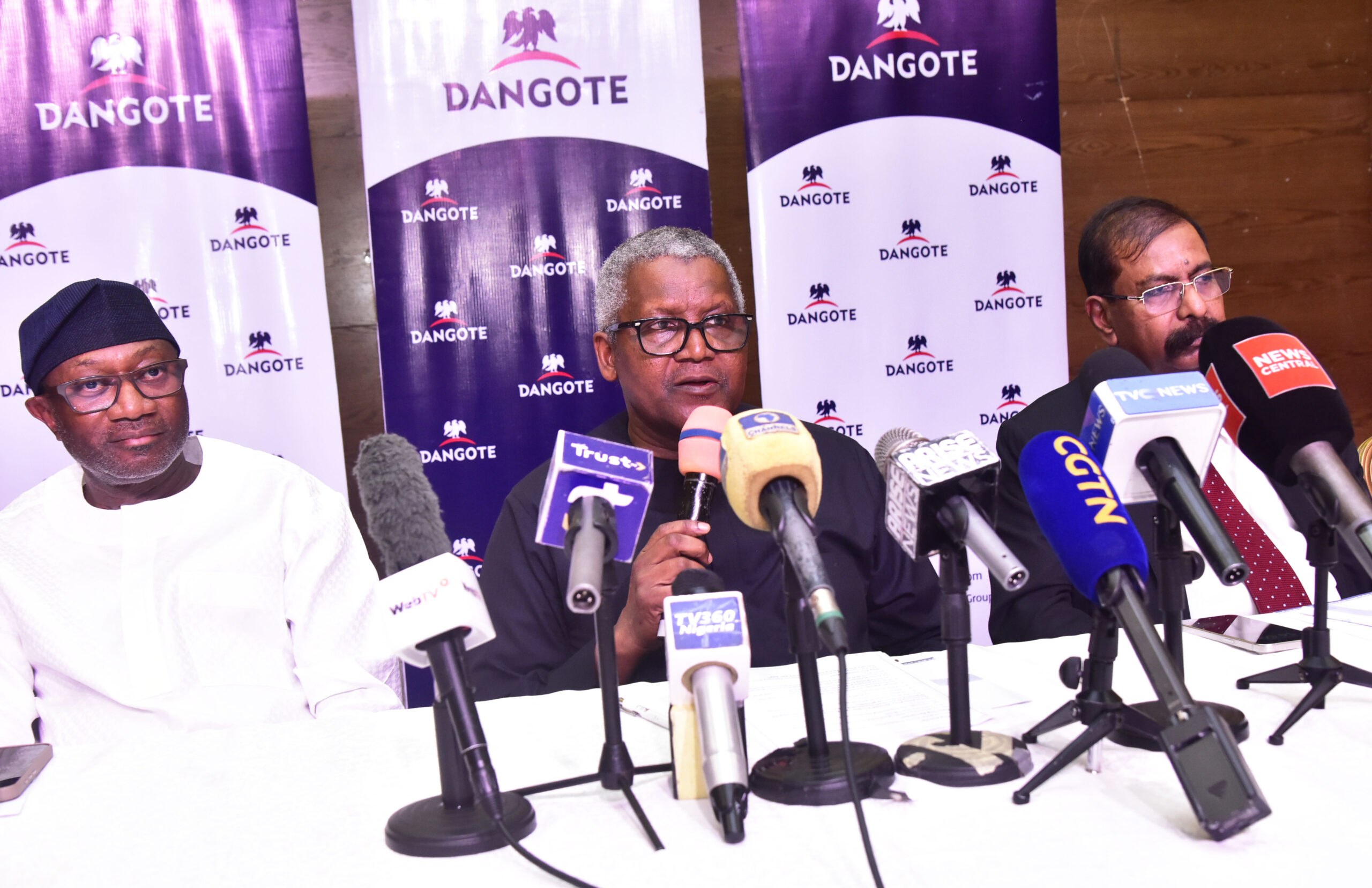
The Dangote Petroleum Refinery is set to become the largest in the world, as Dangote Industries Limited announced plans to expand its capacity from 650,000 barrels per day (bpd) to 1.4 million bpd within the next three years.
President of the Group, Aliko Dangote, made the disclosure during a media briefing in Lagos, explaining that the decision was driven by growing energy demand across Africa, opportunities in cleaner fuels, and Nigeria’s favorable policy environment.
“This expansion reflects our confidence in Nigeria’s future and Africa’s potential to achieve energy independence,” Dangote said.
“It is also a testament to President Bola Ahmed Tinubu’s vision under the Renewed Hope Agenda, which has encouraged industrial growth and investment.”
The $20 billion facility—already the largest single-train refinery globally—will surpass India’s Jamnagar Refinery when the expansion is completed, solidifying Nigeria’s position as a global refining hub.
According to Dangote, the expansion will be financed through internal cash flow, public listing, and strategic investors.
The refinery’s output of polypropylene will also increase from 900,000 to 2.4 million metric tonnes annually, while production of other petrochemicals such as linear alkylbenzene and base oils will also be scaled up.
“With this upgrade, we will produce Euro VI standard fuels that meet the highest global environmental benchmarks,” Dangote said, adding that the refinery will also expand its power generation capacity to 1,000 megawatts for full operational independence.
Dangote projected that annual revenue could exceed $55 billion, making the refinery one of Africa’s most valuable industrial assets.
He reaffirmed plans to list a significant portion of the refinery’s shares on the Nigerian Exchange (NGX) within a year, describing it as part of efforts to democratise ownership and enable Nigerians to share in its value creation.
“Our main listing will be here in Nigeria.
“We want the Dangote Refinery to be a national asset that empowers citizens and strengthens the market,” he said.
The business mogul emphasised that the expansion would create thousands of new jobs, boost small and medium-sized enterprises, and deepen Nigeria’s industrial base.
He credited President Tinubu and the National Security Adviser, Mallam Nuhu Ribadu, for supporting reforms such as Nigeria First, Naira-for-Crude, and the One-Stop Shop Initiative, which he said had strengthened investor confidence.
Dangote also praised government interventions that helped resolve recent refinery disruptions, calling it a sign of strong collaboration between the public and private sectors.
Despite not yet recouping the initial investment in the 650,000 bpd phase, Dangote said the project was a long-term bet on Africa’s future.
“Refining is a long-term venture, and we are expanding because we believe in Africa. Without this refinery, Nigeria would still be depleting reserves to import fuel,” he stated.
He noted that the refinery’s production of high-quality fuel had helped stabilise local supply, reduce toxic imports, and strengthen the naira.
“Nigerians today pay roughly half of what neighbouring countries pay for petrol, and our product quality surpasses even that of Saudi Arabia,” he said.
Assuring Nigerians of a stable fuel supply during the festive season, Dangote stated: “Despite recent global price spikes, there will be no fuel scarcity or price hike during the Christmas and New Year period. Nigerians can finally enjoy a fuel-anxiety-free holiday.”
He thanked the Federal and Lagos State Governments, host communities, and financial partners for their support, stressing that the expansion “is not just about capacity, but about confidence — in our people, our government, and our continent.”
Dangote urged other investors with refinery licences to emulate his example, noting that “when Africa builds its own refining capacity, it builds its own destiny.”

- Kaduna’s 36km Bagoma–Gagumi road to surpass Uba Sani’s previous record — KADRA MD - March 15, 2026
- SERAP urges Tinubu to probe ₦5.9bn spent on NNPC rebranding - March 15, 2026
- Bandits kill Zamfara college director after family paid ₦25.7m ransom - March 15, 2026