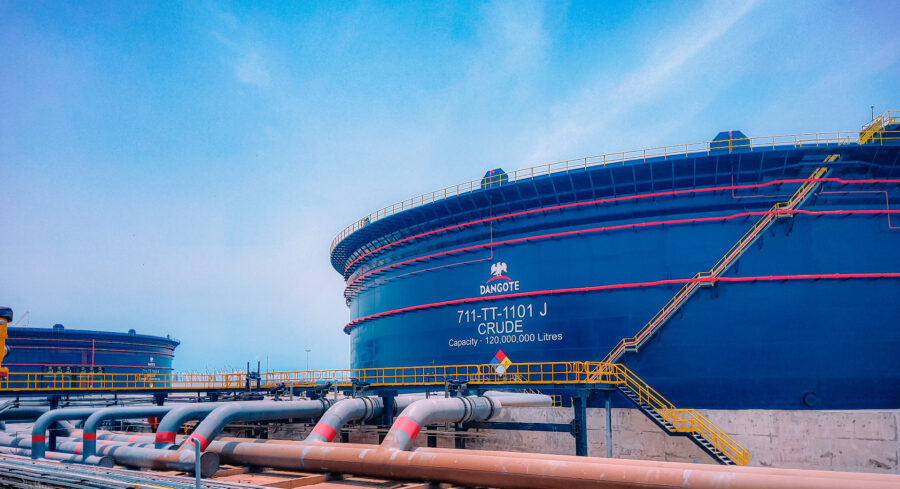
The fuel supply agreement between the Dangote Petroleum Refinery and 20 major petroleum marketers has collapsed following disagreements over pricing.
The deal, which provided for the offtake of about 600 million litres of petrol monthly, reportedly broke down barely a month after it was reached.
Industry sources said the disagreement contributed significantly to the sharp rise in petrol imports recorded in November 2025, when total import volumes jumped to 1.563 billion litres, according to data from the Nigerian Midstream and Downstream Petroleum Regulatory Authority (NMDPRA).
The import figures were contained in the NMDPRA’s November 2025 Fact Sheet on the state of the midstream and downstream sector, which showed a notable surge in imports during the period the pricing dispute escalated.
The arrangement, agreed in October 2025, was designed as a pilot scheme under which 20 selected depot owners would collectively lift about 600 million litres of petrol monthly from the Dangote Refinery, with each marketer taking roughly 30 million litres.
Confirming the initial agreement, the National Public Relations Officer of the Independent Petroleum Marketers Association of Nigeria (IPMAN), Chinedu Ukadike, had earlier said the deal followed a strategic meeting between the refinery and key downstream operators aimed at stabilising fuel supply and easing pump prices.
According to Ukadike, the plan involved limiting direct sales to only 20 primary marketers, who would then distribute products to other dealers, thereby reducing multiple layers of middlemen blamed for price distortions.
However, two industry sources noted that the agreement collapsed over the refinery’s reluctance to significantly adjust its gantry price in line with falling international petrol benchmarks. Under the deal, prices were to be reviewed monthly.
One of the sources said the initial price was set at N806 per litre for coastal delivery and N828 per litre at the gantry.
As part of the agreement, Dangote temporarily restricted direct sales to independent marketers, who could only lift small volumes and had to rely on the approved 20 marketers for supply.
The arrangement reportedly worked smoothly in October, with products supplied via ships and gantries.
Problems emerged in November when international petrol prices fell below Dangote’s selling price, making imports more attractive.
“Importers saw that international benchmark prices had dropped to around N750 per litre, but Dangote was reluctant to review its price accordingly.
“This led to a surge in imports in November,” one source said.
Although the refinery later reduced its gantry price to N699 per litre—the lowest recorded in 2025—the move reportedly came too late.
Marketers and depot owners who had bought products at higher prices were left with losses, while smaller marketers struggled to adjust.
Market data from the Major Energies Marketers Association of Nigeria (MEMAN) showed that the average landing cost of imported petrol fell to N829.77 per litre by late October, lower than Dangote’s ex-depot price at the time. By October 24, Dangote’s gantry price reportedly stood at N877 per litre.
The dispute also reportedly spilled into a public confrontation between Dangote and the former Authority Chief Executive of the NMDPRA, Farouk Ahmed, over the issuance of import licences.
That conflict later culminated in Ahmed’s resignation in December 2025.
Confirming the breakdown, the Chief Executive Officer of petroleumprice.ng, Jeremiah Olatide, said the pricing mechanism was tied to Eurobob, the international benchmark for gasoline, with an understanding that prices would be adjusted monthly based on global crude oil movements.
According to him, while Dangote implemented a price reduction after the first month, it did not match the drop in international prices, prompting marketers to return to imports.
“Yes, the agreement has collapsed. Importation surged in November, and when Dangote noticed this, he slashed the price from N828 to N699 per litre.
“But by then, the relationship with depot owners had already broken down,” Olatide said.
IPMAN’s Ukadike also confirmed that the agreement was no longer in force, noting that the refinery has now liberalised sales.
“Dangote has opened the market. Marketers can now buy products directly, even in small volumes of about 250,000 litres.
“It’s a market strategy to avoid distribution bottlenecks and artificial price hikes,” he said.
He added that tensions were worsened by allegations that some marketers continued importing fuel despite signing the October agreement, undermining its exclusivity.
For now, the refinery has reverted to open-market sales, offering petrol to any interested marketer regardless of volume. Dangote’s spokesperson, Anthony Chiejina, did not respond to requests for comment.
Meanwhile, fresh market data indicate that the spot price of imported petrol has dropped to about N696 per litre at the Apapa jetty, slightly below Dangote’s current gantry price of N699 per litre, according to MEMAN.
The decline has been attributed to lower international crude prices, reduced shipping costs, and a stronger naira, which traded around N1,419 to the dollar.
MEMAN noted that similar downward pressure has been recorded in diesel and kerosene prices, reinforcing competitive dynamics in the downstream market.

- Explosions erupt across Tel Aviv as Iran fires missiles - March 6, 2026
- C’River assembly suspends lawmaker over domestic assault - March 6, 2026
- US grants short-term waiver for stranded Russian oil sales to India - March 6, 2026