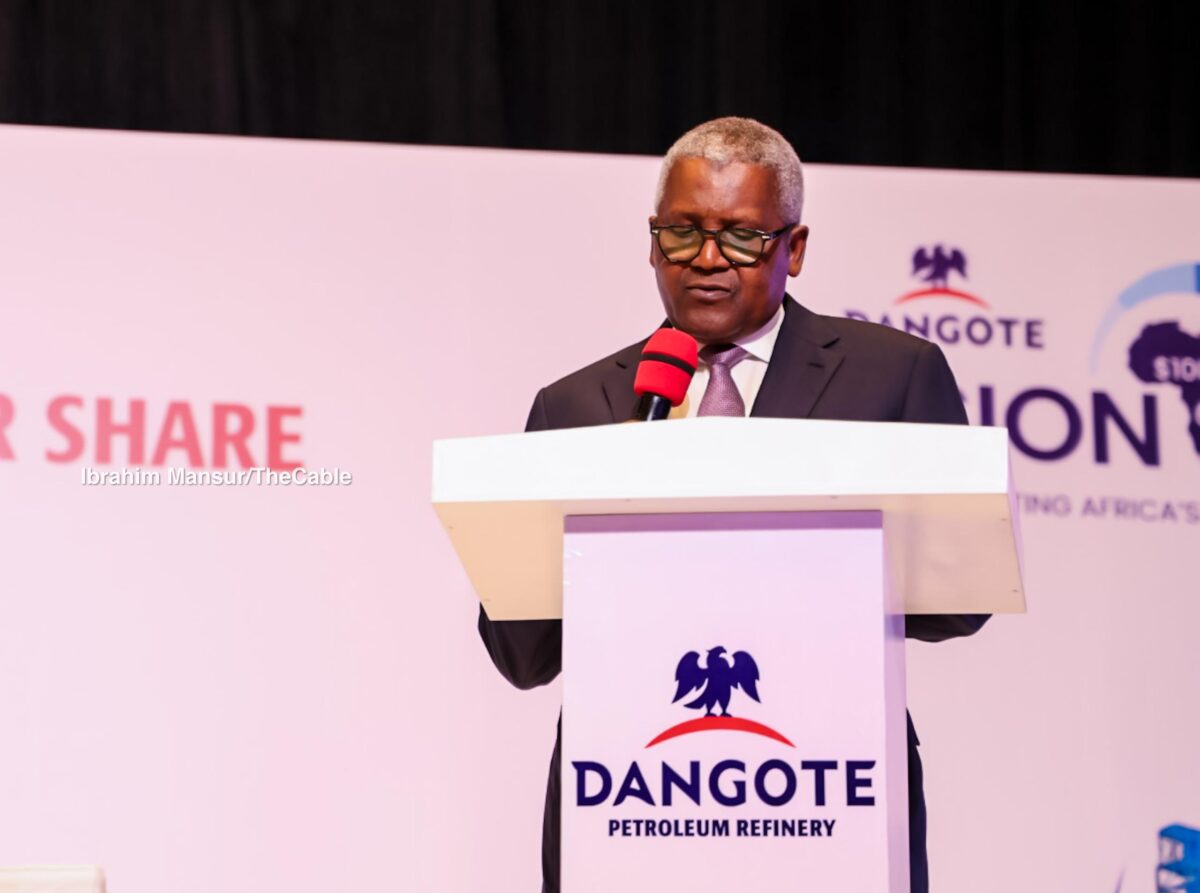
Dangote Industries Limited President, Aliko Dangote, has projected that shares of the Dangote Petroleum Refinery could rise from the current offer price of N525 to as much as N10,000 in the future.
Dangote also said small-scale investors would receive priority in the allocation of shares under the refinery’s planned Initial Public Offering.
He made the remarks in Hausa during an interview with Abis Fulani, translated using Google Gemini. The interview, published on Thursday, gained wider attention on Saturday.
Explaining the proposed share allocation, Dangote said retail investors would be prioritised over large institutional investors, particularly where demand exceeds the available shares.
He said investors seeking to purchase shares worth N50,000, N100,000 or other relatively small amounts would receive priority, while institutional investors seeking large allocations might not receive their full requests.
“When you do something like this—what is called an IPO—all the small-scale investors are the ones who will be given priority first,” he said.
“The big institutional investors who request large allocations will not get everything they ask for. But the small retail investors who want to buy N50,000 worth, or some buying N100,000 worth, and so on, they are the ones who will be given priority allocations.”
Dangote said the remaining shares would then be allocated among other investors.
He also pointed to the potential long-term value of the investment, saying the current N525 offer price could appreciate significantly.
“As I was saying, this share, if you look at it, we are currently at N525. A day will come when this share will reach N10,000,” he said.
He illustrated the potential gain by saying an investor who put N5m into the shares could see the value rise to more than N50m if the share price eventually reached N10,000.
However, such a projection does not guarantee that the shares will attain that price or that investors will make a profit.
Dangote also highlighted the proposed dividend structure, saying shareholders could have the option of receiving dividends in either naira or US dollars.
According to him, the dollar option could provide a measure of protection against the impact of naira depreciation, particularly for Nigerians with financial obligations overseas.
He cited parents with children studying in the United Kingdom as an example, saying dollar-denominated dividends could help reduce the effect of exchange-rate fluctuations on their expenses.
Dangote recalled the naira’s depreciation from about N400 to the dollar to around N1,800, saying the sharp change had placed significant pressure on families with foreign-denominated obligations.
“So your child won’t have to… avoid exchange rate shocks, like when rates moved from N400 up to N1,800,” he said.
“Most children were brought back home as a result. So what we want to prevent is that kind of situation.”
The Dangote Refinery IPO comprises 4.1 billion ordinary shares priced at N525 each. If fully subscribed, the offer is expected to raise about N2.15tn.
The minimum subscription is 10 shares, costing N5,250, while the offer is scheduled to run from September 14 to October 13, 2026.
Investors will be notified of their allotments after applications are processed. However, submitting an application for a particular number of shares does not guarantee that the investor will receive the full amount requested, especially if the offer is oversubscribed.
The shares are expected to be listed on the Nigerian Exchange Main Board after the allotment process, after which their market value will be determined by prevailing demand and supply.
The proceeds from the IPO are expected to support the refinery’s expansion plans, including an increase in its refining capacity from about 650,000–700,000 barrels per day to 1.4 million barrels per day.
While Dangote has projected a potential future price of N10,000, the N525 offer price carries no guarantee of future returns. Once listed, the share price could rise or fall depending on the refinery’s financial performance, refining margins, investor sentiment, demand and broader economic conditions.

- Woman seeks refund of N1.64m mistakenly sent to Pastor Jerry’s church - September 12, 2026
- King’s College remains public despite concession — FG - September 12, 2026
- Man arrested for attempting to sell 16-month-old daughter - September 12, 2026