


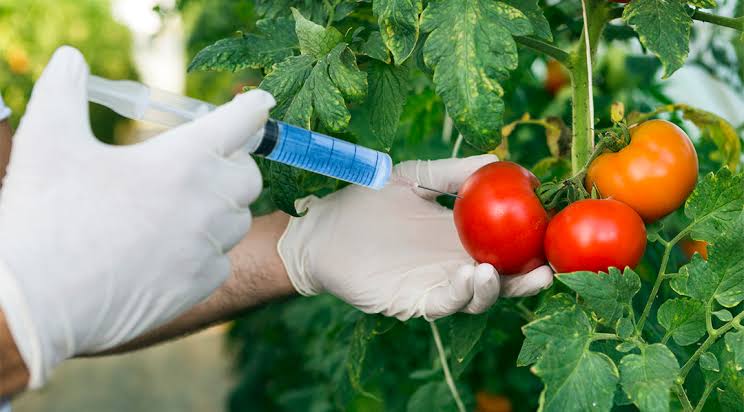

The Federal Government has assured Nigerians that the adoption of Genetically Modified Organisms (GMOs) and related products poses no danger to public health, stressing that the technology is being deployed to strengthen food security, improve nutrition, and boost economic resilience.
Dr. Rose Gidado, Director of the Agricultural Biotechnology Department at the National Biotechnology Research and Development Agency (NBRDA), gave the assurance on Wednesday at a sensitisation workshop for directorate officers of the Federal Ministry of Health and Social Welfare (FMOH/SW) in Abuja.
The workshop, organised by the Open Forum on Agricultural Biotechnology (OFAB), Nigerian chapter, in collaboration with NBRDA, aimed at improving understanding of biotechnology and its role in tackling food insecurity.
Responding to public concerns, Gidado said fears that GMOs were harmful or poisonous were unfounded.
“We cannot give poison to our own people.
“Nigerian scientists working in this field are also consumers, and safety is never compromised,” she said, noting that GMOs have been safely used for over 30 years in more than 45 countries.
She explained that Nigeria’s biosafety framework, regulated by the National Biosafety Management Agency (NBMA), ensures that biotechnology products undergo rigorous safety checks before release.
Dr. Angarawai Ignatius of the International Crops Research Institute for the Semi-Arid Tropics (ICRISAT-NG) added that biotechnology helps improve weak crop traits, making them more resistant to pests, diseases, and climate shocks, while reducing dependence on pesticides.
Prof. Abdullahi Mustapha, Director-General of NBRDA, represented by Dr. Oyedele Julius, said Nigeria’s approach to biotechnology is “robust, transparent, and science-driven,” aligned with global standards.
He noted that the country has already approved insect-resistant and drought-tolerant maize varieties to tackle food shortages.
“Reduced crop losses mean more stable food supply, lower prices, and improved nutrition.
“The safe deployment of biotechnology aligns with President Bola Tinubu’s Renewed Hope Agenda on food security and economic revival,” he said.
Mrs. Olubunmi Aribeana, Director of Food and Drug Services at FMOH/SW, represented by Dr. John Atanda, stressed that every GMO product must undergo strict risk assessments — including allergenicity, nutritional value, long-term health effects, and environmental safety — before approval.
She added that labelling and traceability would be enforced to build consumer confidence.
Other experts, including Prof. Emmanuel Kwon-Ndung of the Federal University, Lafia, acknowledged that opposition to GMOs often stems from political, ethical, or social concerns rather than scientific evidence, underscoring the need for continuous public education.
The workshop, according to organisers, is expected to deepen awareness of modern biotechnology, build confidence in Nigeria’s regulatory system, and promote evidence-based policymaking in health and agriculture.
The push for biotechnology comes amid growing food insecurity in Nigeria, where experts warn that traditional farming methods alone may not meet the demands of a population projected to surpass 240 million.

- Explosions erupt across Tel Aviv as Iran fires missiles - March 6, 2026
- C’River assembly suspends lawmaker over domestic assault - March 6, 2026
- US grants short-term waiver for stranded Russian oil sales to India - March 6, 2026