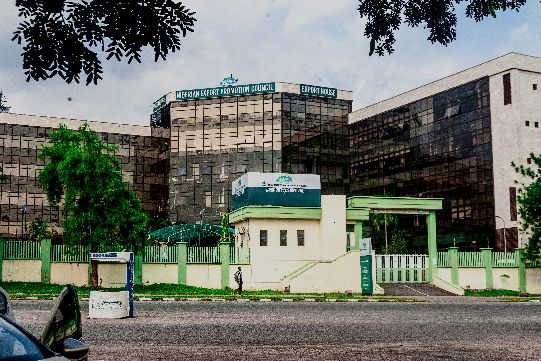
The Federal Government has earmarked N881.13 million for capital projects under the Nigerian Export Promotion Council (NEPC) in the 2026 Appropriation Bill, as part of efforts to deepen non-oil exports and diversify the country’s foreign exchange earnings.
Details from the proposed 2026 budget submitted to the National Assembly show that the allocation will fund institutional strengthening, export infrastructure, certification, market access, and value-chain development across the six geopolitical zones.
The funding forms part of the proposed N58.47 trillion federal budget and follows Nigeria’s record non-oil export earnings of $6.1 billion in 2025 — the highest since the NEPC was established nearly five decades ago.
A breakdown of the capital vote shows that N143.99 million was set aside for the establishment of export clusters, aggregation centres, and hubs nationwide, while N133 million will go toward common facility centres and export skills acquisition centres in four zones to support key regional products.
The government also allocated N84 million for institutional strengthening to improve NEPC’s operational efficiency.
Other provisions include N77 million for certification support for exporters and small businesses under the “Go Global, Go Certification” initiative, and N70 million each for implementing the African Continental Free Trade Area (AfCFTA), participating in international trade fairs and missions, and promoting digital trade and e-commerce to enhance SME market access.
Additionally, N63 million was earmarked for a trade development facility for sesame seed and cowpea exports, N49 million for the licensing and operationalisation of domestic export warehouses, and N42 million to boost non-oil exports through formalising informal cross-border trade and supporting women- and youth-led enterprises.
Lower allocations include N21 million each for asset verification and computerisation at the council’s headquarters and for digital advertising to promote non-oil exports across Abuja and the regions. A further N37.14 million will support improved accounting and financial management systems.
Speaking on the export performance, NEPC Executive Director and Chief Executive Officer, Nonye Ayeni, said the $6.1 billion figure, based on pre-shipment inspection data, represented an 11.5 per cent increase over the $5.4 billion recorded in 2024.
“This marks the highest non-oil export value achieved in the country since the inception of the council,” she said, noting that exports covered agricultural commodities, processed and semi-processed goods, industrial inputs, and solid minerals. She added that Nigeria exported 281 non-oil products in 2025 but acknowledged that a significant volume of trade still occurs informally across land borders.
Industry stakeholders welcomed the allocation and the growth in exports, while calling for greater emphasis on value addition and clearer data breakdowns.
The Director-General of the Manufacturers Association of Nigeria, Segun Ajayi-Kadir, described the funding as a positive step but stressed the need to focus on processed and manufactured exports.
“What is most critical is whether those non-oil export items have added value, because that is what creates jobs and ensures sustainability,” he said.
Similarly, the National Vice President of the National Association of Small-Scale Industrialists, Segun Kuti-George, praised the NEPC’s support for micro, small and medium enterprises through training and participation in international exhibitions.
“It is good news that Nigeria is taking non-oil exports more seriously. The NEPC has been exposing our entrepreneurs to markets within and outside Africa, which is encouraging,” he said.
The government’s latest funding push is seen as part of broader efforts to reduce reliance on crude oil and strengthen Nigeria’s export competitiveness.

- SSANU president raises the alarm over hardship in Eid message - March 20, 2026
- Nigeria advances $20bn gas pipeline plan to Europe - March 20, 2026
- NYSC official arrested over death of pregnant corps member - March 20, 2026