


The Federal Government has identified improved access to capital for women-led businesses as a key strategy to unlock Nigeria’s industrial growth and accelerate opportunities under the African Continental Free Trade Area (AfCFTA) framework.
The Minister of Industry, Trade and Investment, Jumoke Oduwole, disclosed this during a high-level policy dialogue held in Abuja on Friday to commemorate International Women’s Day.
Oduwole said Nigeria’s ambition to build a $1 trillion economy by 2030 would be difficult to achieve without unlocking the full potential of women entrepreneurs. According to her, women-owned businesses across Africa face a financing gap exceeding $49 billion, limiting their ability to expand and compete in continental markets.
Speaking at the event themed “Give to Gain,” the minister noted that women already play significant roles in sectors such as agriculture, trade, manufacturing, services and logistics but remain constrained by limited access to funding.
She explained that the AfCFTA connects 1.4 billion people in a single market valued at about $3.4 trillion, making it one of the largest integrated markets globally. However, she stressed that the economic impact of the agreement would depend on businesses being able to scale operations across borders.
Oduwole noted that despite Africa’s vast market and more than 200 million businesses, only about 345 companies generate over $1 billion in annual revenue, with roughly 20 of them located in Nigeria, highlighting the need to strengthen business competitiveness across the continent.
The minister also pointed out that female-founded companies receive less than 10 per cent of venture and growth capital deployed across Africa, describing access to finance as the biggest constraint facing women entrepreneurs.
She said new frameworks under AfCFTA, including the Protocol on Women and Youth in Trade and the Protocol on Digital Trade, were designed to improve market access and financing opportunities for women and young entrepreneurs.
Oduwole revealed that Nigeria is already taking steps to domesticate these protocols through programmes aimed at preparing women-owned enterprises to access capital and participate in international trade.
She added that Nigeria’s ongoing economic reforms were beginning to attract investment and boost trade expansion, noting that the country recorded $21 billion in capital importation within the first 10 months of 2025, while non-oil exports surpassed $6.1 billion during the same period.
According to her, the government is also pursuing several strategic trade partnerships, including the U.S.-Nigeria Commercial and Investment Partnership, the U.K.-Nigeria Enhanced Trade and Investment Partnership, and the Comprehensive Economic Partnership Agreement with the United Arab Emirates, to expand market access and attract foreign investment.
Also speaking at the event, the Minister of Women Affairs, Imaan Sulaiman‑Ibrahim, stressed that harnessing AfCFTA opportunities requires gender-responsive policies that remove barriers limiting women’s participation in trade.
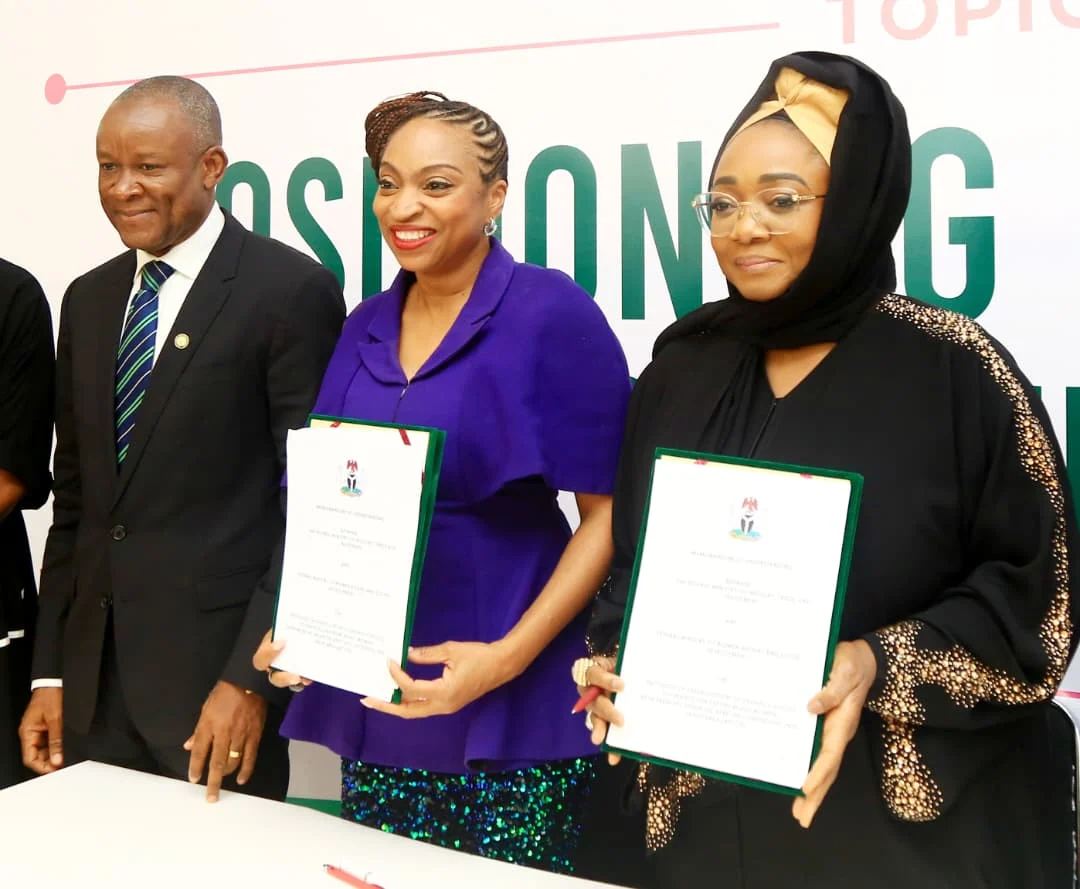
She announced the signing of a Memorandum of Understanding between the Ministry of Women Affairs and the Ministry of Industry, Trade and Investment to expand access to finance for export-ready women entrepreneurs.
The partnership will support initiatives such as export readiness training, improved digital trade capacity and the development of a national database of women-owned enterprises.
The Head of the Civil Service of the Federation, Didi Esther Walson‑Jack, also commended the initiative, noting that women play a critical role in innovation and enterprise development across Africa.
Policymakers, investors and development partners at the dialogue concluded the meeting with a renewed commitment to translate the discussions into concrete policies and programmes aimed at expanding market access, strengthening value chains and empowering Nigerian women-owned businesses to thrive within the AfCFTA framework.

- FG targets $1trn economy through funding for women-led businesses - March 6, 2026
- Petrol hits N995 as Dangote adjusts prices - March 6, 2026
- EFCC returns N279m to Wole Soyinka Centre - March 6, 2026