


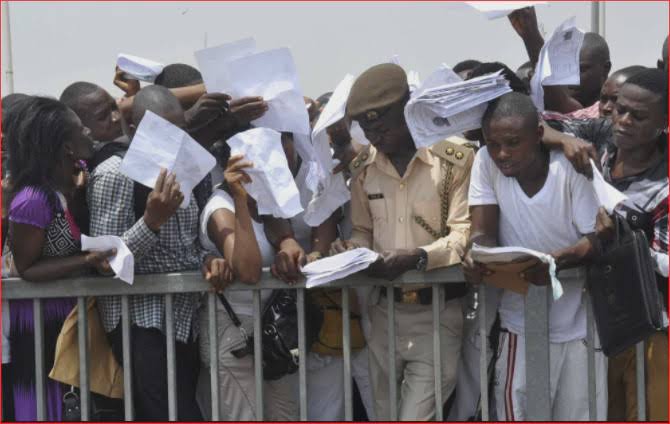

The Federal Government, in collaboration with international development partners, has launched the Revised National Employment Policy (NEP) 2025, aimed at addressing Nigeria’s persistent unemployment crisis and promoting decent work and inclusive economic growth.
The launch, which took place in Abuja, was supported by the International Labour Organization (ILO) under the SEESIN project, the German Development Cooperation (GIZ) through its SKYE Programme, and the Swiss Agency for Development and Cooperation.
Minister of Labour and Employment, Muhammad Dingyadi, described the new policy as a transformative framework designed to build a more equitable and productive labour market for all Nigerians. According to him, NEP 2025 offers forward-looking and inclusive solutions to long-standing labour challenges, particularly high youth unemployment, underemployment, informality, gender inequality, and regional disparities.
Dingyadi noted that the COVID-19 pandemic exposed deep structural weaknesses in Nigeria’s labour market, making the need for proactive and adaptive employment policies more urgent. He said NEP 2025 responds to these realities by offering a strategic roadmap that embraces the opportunities of digital transformation, the green and blue economies, remote work, and the creative (orange) economy.
The revised policy aims to strengthen public employment services, streamline stakeholder coordination, and align national employment initiatives with global best practices.
It is aligned with Nigeria’s National Development Plan (2021–2025), ECOWAS labour protocols, the African Union’s Agenda 2063, the Sustainable Development Goals, and the ILO’s Future of Work Initiative.
“The NEP 2025 is not a mere policy document; it is a national blueprint for lifting millions out of poverty through job creation, youth empowerment, enterprise development, and digital innovation,” Dingyadi stated.
“It treats employment not just as an economic goal but as a tool for social justice, national security, and sustainable development.”
He stressed that the policy includes measurable indicators and timelines to ensure evidence-based implementation and results.
It also promotes the formalisation of the informal sector, improved employability, and the creation of jobs in emerging sectors, especially through innovation and entrepreneurship.
Significantly, the policy recognises remote work as a viable option to improve labour force participation among persons with disabilities, women with caregiving responsibilities, and individuals with mobility limitations.
The Minister called on state governments to adopt and domesticate the policy, stressing that employment creation is a shared mandate that requires coordination at all levels.
He also urged the private sector to collaborate in developing market-responsive skills programmes and to invest in employment-rich sectors.
Development partners were encouraged to continue supporting the strengthening of employment systems, data collection, and policy implementation.
ILO Country Director for Nigeria and ECOWAS, Vanessa Phala, represented by Austin Erameh, said the policy was developed in response to Nigeria’s economic and social challenges that hinder access to quality jobs.
She emphasized the need for national policies rooted in data, social justice, and decent work principles, and called for better coherence between employment, education, labour migration, social protection, and skills development.
Phala added that the NEP’s comprehensive framework includes strategies to improve vocational training, support investment in high-growth sectors, and promote the inclusion of marginalised groups in the workforce.
With clear monitoring and evaluation mechanisms, the policy aims to boost job creation, productivity, and compliance with international labour standards.
The Revised National Employment Policy ultimately provides a unified framework for addressing Nigeria’s employment challenges.
It is expected to reduce unemployment and underemployment, promote inclusive growth, and reposition the labour market to meet evolving global trends and national development goals.

- Port drug seizures hit 2.55mkg, valued at N3trn – NDLEA - March 5, 2026
- Gov Lawal weighs defection to APC amid PDP crisis - March 5, 2026
- FUD expels 20 students, rusticates 15 over exam malpractice - March 5, 2026