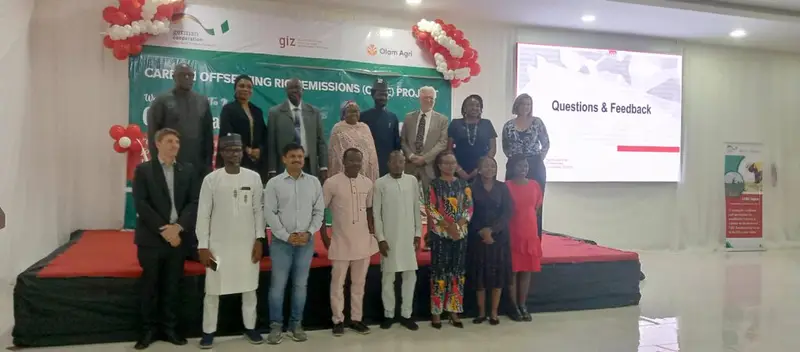

The German Government has inaugurated the Carbon Offsetting Rice Emissions (CORE) Project to promote climate-smart rice farming among 12,000 smallholder farmers across Benue, Nasarawa, and Kano States.
Unveiling the initiative in Abuja on Tuesday, German Ambassador to Nigeria, Annett Günther—represented by Deputy Head of Mission Johannes Lehne—said the three-year pilot project (2024–2027) would help reduce greenhouse gas emissions, strengthen sustainable rice value chains, and prepare the ground for carbon market participation by Nigerian farmers.
Funded by Germany’s Federal Ministry for Economic Cooperation and Development (BMZ) and implemented by GIZ in partnership with Olam Agri, the project will promote practices such as alternate wetting and drying of rice fields and the use of biochar to boost soil health and cut methane emissions.
Günther stressed the urgency of practical climate action in agriculture, noting that Germany contributed €9.94 billion to global climate finance in 2023.
She added that BMZ, alongside the Bill & Melinda Gates Foundation and the EU, has invested €117 million in Nigeria and the ECOWAS region to strengthen food security, jobs, and climate resilience.
Alexis Brakhan, GIZ’s Implementation Manager, said CORE would pioneer a scalable model linking sustainable farming to carbon markets, while Olam Agri’s Senior Vice President of Rice, Paul Nicholson, described the initiative as proof of the company’s commitment to food security and sustainability.
Olamide Fagbuji, Senior Special Assistant to the President on Climate Change, underscored the urgency of the project, warning that Nigeria loses about $100 million annually to climate-related flooding.
He noted that agriculture contributes 25% of GDP but 33% of national greenhouse gas emissions, mainly from methane in rice paddies.
“Without innovation, food insecurity and emissions will worsen,” Fagbuji said, urging stakeholders to invest in climate-smart practices like alternate wetting and drying, improved seed varieties, and low-emission irrigation methods that could reduce methane, increase yields, conserve water, and empower rural farmers.