

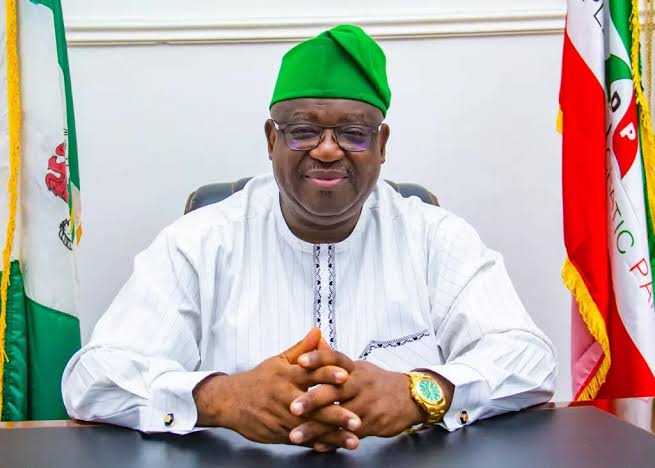
Plateau State Governor, Caleb Mutfwang, has attributed the worsening insecurity in the state to deliberate acts of economic sabotage and systematic land grabbing, which he said are aimed at impoverishing local farming communities and keeping citizens trapped in poverty.
Speaking during a media chat on Thursday, Governor Mutfwang dismissed the common narrative of recurring farmer-herder clashes, calling it a smokescreen for orchestrated violence and criminal displacement of rural communities.
“I’ve challenged the traditional narrative of farmers-herders clashes. It’s a façade that conceals organised criminality meant to prevent people from farming and destabilise our agricultural economy,” he stated.
96 houses destroyed in Plateau community as violence escalates
The governor cited Mangu, one of Plateau’s major agricultural hubs, as a key example. According to him, the pattern of violent attacks escalating at the start of each farming season is too consistent to be coincidental, suggesting a calculated attempt to cripple food production.
Calling for urgent security reforms, Mutfwang renewed his advocacy for the establishment of state police.
He argued that localised security outfits are necessary to effectively tackle the complex and organised nature of the violence plaguing Plateau communities.
“This is not random violence. You don’t decimate an entire village because of cattle rustling. What we are dealing with is well-coordinated criminality that requires intelligence-driven, community-based security infrastructure,” he stressed.
Agriculture sits at the heart of Mutfwang’s development agenda. He identified potato farming as a critical sector he intends to transform into an international export brand. To this end, the state government is partnering with Dutch company Agrico to introduce high-yield seed varieties.
“Plateau produces about 90 percent of what used to be called Irish potatoes in Nigeria. We’ve renamed them ‘Plateau Potatoes’ because we believe we deserve exclusive recognition for this crop,” the governor said.
He also revealed that Plateau State will host the African Potato Conference in 2028 — the first Nigerian host since the last edition in Uganda — in a bid to attract global attention and investment to the sector.
Highlighting the challenges of poor storage, lack of standardisation and limited traceability, Mutfwang pledged to implement reforms that would align Plateau’s produce with international quality standards. “We’re laying a solid foundation to reposition our produce for the global market in the next three to five years,” he said.
The governor also spoke about his administration’s efforts to promote inclusivity and unity across religious and ethnic divides. He pointed to recent outreach to the Muslim community and deliberate steps to correct past marginalisation.
“I’m proud to say I’ve done more than any governor since 1999 to include the Muslim community. One of the most strategic portfolios in my government is held by a Muslim commissioner,” he noted.
According to him, this inclusive approach has begun to foster public trust and social harmony. He cited increasing interfaith visits during religious celebrations as evidence of improving relationships.
“These may seem symbolic, but they are essential to rebuilding trust. Without community participation and belief in government, development will remain a mirage,” Mutfwang said.
He also called for mutual respect and open dialogue in addressing land and herding-related tensions. While acknowledging the violence linked to some Fulani groups, he cautioned against generalising an entire ethnic community.
“Many Fulani families have lived peacefully here for generations. Some are now successful farmers. Herding is not exclusive to them — many locals have employed them to manage cattle,” he explained.
On the humanitarian front, the governor acknowledged the growing number of internally displaced persons (IDPs) due to insecurity. He assured that plans are underway to provide durable solutions for resettlement and reintegration, though he did not go into specific timelines.
Mutfwang also discussed infrastructural achievements, including road projects delivered in previously neglected areas. He cited the newly commissioned road to Mama Iliabo community in Jos as a milestone, noting the community’s appreciation as a motivating force for governance.
Turning to education, the governor criticised what he described as weak leadership in state-owned institutions. He said merit and competence now guide appointments under his administration, in a bid to reverse nepotism and inefficiency.
“We’re putting round pegs in round holes. It’s the only way to build capacity and overcome institutional decay,” he said.
He further revealed that audits uncovered serious anomalies in the civil service, including 600 redundant staff listed under the Plateau State House of Assembly, which only has 24 members. “There are no offices for these people, yet they draw salaries. We’re working to rationalise the workforce and restore transparency,” he added.
While steering clear of direct criticism of the All Progressives Congress (APC)’s performance over the last eight years, Mutfwang reaffirmed his loyalty to the People’s Democratic Party (PDP), saying his focus remains on delivering results.
“I have no regrets being in the PDP. I believe in the party’s ideals and in serving the people effectively,” he said.
Governor Mutfwang also acknowledged the importance of inter-state cooperation, noting that engagements with other northern governors have given him broader insights into shared challenges.
“Plateau often gets a disproportionate share of negative publicity, but when I look at the realities in other states, I realise we’re still in a relatively better position. But that’s a conversation for another time,” he concluded.

- FCCPC raises the alarm over rising counterfeit products in Nigeria - March 25, 2026
- I was part of 1980 bank robbery — Rev. Dachomo - March 25, 2026
- Troops intercept Boko Haram fuel suppliers in Yobe - March 25, 2026