
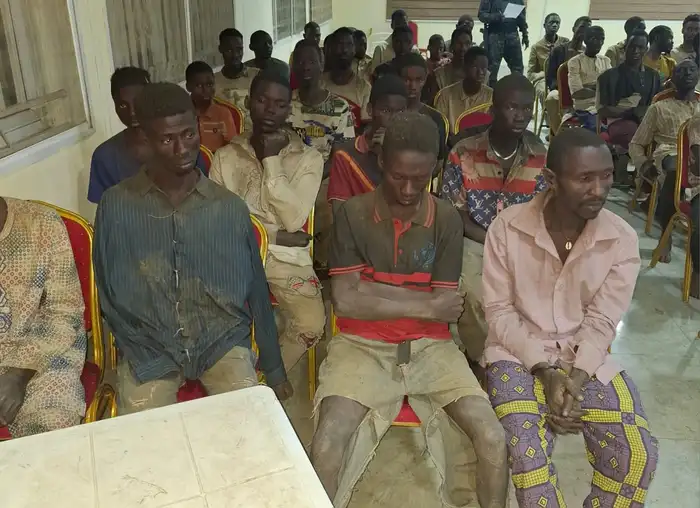

In a major intelligence-led operation, security operatives from the Department of State Services (DSS), in collaboration with the Office of the National Security Adviser (ONSA) and supported by the Nigerian Army, rescued 88 worshippers from bandits’ hideouts in the Kajuru–Kachia axis of Kaduna State early Thursday. The rescued included men, women, and two toddlers.
The victims were part of a group abducted on January 18 when gunmen attacked three churches in Kurmin Wali, kidnapping about 167 worshippers. While 80 had escaped or were released on February 1, the remaining victims had been held in captivity until the latest rescue.
One member of the rescue team described the operation as “purely intelligence-led.” He told security analyst Zagazola that there was “no shooting, no drama.

“Everything depended on timing, trust, and pressure. We had to move quietly through insecure villages, meet the intermediaries, and wait in the bush until the captives were brought out.”
The operation began at 8 p.m. on Wednesday from Kaduna city under DSS escort, with the team navigating narrow and insecure routes to Maro and Cibiya villages.
At 11 p.m., the team made contact with local intermediaries—kachallas—who liaise between communities and criminal groups.
Thirty minutes later, they were guided to Cibiya village, but the captives were not immediately brought out, forcing the team to wait in the bush for over 90 minutes.
“At exactly 12:45 a.m., in a dark thicket outside Cibiya, the waiting ended. From different corners of the bush, shadows emerged—a woman clutching a child, a limping man, then others. In silence, 88 worshippers walked free.
“No sirens, no gunfire, just relief,” the operative recounted.
Despite a minor vehicle mishap in Maro village, the rescued were quickly redistributed among other vehicles, allowing the convoy to return safely to Kaduna.
The DSS received them at headquarters for documentation and profiling by 3:30 a.m.
The rescue operation benefited from the tactical support of the Nigerian Army School of Artillery (NASA), Kachia, as well as coordination from the Garrison Commander, ensuring safe corridors throughout the mission.
Kajuru LGA, known for its forested terrain and poor road access, has long been a pressure point on Kaduna’s security map, providing bandits with hideouts and hostage warehouses.
What sets the Kurmin Wali rescue apart is its method: rather than a large-scale military assault, the operation relied on “fusion intelligence”—combining DSS human intelligence, ONSA strategic oversight, and Army/Navy tactical support.
Analysts say this approach reflects a broader shift in Nigeria’s counter-kidnapping strategy, emphasizing inter-agency coordination to reduce civilian casualties and prevent hostages from being scattered.
The operation also highlighted gaps in official reporting, as initial police statements had denied the incident, a delay that often complicates public trust and emergency response.
As of Thursday, the Kaduna State Government has yet to issue an official statement on the operation.

- Senior ISWAP commander Al-Muhajir killed in Malam Fatori - March 29, 2026
- Rivers govt reveals how Ibas spent ₦302B in six months - March 29, 2026
- PDP convention to prove party is alive, set for smooth proceedings – Wike - March 29, 2026