

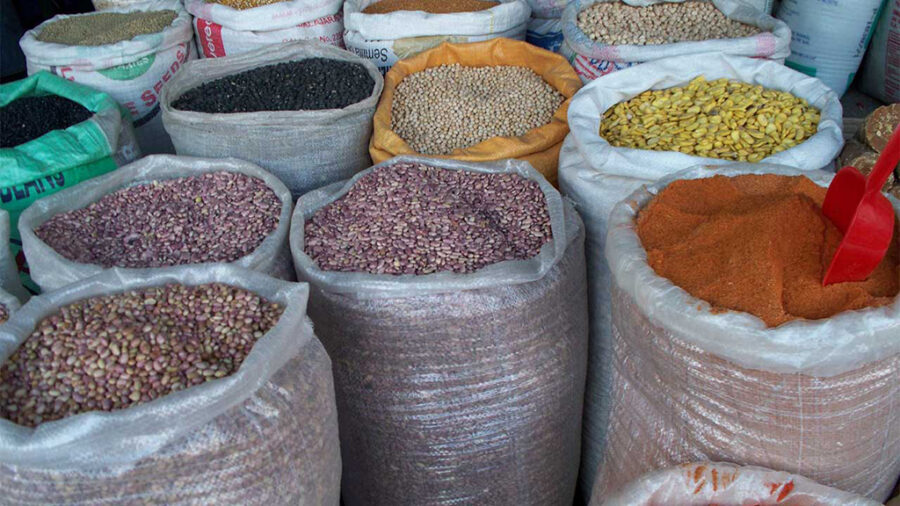

Nigeria’s inflation landscape took an unexpected turn in September 2025, as food prices recorded their first monthly decline in more than ten years, offering rare relief to households battered by soaring living costs.
According to the latest Consumer Price Index (CPI) released by the National Bureau of Statistics (NBS), the nation’s headline inflation fell sharply to 18.02 per cent, down from 20.12 per cent in August — the steepest month-on-month decline in recent years.
The main driver of this moderation was food inflation, which eased significantly to 16.87 per cent in September from 21.87 per cent in August.
On a month-on-month basis, food inflation stood at -1.57 per cent, indicating an actual fall in food prices — a phenomenon last recorded in February 2012, when food inflation dropped to -0.13 per cent.
The NBS attributed the rare decline to the harvest season across key agricultural regions, which boosted supplies of staples such as rice, yam, maize, and vegetables.
Increased availability of locally produced food items typically reduces prices during the third quarter of the year.
The bureau also noted that the recent rebasing of the inflation basket — which updated the list of goods and services used to calculate inflation — helped capture current consumers spending more accurately.
Combined with base effects from last year’s high inflation, the rebasing amplified the slowdown.
However, while Nigerians enjoyed brief respite on locally produced food, the cost of imported food items continued to surge, reflecting persistent pressure from foreign exchange volatility and global market disruptions.
The Imported Food Price Index rose from 111.5 points in January to 124.1 points in September 2025, marking an 11.3 per cent increase in nine months.
On a monthly basis, the index climbed 3.4 per cent, up from 120.0 points in August, underscoring ongoing inflationary strain on imported goods such as wheat, sugar, and dairy products.
This divergence highlights Nigeria’s dual inflation challenge — while domestic harvests are easing pressure on local staples, the nation’s dependence on imported commodities continues to stretch household budgets.
The trend also casts doubt on the government’s earlier decision to allow food importation as a strategy to stabilise supply and reduce prices — a move that now appears to be complicating inflation management amid a volatile exchange rate.
Meanwhile, the Minister of State for Agriculture and Food Security, Aliyu Sabi, attributed the price decline to improved local production, government interventions, and the ongoing harvest season.
Sabi explained that increased output under the National Agricultural Growth Scheme Agro-Pocket (NAGS-AP) programme, launched in 2023, played a major role in boosting supply.
“From 2023, we embarked on massive production through the NAGS Agro-Pocket programme. We injected almost 500,000 metric tonnes of wheat, maize, cassava, and other commodities. This ramped-up production is what’s responsible for the drop in food prices,” he said.
He clarified that the government’s import window introduced last year was designed only to bridge production deficits, not to crash prices.
“The imported items have not even been released. What happened was that once people heard the government would import food, hoarders started releasing their stock.
“When supply increases, prices naturally come down,” he explained.
Sabi added that the ongoing harvest period, which has begun from the southern region and will spread northwards, will likely sustain the downward trend in food prices.
“We are now in the harvest period. As supply improves across regions, food prices will continue to fall,” he affirmed.

- My deputy plotted to remove me from office — Kano gov - April 10, 2026
- Court sets April 14 for hearing in ADC leadership tussle - April 10, 2026
- INEC postpones voter revalidation exercise until after 2027 elections - April 10, 2026