
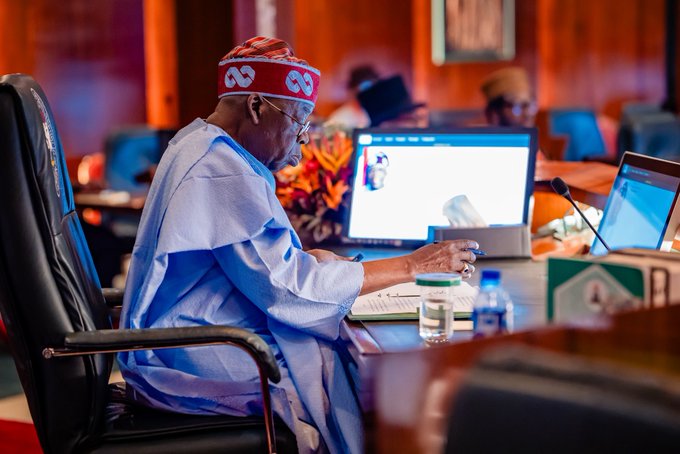

A review of Nigeria’s federal spending shows that President Bola Tinubu and Vice President Kashim Shettima have set up at least 46 committees since May 2023, with allocations and recorded expenditures exceeding ₦13 billion within three years.
Analysis of budget documents from 2023 to 2026, alongside payment records from the public finance platform GovSpend, indicates that about ₦12.99 billion was earmarked for long-standing presidential committees. An additional ₦105.97 million in traceable payments went to individuals and companies supporting specific ad hoc panels.
Overall, the ₦13.1 billion figure equals roughly 62 percent of the ₦21.17 billion spent on similar committees between 2018 and 2025 under the previous administration, according to analysis by The PUNCH. Average yearly spending under the current administration stands at ₦4.37 billion, higher than the roughly ₦3 billion annual average recorded between 2018 and 2022.
Most committees formed since 2023 are short-term panels created to tackle specific policy issues, while others are statutory bodies with permanent secretariats that receive annual funding through the Office of the Secretary to the Government of the Federation.
Budget records show ₦3.73 billion allocated to these committees in 2023. Funded bodies included political officers and standing committees, the Presidential Advisory Committee, the Technical Committee on Land Reforms, the Advisory Committee on the Prerogative of Mercy, the Presidential Enabling Business Environment Council, and standing committees on private jetties and innovations.
Allocations fell to ₦2.96 billion in 2024, rose to ₦3.24 billion in 2025, and stood at ₦3.06 billion in 2026. The Technical Committee on Land Reforms received a notable increase in 2025, drawing ₦478.45 million—more than double its 2024 allocation.
Separate payment data reveals at least six disbursements linked to ad hoc panels between May 2023 and December 2025, totalling ₦105.97 million. Early payments included consultancy fees to firms reviewing earlier salary white-paper reports. Other expenses covered office supplies, honoraria for members of the technology transfer committee through the National Agency for Science and Engineering Infrastructure, printing of committee reports approved via the Federal Ministry of Justice, and administrative costs for the trade malpractices committee.
Since assuming office, the administration has repeatedly relied on committees to address major policy challenges. Within weeks of inauguration, Tinubu created a steering committee to negotiate with labour unions after fuel subsidy removal.
In July 2023, the government formed the Presidential Committee on Fiscal Policy and Tax Reforms, chaired by tax expert Taiwo Oyedele, formerly of PwC. That panel later produced reforms that resulted in four tax laws enacted in 2025.
Additional committees covered palliatives, livestock reforms, flood mitigation—initially chaired by former governor Yahaya Bello—industrial revitalisation, police reforms following deliberations of the Nigeria Police Council, and data coordination initiatives. Several bodies were created through the Federal Executive Council and the National Economic Council, which also set up committees on economic affairs and crude-oil theft led by governors AbdulRahman AbdulRazak and Hope Uzodimma.
Throughout 2024 and 2025, more panels were established across sectors including minimum wage negotiations, social investment, flood prevention, electricity reform, youth development, digital infrastructure, financial inclusion, and political party dispute resolution ahead of the 2027 elections.
Some committees produced concrete outcomes, such as the minimum wage framework, progress toward state police legislation, and the overhaul of the tax system.
However, critics argue that the growing reliance on committees risks becoming an expensive form of patronage. Activist Deji Adeyanju said many panels have delivered little measurable impact and reflect policy inconsistency.
Meanwhile, presidential spokesperson Bayo Onanuga had not responded to requests for comment at the time of reporting.

- FG defends Borno airstrike, promises probe into civilian deaths - April 14, 2026
- Opposition will defeat Tinubu in 2027 no matter what — Galadima - April 14, 2026
- El-Rufai disowns comments on political aspirations attributed to associate - April 14, 2026