
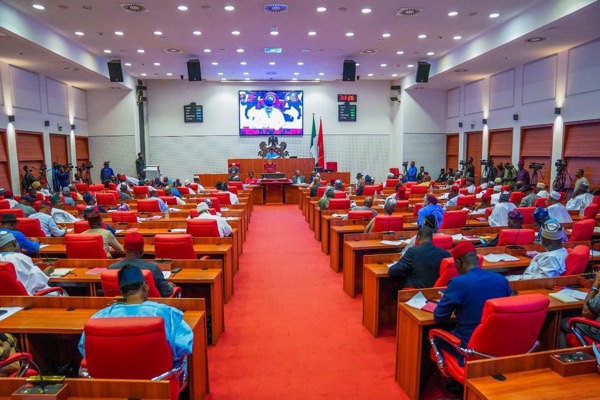

In a sweeping fiscal overhaul to address revenue shortfalls, weak capital project execution and overlapping budget cycles, the National Assembly on Tuesday approved revised budgets for the 2024 and 2025 fiscal years, extending the implementation of the 2025 budget to March 31, 2026.
The lawmakers approved a reworked N43.5 trillion 2024 Appropriation Act and a revised N48.3 trillion framework for the 2025 fiscal year following prolonged plenary sessions in both chambers.
The approvals came after President Bola Ahmed Tinubu transmitted the Appropriation Act (Repeal and Re-enactment) Bills to the legislature last Friday.
In the Senate, the revised figures were adopted after the presentation of a consolidated report by the Chairman of the Senate Committee on Appropriations, Senator Solomon Adeola (Ogun West).
Adeola explained that the exercise was aimed at realigning Nigeria’s budget framework with current economic realities, addressing implementation gaps and restoring fiscal discipline.
He disclosed that the original N35.005 trillion 2024 budget was repealed and replaced with an aggregate expenditure of N43.561 trillion, reflecting updated provisions for statutory transfers, debt servicing, recurrent and capital spending.
For the 2025 fiscal year, Adeola said the earlier N54.99 trillion budget was also repealed and re-enacted with a reduced total expenditure of N48.316 trillion, with part of the capital allocation deferred to 2026 due to funding constraints.
According to him, extensive consultations with the economic management team informed the revisions, particularly concerns over revenue performance, rising debt exposure and the need for more realistic implementation targets.
He added that N8.5 trillion was injected into the capital component of the 2024 budget to fund special interventions addressing security, humanitarian and economic challenges.
On the 2025 budget, the committee noted that N6.674 trillion was removed from capital allocations and deferred to the 2026 fiscal year to improve effectiveness, pending improved revenue inflows.
Adeola also cautioned against the continued practice of running multiple budgets simultaneously, warning that it undermines transparency, accountability and fiscal discipline.
Based on its findings, the Senate approved the repeal and re-enactment of the 2024 Appropriation Act to authorise N43.5 trillion in spending, alongside the revised N48.3 trillion framework for 2025, and extended the lifespan of the 2025 budget to March 31, 2026. The bills were subsequently passed after third reading.
Similarly, the House of Representatives passed the revised N43.56 trillion 2024 budget and the N48.31 trillion 2025 budget after adopting the report of its Committee on Appropriations.
The passage followed clause-by-clause consideration at the Committee of Supply and approval at plenary presided over by Speaker Rt. Hon. Tajudeen Abbas.
A breakdown of the revised 2024 budget shows allocations of N1.74 trillion for statutory transfers, N8.27 trillion for debt servicing, N11.26 trillion for recurrent (non-debt) expenditure, and N22.27 trillion for capital expenditure and development fund contributions.
For the revised 2025 budget, N3.64 trillion is earmarked for statutory transfers, N14.31 trillion for debt servicing, N13.58 trillion for recurrent (non-debt) expenditure, and N16.76 trillion for capital expenditure through development fund contributions.
Like the Senate version, the 2025 budget will run until March 31,

- FG to install 5,000 cameras as Tinubu moves against Plateau terror - April 2, 2026
- FG opens Enugu–Onitsha expressway ahead of Easter - April 2, 2026
- INEC undermining democracy — ADC - April 2, 2026