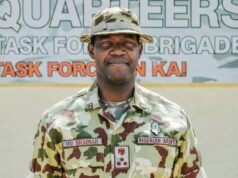

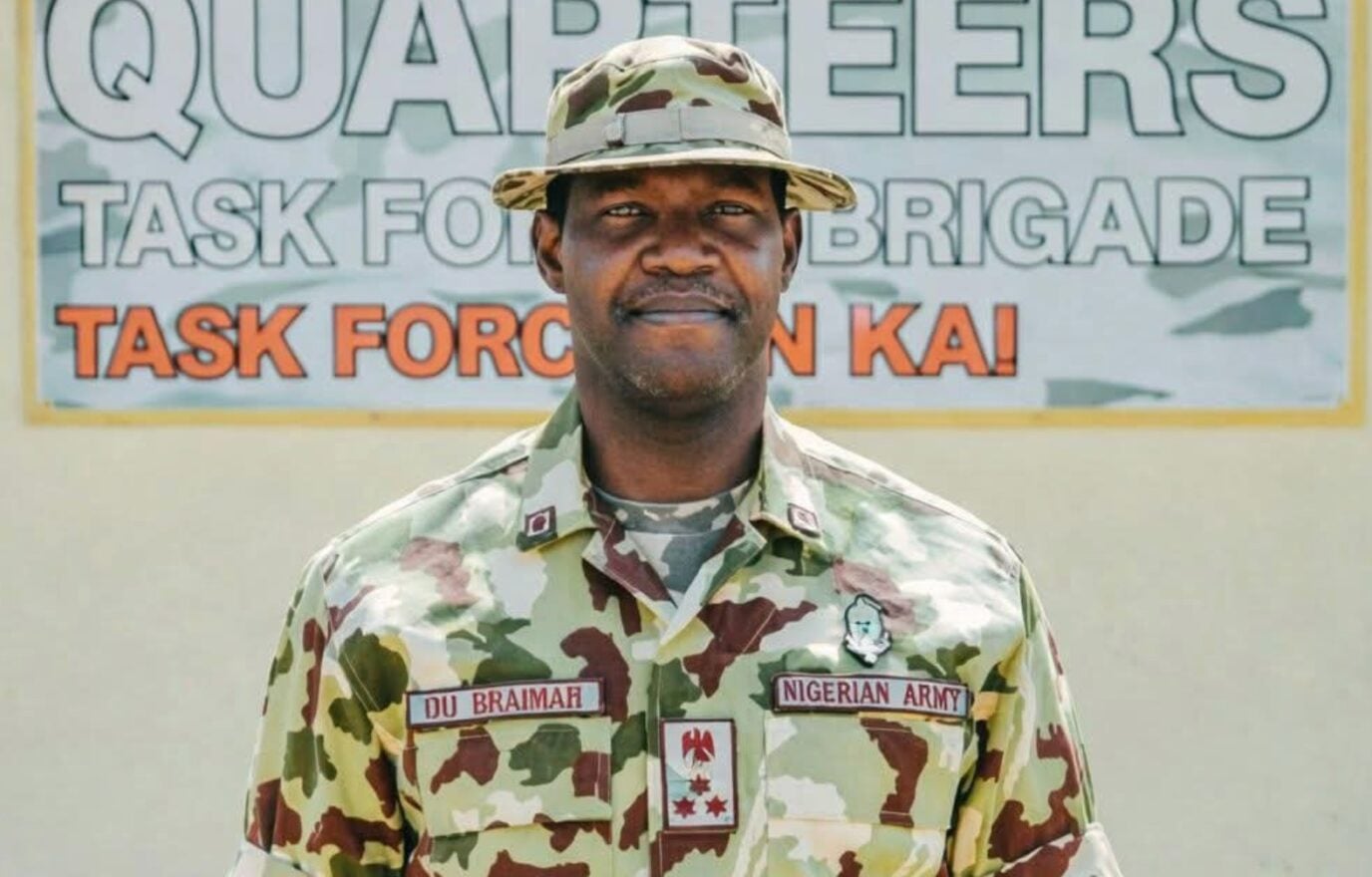

Surviving soldiers have given harrowing accounts of the midnight insurgent assault that killed the Commander of the 29 Task Force Brigade, Brigadier General Oseni Braimah, describing a numerically superior, multi-directional attack that overwhelmed troops and temporarily broke their defensive line at Benisheikh, Borno State.
The attack, launched around 12.30am on Thursday by suspected Boko Haram and Islamic State West Africa Province fighters, simultaneously targeted at least three military formations in the strategic Kaga Local Government Area town along the Maiduguri-Damaturu highway — one of the deadliest coordinated assaults on Nigerian military positions in recent months.
“We are used to coordinated attacks, but this was different. They came in large numbers from different directions at the same time. It felt like they had studied our positions for weeks,” a soldier who survived the attack told Saturday PUNCH, speaking anonymously as he was not authorised to address the media.
A second survivor said the insurgents’ sheer numerical advantage proved decisive. “We stood our ground at first, but they were too many. They attacked from different angles. It was like an ambush,” he said, adding that morale collapsed when word spread that other positions had fallen and that the brigade commander was dead. “That was when fear fully set in.”
The psychological blow, sources said, triggered a breakdown in coordination, forcing some troops to fall back into the town — a withdrawal that created a security gap insurgents exploited to loot military facilities and torch civilian property. The gun battle lasted over 90 minutes, with multiple explosions sending both soldiers and residents fleeing into the night.
Accounts of how Braimah died remain contested. Claims that he was killed because a Mine-Resistant Ambush Protected vehicle malfunctioned were disputed by sources close to the brigade. “The insurgents actually set the MRAP on fire during the attack. Saying he died because the vehicle didn’t start is not accurate. The situation was far more complex,” a highly placed source within the brigade said.
Another insider noted that most of those present at the general’s exact location during the assault also perished, making a definitive account difficult to establish. A former driver to the late general, who identified himself simply as Blacky, pushed back against any suggestion of maintenance negligence on Braimah’s part.
“If you talk about maintenance, General Braimah doesn’t play with repairs. Ask anyone under the 29 Task Force,” he said. However, a separate source within the formation alleged systemic lapses in vehicle upkeep, claiming complaints had been raised previously.
Benisheikh residents described scenes of chaos as the attack spilled into the town. “We heard loud explosions and continuous gunshots. It was terrifying. People were running in all directions. Even soldiers ran into the town for cover,” said Mustapha Abu, a local resident.
Abu said insurgents burned shops and vehicles along major roads, and travellers resting near the Benisheikh secretariat — stranded due to the routine evening closure of the Maiduguri-Damaturu road — abandoned their vehicles and fled. “When I got to the camp after the attack, it was an eyesore,” he added.
The Headquarters of Operation Hadin Kai rejected widespread reports of 17 military fatalities, putting the official death toll at two officers and two soldiers. In a statement on Friday, Media Information Officer Lt.-Col. Sani Uba described alternative figures as “entirely false, misleading, and devoid of credibility.”
He also dismissed the vehicle malfunction narrative, stating that Braimah “was mounted on a high-grade MRAP vehicle, which was temporarily immobilised in the heat of combat while he was actively coordinating the counter-assault” — framing it as evidence of frontline leadership, not equipment failure. Uba maintained that troops of Operation Hadin Kai successfully repelled the attack, forced the insurgents into a disorganised retreat, and retained control of their location.
Braimah’s death extends a grim roll call of senior Nigerian military officers killed in the North-East insurgency. Brigadier General Musa Uba, commander of the 25 Brigade, was killed in 2025. Brigadier General Dzarma Zirkusu, commander of the 28 Task Force Brigade in Chibok, died alongside three soldiers in an ISWAP ambush in Askira-Uba in November 2021. Colonel Dahiru Chiroma Bako succumbed to injuries from a Boko Haram ambush near Wajiroko in September 2020.
Lieutenant Colonel Ibrahim Sakaba was killed during an attack on a base in northern Borno in November 2018, and Lieutenant Colonel Muhammad Abu Ali died in November 2016. Security analysts say the recurring pattern raises urgent questions about operational strategy, intelligence gathering, and force protection.
President Bola Tinubu on Thursday night expressed grief over the killings and commended the troops for fighting to repel the assault.
In a statement by his Special Adviser on Information and Strategy, Bayo Onanuga, the President described the insurgents’ offensive as an act of desperation in the face of sustained military pressure.
“From the reports I have received, our armed forces have been conducting sustained and intense land and air offensives against insurgents, neutralising many of their fighters and commanders,” Tinubu said, urging military leadership and frontline personnel not to be discouraged. He assured that the Federal Government would honour the fallen soldiers and remained committed to defeating terrorism and restoring peace across the country.

- How terrorists stormed military base, killed Gen Braimah — Soldiers - April 11, 2026
- My deputy plotted to remove me from office — Kano gov - April 10, 2026
- Court sets April 14 for hearing in ADC leadership tussle - April 10, 2026