
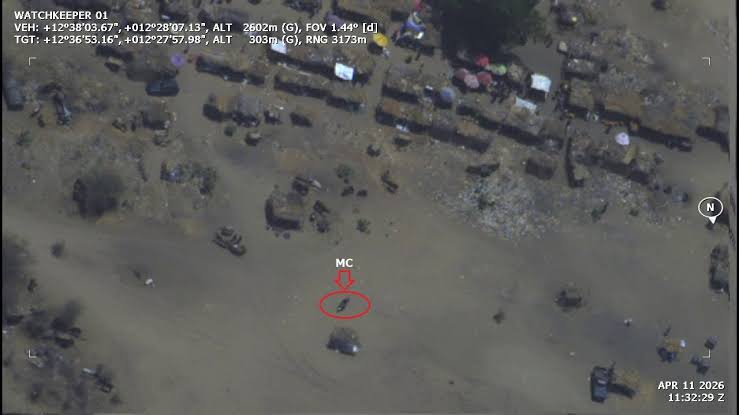

The Nigerian military has defended a Saturday airstrike on Jilli village market near the Borno-Yobe border, insisting the location was a terrorist logistics hub, even as the death toll climbs and public anger intensifies.
The strike, carried out under Operation HADIN KAI on April 11, targeted what the military described as an Islamic State West Africa Province (ISWAP) enclave in Gubio Local Government Area of Borno State. Local sources put the death toll at over 40, while Amnesty International cited witness accounts suggesting over 100 fatalities.
A ward councillor, Malam Lawan Zannah, told journalists he personally verified about 200 deaths, adding that scores of injured victims could not be evacuated due to a lack of vehicles.
The Media Information Officer of the Northeast Joint Task Force, Lt. Col. Sanni Uba, said the strike followed sustained intelligence, surveillance, and reconnaissance missions that tracked ISWAP fighters, motorcycles, and gun trucks converging on the area. He linked the operation to a January 2026 IED attack that killed eight soldiers along the Bindul axis, and coordinated attacks in Ngamdu and Benisheik on April 9.
“Post-strike assessment confirmed that scores of terrorists were neutralised, with their vehicles and technicals destroyed,” Uba said, adding that a terrorist courier, identified as “Turja Bulu,” was arrested in Ngamdu and confessed to involvement in the Benisheik attack.
The Yobe State Emergency Management Agency, however, confirmed that traders — including residents of Geidam who had crossed the border for market activities — were caught in what it described as an accidental strike. Borno Governor Babagana Zulum noted that the Jilli and Gazabure markets had been officially closed for five years, while the Yobe State Government acknowledged civilians were inadvertently hit.
The Nigerian Air Force announced it had activated its Civilian Harm Accident and Investigation Cell to conduct a fact-finding mission.
Amnesty International condemned the strike as “reckless,” calling for an immediate and impartial investigation. Former Vice-President Atiku Abubakar described it as a “devastating failure,” questioning the value placed on Nigerian lives.
Former Chief of Army Staff Lt. Gen. Tukur Buratai (retd.) backed the military, saying the operation was based on credible intelligence and that responsibility lay with terrorists who deliberately embed themselves within civilian populations.
Security experts called for a systemic overhaul, emphasising the need for stronger human intelligence, multi-layered targeting verification, and institutionalised civilian harm mitigation mechanisms.
The Jilli strike comes less than a month after a March 16 airstrike in Borno State killed at least 23 people and injured 108 others near a market, a post office, and the gate of the University of Maiduguri Teaching Hospital.

- Nigeria’s electricity output rises to 4,300MW in two weeks — FG - April 13, 2026
- US hails Nigeria over conviction of 386 militants - April 13, 2026
- 15-year-old ISWAP courier confesses to Ngamdu attack, exposes Jilli logistics network - April 13, 2026