


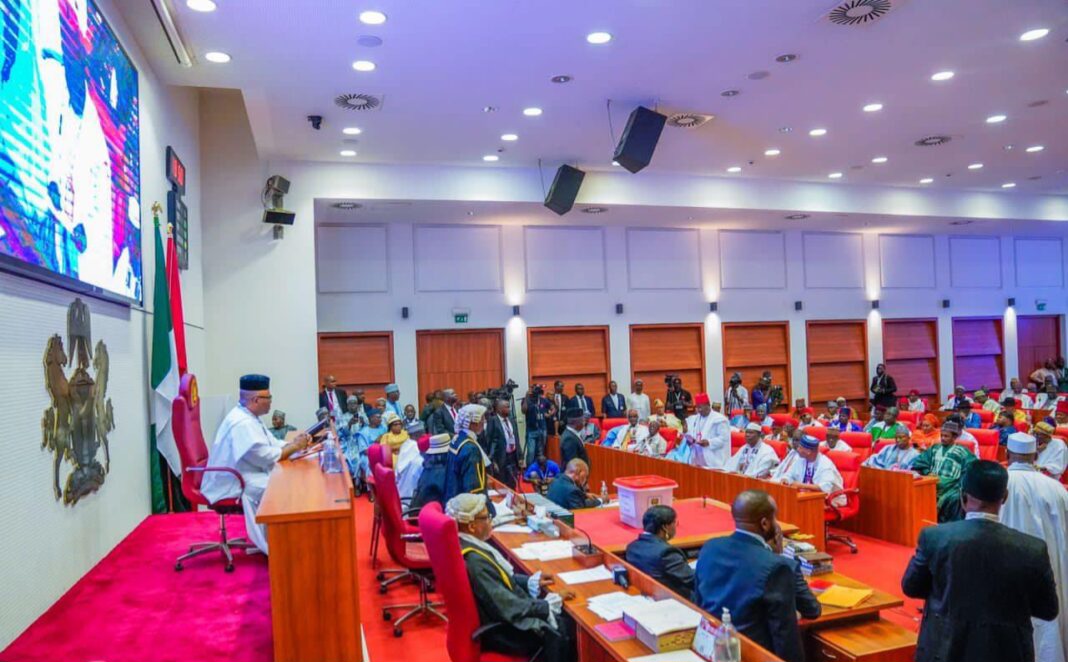
The National Assembly has proposed 74 additional legislative seats for women in the Senate and House of Representatives, alongside three reserved seats in each state House of Assembly, as part of efforts to boost women’s representation in Nigeria’s political system.
The proposal, which is part of the ongoing review of the 1999 Constitution, would allocate one additional Senate and House of Representatives seat to each of the 36 states and the Federal Capital Territory.
Senate Leader, Opeyemi Bamidele, disclosed this on Monday at the 2026 Law Week organised by the International Federation of Women Lawyers (FIDA), Ekiti State chapter, in Ado-Ekiti.
Bamidele, who is also Vice Chairman of the Senate Committee on the Review of the 1999 Constitution, said the proposed amendment was aimed at breaking barriers limiting women’s participation in governance and promoting an inclusive political culture.
He said the proposal would create special legislative seats for women without displacing existing elected representatives.
“A Bill for an Act to alter the provisions of the Constitution of the Federal Republic of Nigeria, 1999 to provide for special seats for women in the National and state Houses of Assembly and for related matters is receiving our attention at the National Assembly,” he said.
The Senate leader said the proposal followed extensive consultations and consensus-building, adding that the constitution review process had commenced early to ensure a comprehensive and inclusive exercise.
He explained that the proposed arrangement would create 37 additional seats in the Senate and 37 in the House of Representatives, with each state and the FCT entitled to one extra seat in both chambers.
Bamidele also said the committee had proposed three additional seats reserved for women in each state House of Assembly.
According to him, the arrangement is expected to last for 16 years, covering four electoral cycles, before a comprehensive review.
“This arrangement is proposed to run for a period of 16 years, four electoral cycles, before a comprehensive review. This is a sunset clause designed to ensure sustainability and to allow for the organic development of a more inclusive political culture,” he said.
He added that the National Assembly was engaging state Houses of Assembly, whose concurrence is required for the constitutional amendment to be approved.
Senate begins probe as corps member dies in Enugu NYSC camp
Bamidele described the proposal as a non-partisan intervention aimed at addressing the exclusion of women from political decision-making.
He said advocacy by senior government officials, including First Lady Oluremi Tinubu, had strengthened the resolve of the 10th National Assembly to advance the initiative.
“The rationale is anchored on a simple, yet profound, principle of constitutional law: the foundational precept of representative democracy.
“A democracy that systematically excludes over half of its population from the decision-making tables that determine their futures is, at best, a flawed democracy and, at worst, a veiled oligarchy,” he said.
The Senate leader also called for stronger legislative measures to protect women, children and persons with disabilities, particularly through improved access to healthcare, education and social protection.
He stressed that justice must be accessible, affordable, timely and effective, especially for victims of domestic violence and child abuse.
Bamidele urged stronger collaboration among the legislature, executive, judiciary, law enforcement agencies, social welfare institutions, civil society organisations and other stakeholders to improve the protection of vulnerable groups.
He also charged FIDA to deepen its engagement with the National Assembly by identifying gaps in existing laws, proposing reforms and ensuring that policies and budgetary provisions translate into tangible benefits.
In her address, the Vice-Chancellor of Afe Babalola University, Ado-Ekiti, Prof. Smaranda Olarinde, called for stronger legal and institutional frameworks to protect women and children against emerging forms of abuse.
Olarinde warned that the increasing use of artificial intelligence and digital platforms had created new threats, including cyberstalking, online harassment, deepfake images, impersonation and child exploitation.
She called for collaboration among government institutions, the judiciary, law enforcement agencies, universities, traditional and religious leaders, the media and civil society organisations to tackle gender-based violence and child abuse.
The Chief Judge of Ekiti State, Justice Lekan Ogunmoye, described Bamidele as well-positioned to address emerging issues requiring legislative and policy reforms to protect women and children.
FIDA Ekiti Chairperson, Ayobami Olowoyo-Richards, reaffirmed the association’s commitment to promoting and protecting the rights of women and children, urging stakeholders to strengthen laws and institutions to ensure justice remains accessible and responsive.

- Army destroys kidnappers’ camp in Kogi - November 3, 2026
- NAFDAC threatens crackdown on adulterated foods - November 3, 2026
- Sokoto govt seals ADC campaign office - November 3, 2026