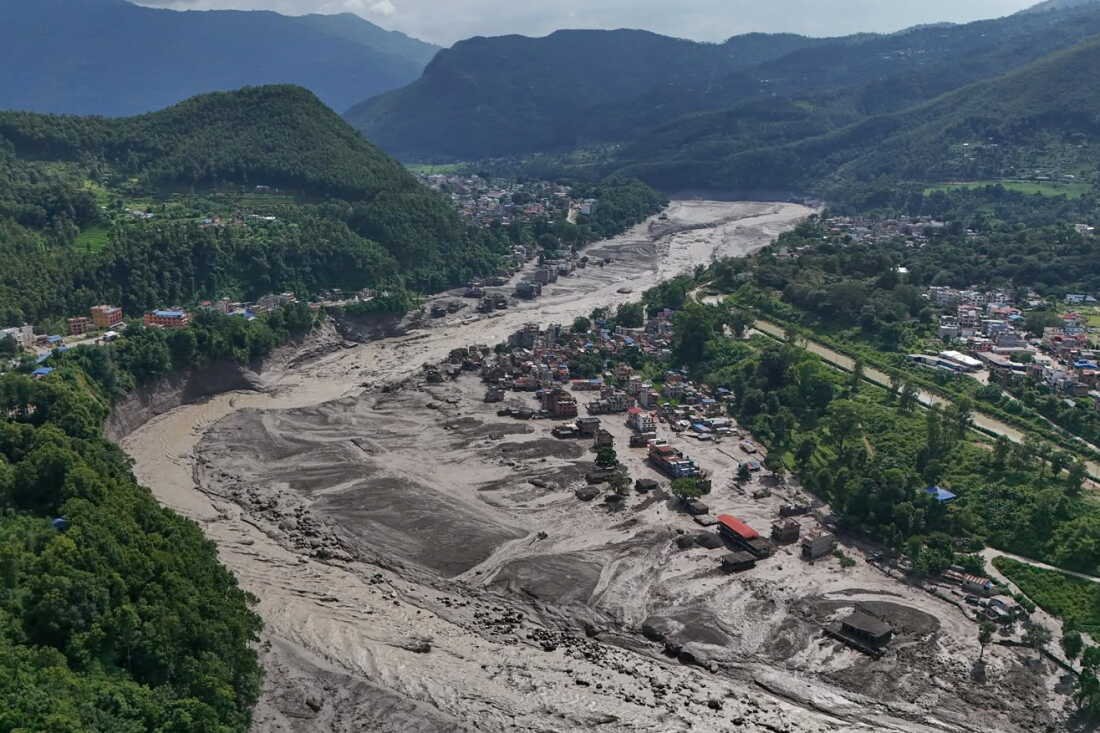
Rescuers in Nepal and China’s autonomous region of Tibet were still battling to locate thousands of people missing on Saturday, August 29, 2026, days after deadly flash floods swept through the Himalayan region, engulfing villages.
The number of missing rose to nearly 3,000 on Friday as emergency teams said they had recovered 633 bodies.
India government said it is stepping up monitoring of its Himalayan regions bordering China and Nepal, days after deadly floods apparently triggered by a glacial collapse.
The United States Geological Survey said Wednesday’s disaster on the Tibet-Nepal border was caused by a glacial collapse that created a torrent of debris.
While the exact cause of the collapse is unclear, climate change is causing glaciers to melt worldwide, increasing the risks of such disasters.
Satellite images from Thursday to Saturday morning suggest that water in the lake – straddling the China-Nepal border at the confluence of two rivers – has been slowly flowing through, decreasing the reservoir gradually, state broadcaster CCTV reported, citing the Water Resources Ministry.
The ministry said satellite imagery of the surface area of the lake at Purepu Tsangpo river showed it was 99,000 sqm in size – around the size of 14 football fields combined – having shrunk by 21,000 sqm compared with images from Thursday.
Nepal’s disaster authority raised the number of missing to nearly 3,000 and increased the death toll in the country to over 600, three days after devastating floods struck.
US-Iran war weakens OPEC+ grip on oil market as supply disruptions limit influence
The list includes a large rise in Nepalis listed as missing, up from a total of 1,924 the previous night. The number of missing foreigners remains at 517, according to the National Disaster Risk Reduction and Management Authority.
The Nepal Electricity Authority said 11 hydropower stations and one solar power station had stopped operating, with a combined capacity of 431.1 megawatts.
This represents about 10 percent of Nepal’s installed electricity generation capacity, according to the authority.
Another 15 power projects under construction, with a combined planned capacity of 470 megawatts, have also been damaged.
More than 900 hydropower workers are missing.

- Oyebanji re-appoints SSG, CPS, chief of staff - October 17, 2026
- WAEC: 56,000 candidates register for 2026 private WASSCE - October 17, 2026
- Banks raise N4.65trn in fresh capital — CBN - October 17, 2026