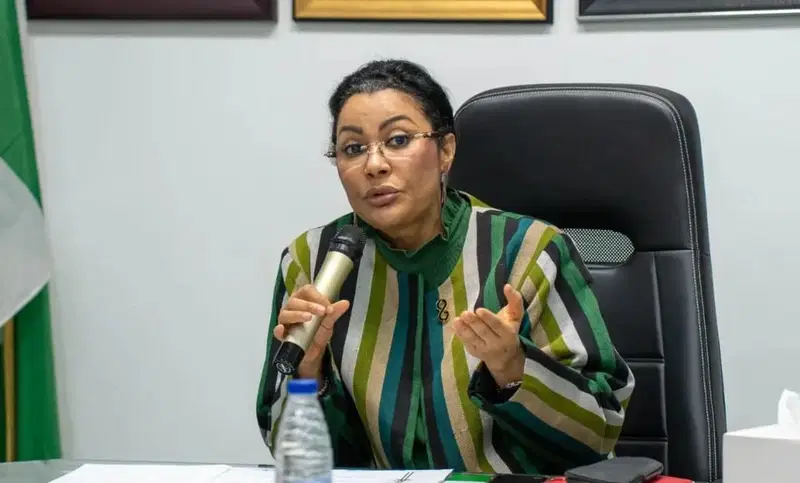

Nigeria needs to sustain a minimum annual growth rate of 10 percent over the next decade to reach its goal of becoming a $1 trillion economy, the Minister of State for Finance, Dr. Doris Uzoka-Anite, has said.
Speaking at the National Economic Council (NEC) conference in Abuja on February 9–10, Dr. Uzoka-Anite acknowledged that the economy is stabilising, recording a 4 percent growth recovery in 2025.
However, she stressed that achieving a trillion-dollar economy would require more aggressive expansion, noting that while 6–7 percent growth is adequate for poverty reduction, double-digit growth is essential for transformational development.
The Minister highlighted the Federal Government’s shift from being the primary spender to a strategic enabler under the Domestic Growth Acceleration Strategy (DGAS), incorporated into the 2026–2030 National Development Plan.
She explained that the strategy introduces “Investment Budgeting” to de-risk projects and attract private investment at three to five times the level of public spending.
“Our role must evolve decisively from being the primary spender to being an enabler of investments that de-risk and unlock private capital. The government alone cannot finance the transformation we seek.
“Strategic public de-risking can mobilise private investment at a multiplier of 3 to 5 times public allocation in key infrastructure,” she said.
“For accelerated development at the desired scale, we need a deliberate framework—Investment Budgeting—that mobilises private capital, builds productive assets, and generates long-term economic returns.”
On the 2026 fiscal outlook, Dr. Uzoka-Anite projected revenues of ₦34 trillion and a tax-to-GDP ratio moving toward 18 percent, following the full implementation of the Nigeria Tax Act 2025 and tax harmonisation across states.
She added that the Central Bank of Nigeria aims to reduce inflation below 13 percent by year-end, supported by ongoing bank recapitalisation, a trade surplus, and foreign reserves above $40 billion.
“The mathematics is clear. At current government allocation rates, it would take more than 111 years to mobilise the $300 billion needed for infrastructure. Investment Budgeting that leverages private capital is essential.
“A capital pool of $100 billion, assuming a marginal propensity to consume of 0.64–0.75, could generate $278–$400 billion in economic output,” the Minister said.
She cautioned that risks such as oil price volatility, food supply disruptions, and climate shocks could affect growth, urging disciplined execution and stronger federal-state collaboration to translate macroeconomic stability into improved living standards for Nigerians.

- JAMB releases 2026 Mock UTME results - April 1, 2026
- ADC faction storms INEC, demands Bala’s recognition - April 1, 2026
- Atiku, Kwankwaso rally opposition bloc for 2027 - April 1, 2026