
Nigeria has secured a $1 billion innovation fund aimed at supporting start-ups in the marine and blue economy sector, as part of ongoing efforts to diversify the economy beyond oil.
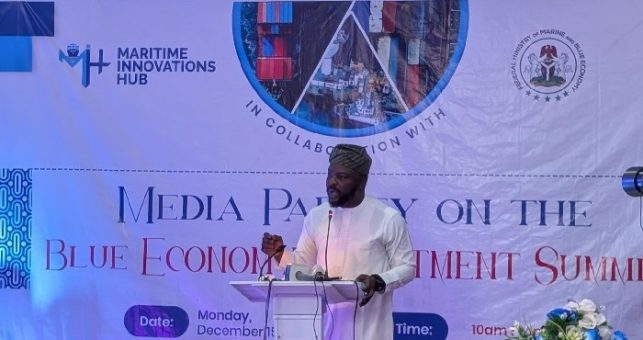
The Chief Executive Officer of the Maritime Innovations Hub, Mrs Ronke Kosoko, disclosed this on Tuesday during a media parley held in Abuja in collaboration with the Ministry of Marine and Blue Economy.
The event attracted key government officials, including the Special Adviser to the President on Social Media, Olusegun Dada, as well as representatives of the National Inland Waterways Authority (NIWA), the Nigerian Maritime Administration and Safety Agency (NIMASA), the Nigerian Shippers’ Council, and other ministries and agencies.
Kosoko said the $1 billion fund would be formally unveiled at the Blue Economy Investment Summit scheduled to hold in Lagos between March 9 and 11, 2026.
She added that international financiers are expected to meet with President Bola Tinubu and the Governor of the Central Bank of Nigeria (CBN), Olayemi Cardoso, during the summit.
According to her, the fund builds on Nigeria’s earlier success in securing a $100 million training and capacity-building investment for the maritime sector.
“When the $100 million offer came, I wasn’t actively seeking it. Global partners trust us because of our track record.
“While that was being processed, the $1 billion offer followed, which required another round of engagement with the Presidency,” she said.
She explained that her sustained engagement with the ministry over the past months was tied to finalising the process, noting that discussions were now close to completion.
“They will be coming into the country in March 2026 to meet the Honourable Minister for Marine and Blue Economy, the CBN Governor and Mr President.
“They are also prepared to support maritime start-ups with funding and international training opportunities,” she added.
Kosoko noted that global investors are driven by performance rather than politics.
“These organisations control billions of euros and dollars, and they are not interested in local political drama. They want results. Once the framework is right, the funds will come,” she said.
She highlighted Nigeria’s vast coastline and strategic location along major international shipping routes as key advantages for developing the blue economy, which covers maritime transport, fisheries, coastal tourism, shipbuilding and ocean-based renewable energy.
However, she lamented that inadequate port infrastructure, policy challenges and limited access to finance have hindered growth, forcing shipping lines and investors to relocate to neighbouring countries.
Kosoko disclosed that about 370,000 youths across the 36 states and the Federal Capital Territory would participate virtually in the March 2026 summit, alongside 28 governors and 37 serving senators. She noted that 10 governors were already represented at the Abuja parley.
“Nigeria is losing billions of naira to ports in Lomé and Côte d’Ivoire. These countries identified our weaknesses and built competitive advantages around them, while Nigeria is left with trans-shipment and smuggling,” she said.
She added that reclaiming these lost opportunities has become a priority for the Technical Assistant to the Minister of Marine and Blue Economy, who will lead a special session on the issue at the 2026 summit.
Speaking at the event, Dada called for clearer and more accessible policies, urging government agencies to communicate initiatives in simple language to encourage youth participation and build public trust.
He emphasised that effective communication is essential to ensuring widespread engagement with government-led economic reforms.

- Nigeria, UAE seal $200m defence deal - March 17, 2026
- Nigeria ranks lowest in global obesity response index - March 17, 2026
- Police, FAAN clash over ‘bandits’ arrest at Akure Airport - March 17, 2026