

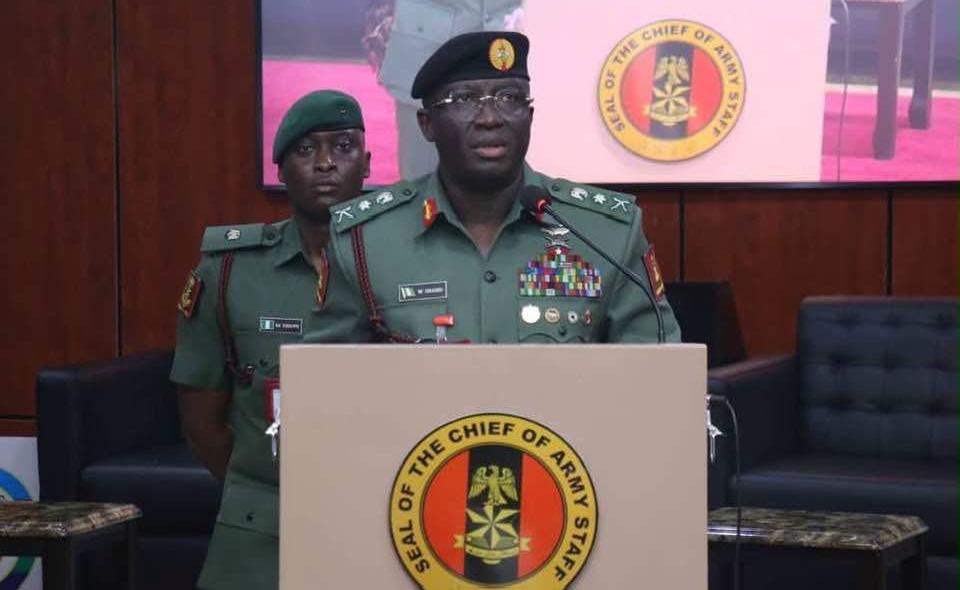
The Nigerian Army’s expansion from eight to 12 divisions must translate into improved combat capability and measurable security gains, Chief of Army Staff, Lt.-Gen. Waidi Shaibu, has said.
Shaibu spoke on Monday at the graduation lecture of Army War College Nigeria Course 10/2026 in Abuja, where he called for stronger joint operations, intelligence sharing and integration of military capabilities across multiple domains to tackle Nigeria’s evolving security threats.
He said the expansion was designed to improve territorial coverage, address emerging threats and strengthen the Army’s operational responsiveness across the country.
However, the Army Chief stressed that increasing the number of divisions and personnel would not, on its own, guarantee better security outcomes.
He said the effectiveness of the expanded force would depend on trained personnel, modern technology, actionable intelligence, efficient logistics and effective command and control systems.
Shaibu urged military commanders to adopt innovative approaches that integrate intelligence, technology, information operations and combat capabilities across different operational domains.
He also emphasised the need for professionalism, discipline and respect for the rule of law, saying these remained essential to public confidence and institutional credibility.
The COAS charged participants of Course 10/2026 to apply the strategic knowledge and leadership skills acquired during their training to improve operational effectiveness, strengthen cooperation among security agencies and support the Army’s transformation.
Delivering the graduation lecture, titled “Winning in Complex Security Environments: Reimagining the Nigerian Army Force Structure for Multi-Domain Operations,” former National Security Adviser, Maj.-Gen. Babagana Monguno (retd.), called for a fundamental review of military structures, doctrines and operational concepts.
Monguno said modern warfare increasingly required the integration of land, air, cyber and information capabilities to respond effectively to emerging threats.
He identified unmanned aerial systems, artificial intelligence and digital communication platforms as technologies rapidly reshaping military operations.
The retired general advocated sustained investment in technological innovation, intelligence integration, institutional reforms and continuous professional military education to prepare commanders for increasingly complex security environments.
Earlier, the Commandant of the Army War College Nigeria, Maj.-Gen. Umar Alkali, commended the COAS for supporting the institution’s efforts to develop operational-level commanders and strategic leaders.
Alkali said participants of Course 10/2026 had undergone rigorous training aimed at strengthening their critical thinking, operational planning and leadership skills for contemporary military operations.
The graduation lecture formed part of activities marking the completion of Course 10/2026, with the Army emphasising the need to develop professionally trained, technologically adaptable and operationally proficient commanders.

- Court dismisses Aisha Achimugu’s N10bn suit against EFCC - October 12, 2026
- EFCC arraigns Nigerian-American over $320,000 vehicle import fraud - October 12, 2026
- Wike moves to deliver FCT, Rivers for Tinubu in 2027 - October 12, 2026