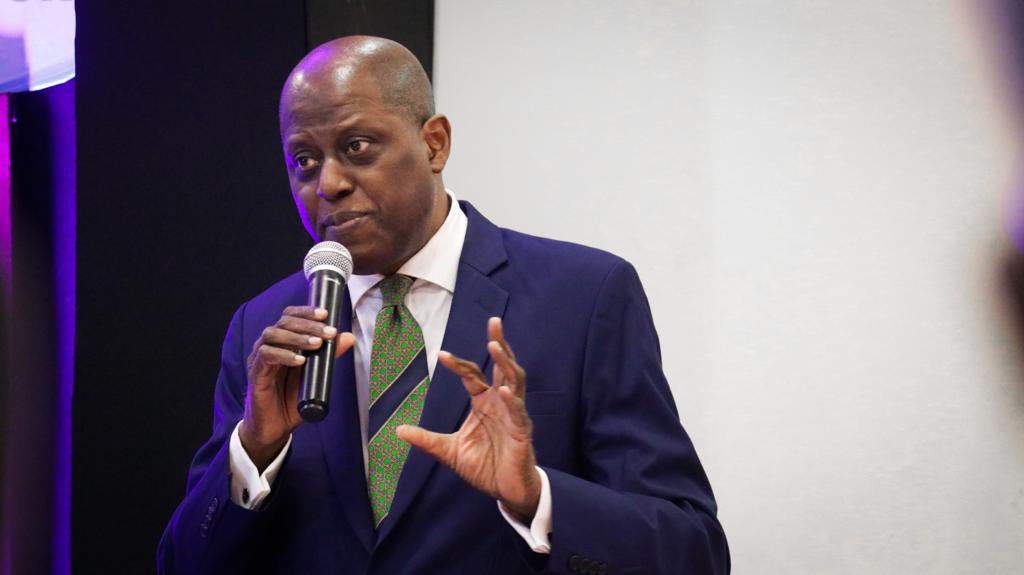

Nigeria’s external position has strengthened sharply, with the current account balance rising 85% to $5.28 billion in Q2 2024, according to Central Bank of Nigeria (CBN) Governor Olayemi Cardoso.
Speaking at the 60th Bankers’ Dinner of the Chartered Institute of Bankers of Nigeria (CIBN) on Friday, Cardoso said the rise, alongside higher foreign reserves and stronger market fundamentals, positions the country to better withstand global economic shocks.
Nigeria’s foreign reserves reached $46.7 billion by mid-November—the highest in nearly seven years—providing over 10 months of forward import cover.
“Importantly, these FX reserves are being rebuilt organically through improved market functioning, stronger non-oil exports, and robust capital inflows, not by borrowing,” Cardoso noted.
Cardoso also provided an update on the ongoing bank recapitalisation drive, revealing that 27 banks have accessed the market to raise fresh funds.
Sixteen banks have already met or exceeded the new capital requirements, with the rest progressing toward the March 31, 2026 deadline.
Stress tests conducted this year show the sector remains “fundamentally robust,” with key prudential indicators well within regulatory benchmarks.
The recapitalisation targets, set by the CBN in March 2024, require commercial banks with international authorisation to raise N500 billion, national banks N200 billion, regional banks N50 billion, and non-interest banks between N10 billion and N20 billion, depending on licence category.
The CBN governor highlighted reforms implemented in 2024—including a market-determined exchange rate, the Electronic Forex Market Surveillance System, and enhanced risk-based supervision—as factors strengthening Nigeria’s economic shock-absorbing capacity.
“With oil now a smaller share of GDP and fiscal revenues, the flexible FX regime, rising non-oil exports, and growing services trade help cushion against oil-price volatility,” he said.
He reaffirmed the CBN’s commitment to disciplined monetary policy and price stability, emphasizing these as essential foundations for investment and growth.
Cardoso also called for stronger collaboration to tackle rising insecurity, a persistent threat to economic progress.
In his remarks, CIBN President Pius Olanrewaju praised the banking sector for its resilience and adaptability, noting that many institutions have already met recapitalisation thresholds ahead of schedule.
He said this strengthens investor confidence and positions the sector to support Nigeria’s goal of a $1 trillion economy by 2030.
Oliver Alawuba, Chairman of the Body of Bank CEOs and CEO of United Bank for Africa, urged banks to increase lending to youths, SMEs, women entrepreneurs, and the creative sector, describing credit as a tool for economic benefit rather than personal gain.
He also assured smooth banking operations during the festive season, citing ongoing collaboration with the CBN to ensure adequate cash availability and stronger cybersecurity measures against evolving digital fraud risks.

- Uba Sani’s policies putting farmers first — Agriculture commissioner - March 13, 2026
- Police arrest three kidnappers in Gombe - March 13, 2026
- N1.35bn fraud: Retrial of Sule Lamido, sons stalled over absence in court - March 13, 2026