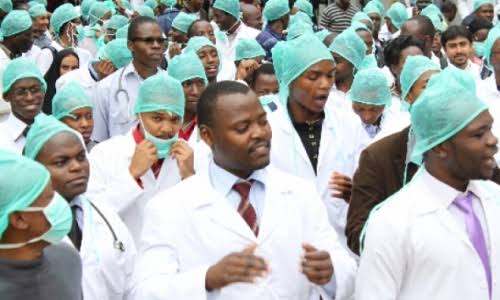

Nigeria’s healthcare system is grappling with a severe manpower crisis, as the number of practising doctors has fallen to about 40,000, far below the estimated 300,000 required to adequately serve the country’s population of over 220 million.
In 2024, the Minister of Health and Social Welfare, Prof. Muhammad Pate, disclosed that Nigeria had around 55,000 licensed doctors.
He also revealed that at least 16,000 doctors had emigrated in the past five years, while about 17,000 others had exited active service.

However, fresh data from the Lagos State Commissioner for Health, Prof. Akin Abayomi, indicates a sharper decline, with the number of practising doctors dropping from 55,000 to about 40,000 within one year.
Abayomi made this known during a presentation at a one-day leadership dialogue in Lagos themed “Strengthening PHC Systems: A Joint Leadership Dialogue.”
The event, organised by the Lagos State Primary Health Care Board with support from development partners, examined challenges limiting the effectiveness of primary healthcare services and proposed long-term solutions.
The commissioner identified manpower shortage as one of the most pressing challenges confronting Nigeria’s health sector.
He disclosed that Lagos State currently has only about 7,000 doctors serving an estimated population of nearly 30 million people.
“Nigeria presently has about 40,000 doctors, whereas the country needs roughly 300,000. Lagos alone requires about 33,000 doctors but has only around 7,000,” Abayomi said.
He noted that the doctor-to-population ratio in Lagos remains far below acceptable standards, significantly affecting service delivery.
To help address the gap, Abayomi said the state government is investing in its newly established University of Medicine and Health, which is expected to produce about 2,500 healthcare professionals annually within the next five years, including doctors, laboratory scientists and other critical personnel.
The worsening shortage has been largely attributed to the mass emigration of healthcare professionals—popularly known as the japa syndrome. Doctors, nurses and pharmacists continue to leave the country in large numbers in search of better working conditions abroad.
A 2017 survey conducted by a Nigerian polling organisation in collaboration with Nigeria Health Watch found that about 88 per cent of Nigerian doctors were actively seeking employment outside the country.
According to the General Medical Council of the United Kingdom, the number of Nigerian-trained doctors practising in the UK has risen to 11,001.
The President of the Nigerian Medical Association (NMA), Prof. Bala Audu, recently warned that Nigeria has transitioned from experiencing passive brain drain to becoming a direct recruitment hub for foreign governments.
In an interview with PUNCH HealthWise, Audu said international recruiters now visit Nigeria to directly hire doctors—especially specialists such as obstetricians, gynaecologists and paediatricians—by offering better pay, infrastructure and working conditions.
“Foreign governments now come into Nigeria to recruit doctors and take them away,” he said, lamenting that the country continues to lose specialists despite rising population growth and persistently high mortality rates.
He warned that the steady loss of skilled birth attendants has contributed to Nigeria’s high maternal mortality, noting that in some specialties, more Nigerian doctors may now be practising abroad than at home.
A former NMA President, Prof. Mike Ogirima, also described Nigeria’s doctor-to-patient ratio as “horrible,” estimating it at about one doctor to 8,000 patients—far worse than the World Health Organisation’s recommended ratio of one doctor to 600 patients.
Ogirima noted that Nigeria produces an average of only 3,000 doctors annually, making it nearly impossible to close the current deficit.
“At that rate, it would take at least 10 years to catch up, assuming no doctor leaves the system—which is unrealistic,” he said, adding that the shortage has left doctors overworked and severely burned out.
Health experts have warned that if the current pace of emigration continues, Nigeria may need at least 20 years to train the more than 400,000 health workers required to bridge the gap.
They have called on governments at all levels to urgently improve funding, working conditions, security and welfare packages for health workers, including comprehensive insurance schemes, warning that without decisive action, the crisis in Nigeria’s healthcare system will continue to deepen.

- Tinubu directs nationwide rice distribution for Ramadan, Lent - March 16, 2026
- NDPC warns against unauthorised public video sharing - March 16, 2026
- Togo seeks increased electricity supply from Nigeria - March 16, 2026