

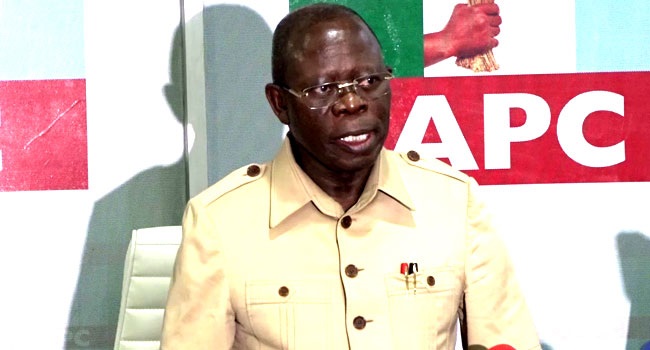
Senator Adams Oshiomhole, representing Edo North, has recalled how he mobilised residents of Ogun State to protest the removal of petrol subsidy under former President Olusegun Obasanjo.
Oshiomhole, who was President of the Nigeria Labour Congress (NLC) during Obasanjo’s administration, spoke on Sunday at the seventh national discourse organised by The Companion, an association of Muslim men in business and the professions, at the University of Lagos.
The event, themed “Nigeria’s Political Landscape and the Ethno-Religious Divides,” was chaired by former Kano State Governor Ibrahim Shekarau, with Lagos State Deputy Governor Obafemi Hazmat as the special guest of honour.
Recalling the controversy over subsidy removal under Obasanjo, Oshiomhole said he opposed the policy because he believed the government lacked the capacity and infrastructure to ensure that savings from subsidy removal reached ordinary Nigerians.
He said he travelled to Abeokuta, where he mobilised residents, including Afolabi Salisu, Chairman of the Senate Committee on ICT and Cyber Security, to oppose the policy.
“All I tried to do when I was NLC President, for example, was to go to Abeokuta and say to Abeokuta people, ‘This subsidy Baba wants to take, he can take it, but he cannot return it to the poor because they claim it is wasteful. They will take it and do something for the poor,’” Oshiomhole said.
He argued that although the government had the authority to remove the subsidy, it lacked the institutional capacity to distribute the resulting savings equitably.
“To prove [this to] the people, I got Ogun people, including Afolabi, to go on strike against Obasanjo,” he said.
Oshiomhole added that workers and students at the University of Lagos also joined the protests, while university management publicly maintained neutrality.
He said some Nigerians who criticised his opposition to subsidy removal at the time had since complained about rising petrol prices and the cost of living.
“Now, everybody is saying, ‘I can’t pay N100,000 for one litre, how much is my salary?’ I have seen those who used to lecture me about wastage, diversion, better deployment of resources, I have seen them now speaking my language,” he said.
However, Oshiomhole said he believed the debate had moved beyond the old arguments, adding, “We’ve moved on, forward ever, backward never.”
Oshiomhole rejects ethnic politics
Speaking on the theme of the discourse, Oshiomhole argued that ethnicity should have no place in Nigeria’s democratic system.
He said Nigerians from different ethnic groups faced similar socioeconomic challenges, particularly poverty and hunger.
“In my view, there is no such thing as ethnic right because within every ethnic group, you have the oppressor and the oppressed. You have the good, the bad and the ugly,” he said.
According to him, democracy should protect and promote individual rights rather than confer privileges based on ethnic identity.
He accused ethnic and religious leaders of exploiting identity politics as a means of gaining political power.
“But ethnic champions and religious elites manipulate ethnic privileges to provide a false basis for electioneering and means to acquire power,” he said.
Oshiomhole urged Nigerians to focus on the ideas, values and competence of political candidates rather than their ethnic backgrounds.
“My summary is this: we own Nigeria. The challenge we have now is how to demystify the ethnic thing, remove that shield, let everybody bear his father’s name. Let’s compete for power not on the basis of where you come but on the basis of the ideas and values you bring,” he said.
Subsidy debate returns ahead of 2027
Oshiomhole’s comments come amid renewed political disagreements over the removal of petrol subsidy by President Bola Tinubu’s administration.
The policy has become a major issue ahead of the 2027 elections, with opposition figures divided over whether the subsidy should remain abolished.
Peter Obi, presidential candidate of the Nigeria Democratic Congress (NDC), recently reiterated his support for subsidy removal but criticised the government over its handling of the funds generated from the policy.
Former Vice-President Atiku Abubakar, the presidential candidate of the African Democratic Congress (ADC), has meanwhile promised to restore petrol subsidy if elected in 2027.
Atiku argued that the Tinubu administration had failed to adequately account for the savings from subsidy removal.
Tinubu has rejected the proposal, describing a return to subsidy as economically unsustainable and arguing that the previous subsidy regime placed significant pressure on government finances.
The controversy followed a disclosure by the Minister of Finance and Coordinating Minister of the Economy, Taiwo Oyedele, that subsidy removal generated N15.8 trillion in resources for the federation between June 2023 and December 2025.

- IPOB denies plan to revive sit-at-home in South-East - October 12, 2026
- APC slams Atiku of lacking statesmanship over ‘Bola’ remark - October 12, 2026
- Engineer caught on hidden camera poisoning colleague with toxic metal - October 12, 2026