

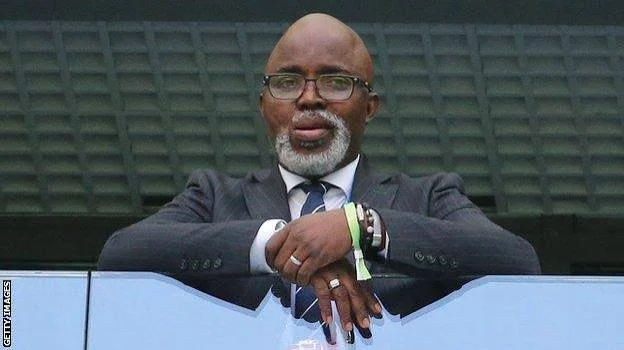
Former Nigeria Football Federation (NFF) President Amaju Pinnick has revealed what he described as the reasons sportswear giants Adidas and Puma ended or resisted commercial relationships with Nigerian football.
Pinnick made the disclosure in the latest episode of The Pinnick Tapes (Remastered): NFF Scandals EXposed, published on former Super Eagles coach Sunday Oliseh’s YouTube channel, Global Football Insights With Oliseh.
Recalling his early days as NFF president, Pinnick said he was shocked when Adidas informed the federation of its decision to leave shortly after he assumed office.
He said he travelled to Zurich to meet the company’s president in an effort to convince the sportswear manufacturer to reconsider its decision.
“I was utterly flabbergasted when I got the letter from Adidas. A few weeks or a few months into my being NFF president, they were leaving,” Pinnick said.
He, however, said he later discovered that several issues had influenced Adidas’ decision, although he declined to disclose the details publicly.
According to him, the sponsorship crisis extended beyond Adidas, with companies including Globacom, General Insurance and Guinness also withdrawing or indicating plans to end their relationships with Nigerian football.
Pinnick said he subsequently sought a partnership with Puma but initially faced resistance from the company’s top executive.
He recalled meeting the Puma executive during the 2015 Africa Cup of Nations in Equatorial Guinea, saying the official initially refused to engage with him after learning that he was Nigerian.
According to Pinnick, the executive later explained that three Nigerians had previously visited his home on Christmas Day and allegedly proposed abandoning an existing Adidas contract in exchange for certain demands.
“He told me a story about how three Nigerians came to his house on a Christmas Day to tell him, ‘We can jettison the contract we have with Adidas, but this is what we wanted.’
“And from there on, he made up his mind never ever to have anything to do with Nigeria. He blacklisted Nigeria,” Pinnick said.
He did not disclose the identities of the three Nigerians or the nature of the demands they allegedly made.
Pinnick said the experience motivated him to secure another major international kit sponsor for the Super Eagles despite the setbacks involving Adidas and Puma.
He said he travelled to the United States and the Netherlands in search of a new partnership and eventually secured a deal with Nike.
“And that’s where I went to my room and I prayed and I said, ‘God, give us Nike.’ It was a tough call, but eventually we got Nike,” he said.
Pinnick also rejected claims that his administration lost sponsors, arguing that it instead increased the NFF’s commercial revenue.
“When I was president of NFF, no sponsors left me. I brought in sponsors. I went from zero to almost 80% of self-funding,” he said.
He added that the federation’s audited accounts, prepared by PricewaterhouseCoopers, could verify his claims.
Pinnick said the sponsorship difficulties he encountered predated his administration, insisting that he inherited a federation where several major commercial partners were already withdrawing.
The former NFF president said his administration responded by aggressively pursuing new partnerships and increasing private-sector funding.
The interview also touched on Nigeria’s failure to qualify for the 2022 and 2026 World Cups, unpaid wages owed to coaches and players, political interference and other structural challenges affecting Nigerian football.

- Maina’s son arrested in Abuja after fleeing money laundering trial - October 17, 2026
- Kwankwasiyya protests NDC governorship candidate’s omission from INEC list - October 17, 2026
- Tinubu approves lifetime salaries for retired immigration chiefs — Minister - October 17, 2026